Generated with Monsha
Photosynthesis: The Solar-Powered Factory
Lesson Plan · 9th · English
Photosynthesis: The Solar-Powered Factory
Lesson Overview
This lesson uses the Hooked Model (Trigger, Action, Reward, Investment) combined with a Constructivist approach to engage 9th-grade students in the discovery of photosynthesis. Rather than simply memorizing a formula, students will investigate the mystery of plant mass and build their understanding of energy transformation.
Key Concepts
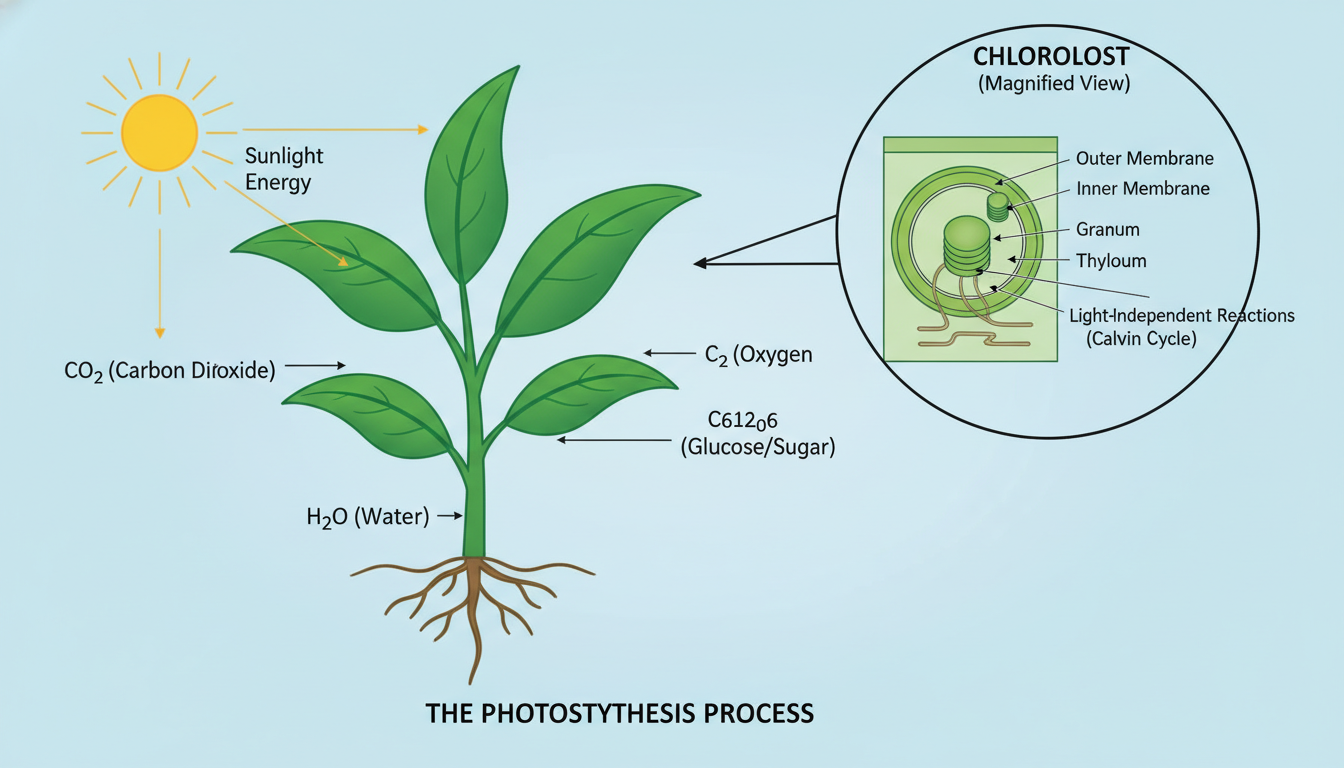
- The Chemical Equation: Understanding the reactants and products: .
- Energy Transformation: How plants convert radiant (light) energy into stable chemical energy (glucose).
- Organelle Function: The role of the chloroplast and chlorophyll in capturing light.
- The Law of Conservation of Mass: Recognizing that the mass of a tree comes primarily from the air (CO2), not the soil.
Material & Resources Needed
- Visual Aid: A large potted plant and a small bag of potting soil.
- Lab Materials: Elodea (aquatic plant), test tubes, water, and a light source (for the 'Reward' demonstration).
- Digital/Physical Puzzle: Equation cards (CO2, H2O, Light, Glucose, O2) for students to arrange.
- Handouts: Inquiry data sheet based on Van Helmont’s willow tree experiment.
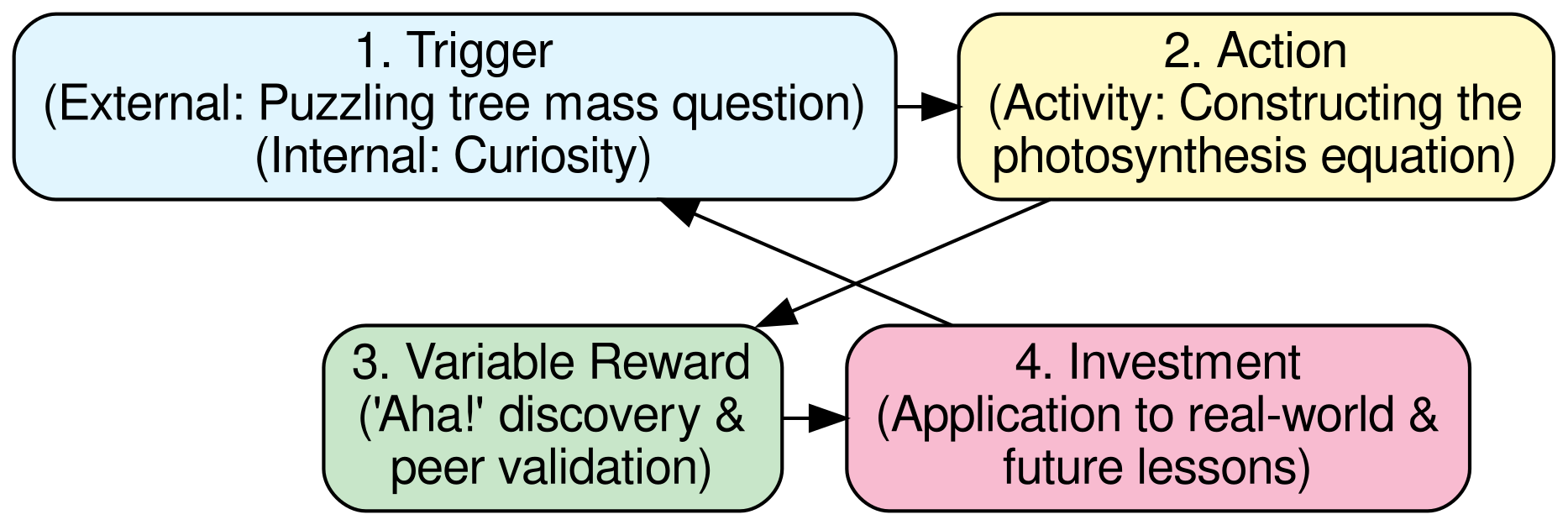
- Technology: Projector for the Hooked Model flow diagram.
Lesson Flow: The Hooked Model (40 Minutes)
1. The Trigger (5 mins)
- External Trigger: The teacher shows a 5lb bag of soil and a massive photo of a Sequoia tree. The Mystery: "If this tree weighs 100 tons, and it grew from a tiny seed in the ground, where did all that 'stuff' come from? Is there a 100-ton hole in the ground?"
- Internal Trigger: Curiosity and the desire to solve a logic puzzle (Constructivist start: challenging prior misconceptions that plants 'eat' soil).
2. The Action (15 mins)
- Activity: In small groups, students analyze a simplified version of Van Helmont's experiment data (showing soil mass barely changes while plant mass increases).
- Construction: Students use the equation cards to 'build' what they think the plant is taking in from its environment to create that mass. They must justify why they chose CO2 and H2O based on the data.
3. Variable Reward (10 mins)
- The 'Aha!' Moment: The teacher reveals a submerged Elodea plant under a bright light. Students observe bubbles (Oxygen) forming.
- Social Reward: Groups share their 'built' equations. Correct placement of the 'Light Energy' card above the arrow is celebrated as the "key" that unlocks the process. The reward is the satisfaction of solving the mass mystery.
4. Investment (10 mins)
- The Payoff: Students are asked to predict: "If we doubled the CO2 in a greenhouse, what happens to the 'Action'?" or "What happens to us if the plants stop their 'Investment'?"
- Future Value: Students write one 'loading' question for the next lesson (Cellular Respiration), connecting how we 'unlock' the energy plants just stored.
Assessment and Evaluation Plan
- Formative Assessment (During Action): Teacher circulates to observe group discussions and the 'Equation Puzzle' construction, providing scaffolds where needed.
- Exit Ticket (Investment Phase): Students must complete a "Mass Flow" diagram: Draw an arrow from the source (Air/CO2) to the destination (Plant Mass/Glucose).
- Peer Evaluation: Groups provide one piece of feedback to another group's proposed chemical equation justification.
Differentiation Strategy
- For Visual Learners: Use the provided Figure 1 diagram and color-coded equation cards (e.g., all reactants in blue, products in green).
- For Kinesthetic Learners: The physical manipulation of the equation cards and the observation of the Elodea bubbles.
- For Advanced Learners (Tiered Inquiry): Ask these students to calculate the molar mass of the inputs vs. outputs to prove the Law of Conservation of Mass.
- For English Language Learners (ELL): Provide a bilingual vocabulary mat with terms like Photosynthesis/Fotosíntesis, Light/Luz, and Oxygen/Oxígeno alongside visual icons.