Generated with Monsha
The Mechanics and Regulation of Mitosis: A Grade 12 Guide
Anything · Grade 12 · English
The Mechanics and Regulation of Mitosis: A Grade 12 Guide
Introduction to the Cell Cycle
In eukaryotic organisms, the cell cycle is a highly ordered sequence of events that results in the duplication of a cell’s genetic material and its subsequent division. For somatic cells, this process is known as mitosis. The goal of mitosis is to produce two daughter cells that are genetically identical to the original parent cell, ensuring continuity in tissue growth and repair.
The Ploidy of Mitosis
In a diploid organism, the parent cell starts as
. After DNA replication in the S phase, the cell remains
in terms of chromosome count but doubles its DNA content. After cytokinesis, two identical diploid cells are formed:
During the S phase, the state can be represented as:
Where
is the haploid number and
is the DNA content.The Phases of the Cell Cycle
The cell cycle is divided into two main stages: Interphase and the Mitotic (M) Phase.
1. Interphase
Interphase accounts for approximately 90% of the cell cycle and consists of three sub-phases:
- G1 Phase (Gap 1): The cell grows in size and synthesizes proteins and organelles.
- S Phase (Synthesis): DNA replication occurs. Each chromosome is duplicated into two identical sister chromatids joined at a centromere.
- G2 Phase (Gap 2): Final preparations for division, including the synthesis of microtubules.
2. The Mitotic Phase (M Phase)
This phase is divided into mitosis (nuclear division) and cytokinesis (cytoplasmic division).

The Stages of Mitosis
- Prophase: Chromatin condenses into distinct chromosomes. The nucleolus disappears, and the centrosomes begin to move to opposite poles, forming the mitotic spindle.
- Metaphase: The spindle fibers attach to the kinetochores of the sister chromatids. The chromosomes align at the metaphase plate (the equator of the cell).
- Anaphase: The centromeres split, and sister chromatids are pulled apart by the shortening spindle fibers toward opposite poles. They are now considered individual chromosomes.
- Telophase: Two new nuclear envelopes form around the separated chromosomes at each pole. The chromosomes begin to de-condense back into chromatin.
Visualizing Mitosis
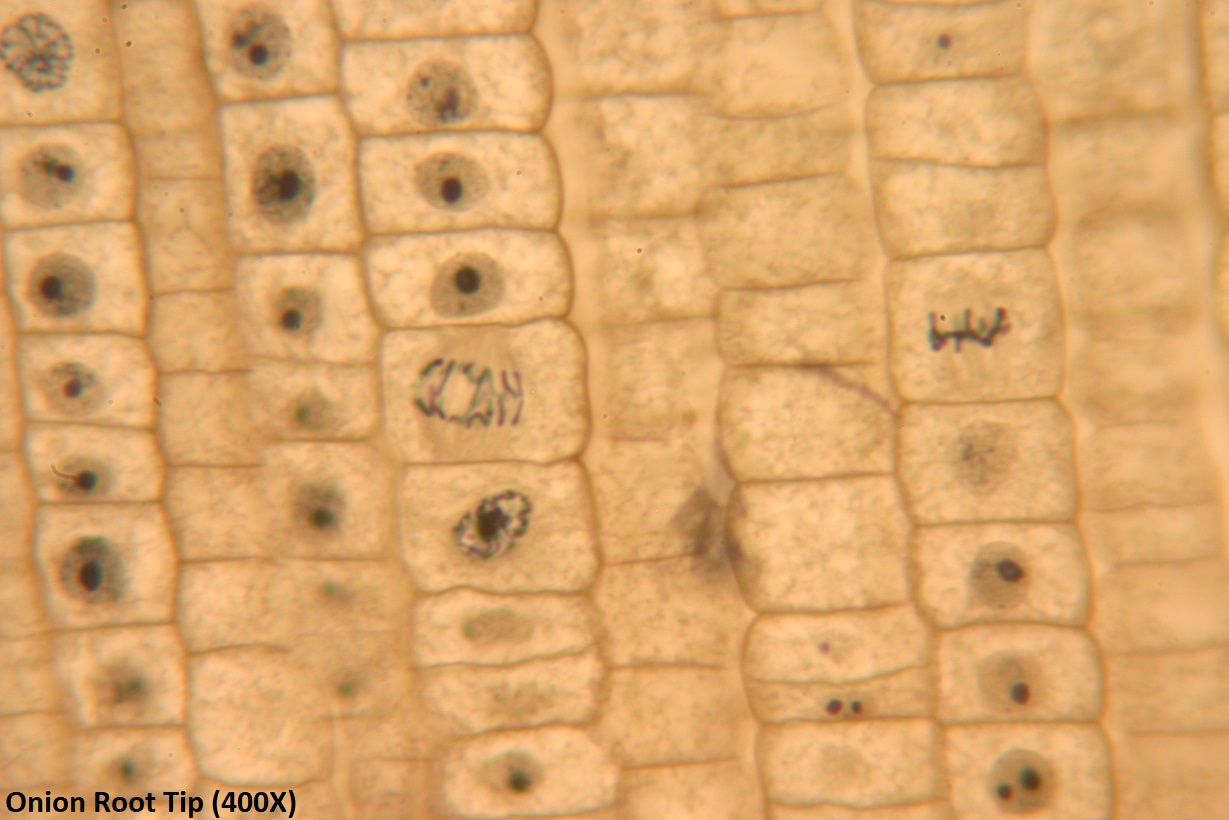
In a laboratory setting, mitosis is often observed in rapidly dividing tissues, such as the meristematic tissue of an onion root tip. Under a light microscope, different stages can be identified by the arrangement and appearance of the chromosomes.
Regulation of the Cell Cycle
Mitosis must be tightly regulated to prevent errors, such as the uncontrolled cell division characteristic of cancer. This regulation is managed by checkpoints and biochemical signals.
- Checkpoints: Occur at G1, G2, and M. The cell monitors internal and external cues (e.g., DNA damage, cell size) before proceeding.
- Cyclins and CDKs: The cycle is driven by proteins called cyclins that bind to cyclin-dependent kinases (CDKs). For example, the Maturation Promoting Factor (MPF) is a cyclin-CDK complex that triggers the transition from G2 into mitosis.
Plant vs. Animal Cell Mitosis
While the nuclear division is similar, the physical separation of the daughter cells (cytokinesis) differs significantly:
Feature | Animal Cells | Plant Cells |
|---|---|---|
Centrioles | Present in centrosomes | Usually absent |
Cytokinesis | Forms a cleavage furrow (outside-in) | Forms a cell plate (inside-out) |
Shape Change | Cells become rounded during division | Cells maintain rigid shape |
Significance of Mitosis
- Growth and Development: Enables a multicellular organism to grow from a single-celled zygote.
- Cell Replacement: Replaces damaged or dead cells in tissues like skin and blood.
- Asexual Reproduction: Allows certain organisms (e.g., yeast, hydra) to reproduce offspring that are genetically identical to the parent.