Generated with Monsha
Save this resource to edit, expand, or export it, or create more resources for free.
The Incredible Journey: The Human Digestive System
Presentation Slides
Grade 5
English
The Incredible Journey: The Human Digestive System
The Incredible Journey: Human Digestive System Worksheet
The Incredible Journey: Human Digestive System Worksheet
At a Glance: The Digestive Journey
Digestion is the process your body uses to break down food into nutrients, which it needs for energy, growth, and repair. This journey involves several organs working together to perform both mechanical digestion (physical mashing) and chemical digestion (using enzymes and acids).
Activity 1: Vocabulary Match
Draw a line to match each vocabulary word with its correct definition.
Vocabulary Word | Definition |
|---|---|
1. Bolus | A. The wave-like muscle contractions that push food down. |
2. Peristalsis | B. Tiny, finger-like bumps that soak up nutrients in the small intestine. |
3. Chyme | C. A soft ball of chewed food mixed with saliva. |
4. Villi | D. A green liquid made by the liver that breaks down fats. |
5. Bile | E. The thick, soupy liquid that food becomes in the stomach. |
Activity 2: The Path of Food
Number the organs below from 1 to 5 to show the order that food travels through your body.
- Stomach
- Large Intestine
- Mouth
- Esophagus
- Small Intestine
Activity 3: Label the Digestive System
Identify the parts of the digestive system using the diagram below. Write the name of each organ next to its corresponding number.
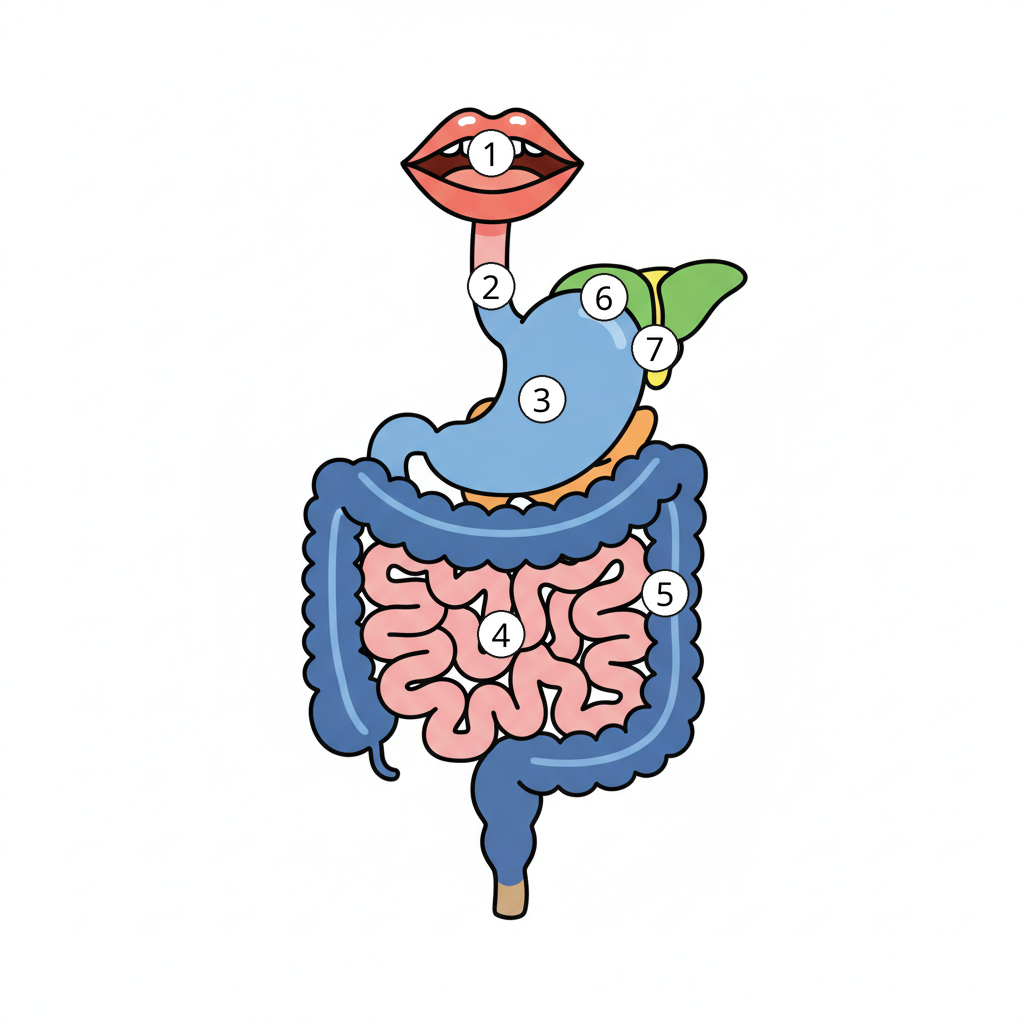
1.
2.
3.
4.
5.
6.
7.
Activity 4: Digestive Check-up
Circle the correct answer for each question below.
1. Where does digestion actually begin?
A) The Stomach
B) The Esophagus
C) The Mouth
D) The Small Intestine
2. What is the main job of the Small Intestine?
A) Absorbing nutrients into the blood
B) Absorbing water from waste
C) Storing bile
D) Grinding food with teeth
3. Which organ acts like a "helper" factory, producing bile?
A) Liver
B) Pancreas
C) Gallbladder
D) Large Intestine
4. Which of these is an example of mechanical digestion?
A) Saliva breaking down starch
B) Teeth grinding an apple
C) Gastric acid dissolving meat
D) Enzymes breaking down fat
5. Why is the Large Intestine important?
A) It is 20 feet long and catches nutrients.
B) It soaks up water and prepares waste to leave the body.
C) It creates chyme using strong acids.
D) It moves food through peristalsis.
Activity 5: Thinking Like a Scientist
Your stomach contains very strong acid that helps break down food. Why doesn't this acid eat through the walls of the stomach itself? Explain your answer below.