Generated with Monsha
Save this resource to edit, expand, or export it, or create more resources for free.
Cells Reading Passage — 7th Grade Science (with Comprehension Questions)
Adaptive Reading Passage
Grade 7
English
Cells Reading Passage — 7th Grade Science (with Comprehension Questions)
Cells: The Smallest Living Things
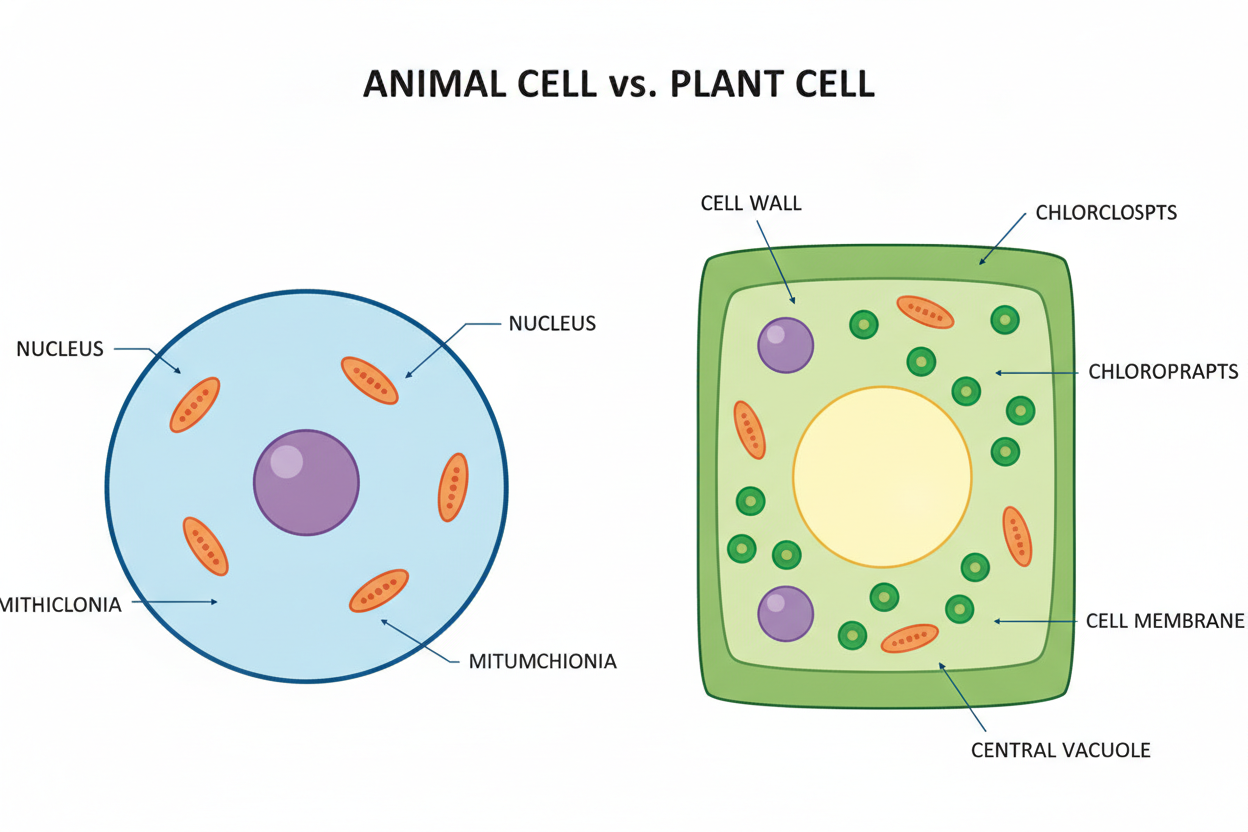
Imagine you are looking at a giant skyscraper. From a distance, it looks like one solid object. But as you get closer, you see it is made of millions of individual bricks. Living things are just like that skyscraper. Whether it is a tiny blade of grass or a massive blue whale, every living thing is built from tiny "bricks" called cells. A cell is the smallest unit of life that can perform all the functions necessary to keep an organism alive. This idea is a core part of Cell Theory, which also states that all living things are made of cells and that all cells come from other existing cells. It sounds simple, but this discovery changed everything we know about how life works!
To understand how a cell works, it helps to think of it as a busy, organized city. Every part has a specific job to keep the city running smoothly. The first thing any city needs is a border. The [color:#2E7D32]cell membrane[/color] acts like the city gates or a security fence. It surrounds the cell, protecting it from the outside world while carefully deciding what can enter (like water and nutrients) and what must leave (like waste).
Deep inside the cell is the [color:#1565C0]nucleus[/color], the "City Hall" of our tiny metropolis. This is the command center where all the instructions—stored in DNA—are kept. The nucleus tells the cell when to grow, when to divide, and how to function. Surrounding the nucleus and filling the rest of the cell is the cytoplasm. Think of the cytoplasm as the city’s land and open space. It is a jelly-like substance that holds everything in place and allows materials to move around efficiently.
Of course, no city can run without power. The [color:#C62828]mitochondria[/color] are the power plants of the cell. They take in nutrients and break them down to create energy that the cell can use to do its work. Without mitochondria, the cell would run out of "battery" and eventually stop working.
While animal cells have these basic parts, plant cells have a couple of special "upgrades." First, they have a cell wall. If the membrane is a fence, the cell wall is a thick, sturdy fortress wall made of cellulose. It gives the plant structure and allows it to grow tall without having a skeleton. Plants also have [color:#2E7D32]chloroplasts[/color], which act like solar panels. They capture energy from sunlight to make food for the plant through a process called photosynthesis.
Why do these tiny specks matter? Because life is a team effort. Some organisms, like bacteria, are made of only one cell. However, a human body is made of trillions! Each cell is a living world of its own, working perfectly to keep you breathing, thinking, and growing. From the smallest bacteria to the tallest tree, all life starts with the cell.
Comprehension Questions
1. What is the primary function of the mitochondria in a cell?
A. To store the cell's DNA
B. To decide what enters and leaves the cell
C. To act as a sturdy fortress wall
D. To create energy for the cell to use
2. Which part of the cell is referred to as the 'command center' because it contains instructions for the cell's functions?
A. Nucleus
B. Chloroplast
C. Cytoplasm
D. Cell Wall
3. In the passage, the word 'nutrients' most nearly means:
A. Building materials and fuel
B. The cell's DNA
C. Tools for construction
D. Waste products
4. Use the Analogy to Explain
Based on the city analogy used in the text, why is the cell membrane compared to city gates or a security fence? Use evidence from the passage to explain your answer.
5. Short Answer Application
If a cell were a school instead of a city, which person or room in the school would represent the nucleus? Explain your reasoning by comparing their job to the job of the nucleus.
- D — The passage describes mitochondria as the 'power plants' that create energy for the cell.
- A — The nucleus is described as the command center or 'City Hall' where DNA instructions are stored.
- A — Nutrients are things the cell takes in to get energy and grow, similar to fuel or food.
Cells Reading Passage — 7th Grade Science (Lexile 1040L)
Cells: The Smallest Living Things
Consider the architectural complexity of a massive skyscraper. From a distance, the structure appears as a singular, monolithic entity; however, upon closer inspection, it is revealed to be composed of millions of individual bricks. Living organisms operate on a remarkably similar principle. Whether it is a microscopic blade of grass or a colossal blue whale, every living thing is constructed from fundamental building blocks known as cells. A cell is defined as the smallest unit of life capable of performing all the biological processes essential for an organism's survival. This concept is a cornerstone of Cell Theory, which further asserts that all living organisms are composed of one or more cells, and that all cells arise from pre-existing cells. Though the concept may seem straightforward, this discovery fundamentally transformed our understanding of biological complexity.
To comprehend the internal mechanics of a cell, it is useful to visualize it as a sophisticated, highly organized city. Within this microscopic metropolis, every specialized structure, or organelle, performs a specific function to ensure the city operates efficiently. Every city requires a boundary, and the [color:#2E7D32]cell membrane[/color] serves as this protective perimeter. Functioning like a semi-permeable security fence, it encapsulates the cell’s contents and regulates the movement of substances. It meticulously monitors the environment, permitting essential nutrients and water to enter while actively expelling metabolic waste products.
Situated deep within the cell’s interior is the [color:#1565C0]nucleus[/color], the administrative "City Hall" of the metropolis. This is the primary command center where genetic instructions, stored in the form of DNA, are securely housed. The nucleus orchestrates the cell's activities, determining when the cell should grow, replicate, or perform specific metabolic tasks. Occupying the space between the nucleus and the membrane is the cytoplasm. This jelly-like substance serves as the city’s physical landscape, providing a medium that suspends the organelles and facilitates the transport of materials throughout the cellular environment.
Invariably, a city requires a consistent power supply to remain operational. The [color:#C62828]mitochondria[/color] function as the cell's internal power plants. Through a process called cellular respiration, these organelles convert nutrients into chemical energy that powers the cell’s various activities. Without functioning mitochondria, the cell would lack the energy necessary to maintain its life-sustaining processes.
While animal cells possess these fundamental components, plant cells feature specialized "infrastructure" adapted to their unique needs. The cell wall provides an additional layer of protection; if the membrane is a fence, the cell wall is a rigid, external fortress composed of cellulose that provides structural support, allowing plants to grow vertically without a skeletal system. Furthermore, plants contain [color:#2E7D32]chloroplasts[/color], which function like biological solar panels. These organelles capture radiant energy from the sun to synthesize food through photosynthesis.
Ultimately, these microscopic units are the foundation of all biological existence. While some organisms consist of only a single cell, the human body is a cooperative network of trillions of specialized cells working in unison. Each cell is an intricate world of its own, ensuring that you can breathe, think, and grow. From the most primitive bacteria to the most complex multicellular organisms, life begins and ends with the cell.
Comprehension Questions
1. Based on the text, what is the specific role of the mitochondria within the cellular 'city'?
A. To provide a rigid external structure for the cell
B. To act as the primary storage site for genetic DNA
C. To convert nutrients into energy for cellular functions
D. To regulate which substances are permitted to enter the cell
2. Which organelle is responsible for 'orchestrating' the cell's growth and replication?
A. Nucleus
B. Cell Membrane
C. Chloroplast
D. Cytoplasm
3. In the context of the passage, what does the word 'semi-permeable' most likely imply about the cell membrane?
A. It is a solid wall that prevents all movement.
B. It is only found in plant cells.
C. It is a liquid substance that fills the cell.
D. It allows only specific substances to pass through.
4. Use the Analogy to Explain
Based on the city analogy provided in the text, explain why the cytoplasm is compared to the city's "land and open space." Use specific details from the passage to support your explanation.
5. Short Answer Application
Imagine you are describing a cell using a school analogy instead of a city. Which specific room or person in a school would best represent the nucleus, and why? Justify your choice by comparing their responsibilities to the biological function of the nucleus.