Generated with Monsha
ILAW Framework: Research Planning and Field-Specific Issue Identification
Anything · Age 16–17 · English
ILAW Framework: Research Planning and Field-Specific Issue Identification
LESSON PLAN: INQUIRIES, INVESTIGATION, AND IMMERSION (ILAW FRAMEWORK)
Section | Details |
|---|---|
Lesson Title | Navigating the Inquiry: Research Planning and Field-Specific Issue Identification |
Learning Area/s | Inquiries, Investigation, and Immersion (3Is) |
Grade Level | Grade 12 |
No. of Sessions | 5 Sessions (Approx. 7.5 hours) |
References | DepEd Order No. 42, s. 2016 (Policy Guidelines on Daily Lesson Preparation); Inquiries, Investigation, and Immersion Curriculum Guide; Practical Research 1 & 2 Modules. |
Declaration of AI Use | This lesson plan was developed with AI-assisted drafting and formatting support to align with the ILAW framework. |
Intentions
Learning Competency and Curriculum Standards
Content Standards:
The learner demonstrates an understanding of the concepts and principles of the research process, the importance of identifying specific issues within a field, and the structure of a comprehensive research plan.
Performance Standards:
The learner is able to prepare a viable research plan that focuses on relevant issues and ideas within their respective field of specialization (STEM, ABM, HUMSS, GAS, or TVL).
Learning Competency:
Prepares a plan and focus on issues and ideas in their respective field.
Learning Objectives
Knowledge
- Identify the essential components of a research plan (Title, Problem Statement, Methodology, and Timeline).
- Explain the criteria for selecting a researchable issue within a specific academic track.
- Differentiate between a broad topic and a narrowed research focus.
Skills
- Formulate a clear research title based on an identified field issue.
- Construct a preliminary research timeline (Gantt Chart) for the semester.
- Conduct a rapid situational analysis to identify "research gaps."
Values
- Demonstrate intellectual honesty and ethics in planning research.
- Value the role of systematic planning in solving community or industry problems.
- Show resilience in refining ideas based on peer and teacher feedback.
Learner Context
Grade 12 learners have already completed Practical Research 1 (Qualitative) and Practical Research 2 (Quantitative). They possess foundational knowledge of research parts but often struggle with the transition to "Immersion," where they must apply these skills to a capstone-style project. Learners come from diverse strands, requiring differentiated focus areas for their research planning.
Learning Experience
Pre-Lesson
Opening Quotation:
"A goal without a plan is just a wish." — Antoine de Saint-Exupéry
Ask:
- How many research projects have you started but struggled to finish?
- What is the biggest challenge you face when starting a new investigation?
Flow
SESSION 1: THE CORE OF THE INQUIRY
- Explore: Students perform a "Brainstorming Cloud" where they write down three problems they observed in their community or chosen track on separate sticky notes.
- Explain: Teacher discusses the difference between a "Subject Area" and a "Researchable Issue."
- Elaborate: "Problem-Issue-Title" Activity. Students take one broad problem and narrow it down to a specific issue and a working title.
- Evaluate: Exit Ticket: Write one potential research title and the field it belongs to.
SESSION 2: COMPLIANCE AND PLANNING
- Review: Recap the narrowed titles from Session 1.
- Motivation: Display a messy schedule vs. a clean Gantt Chart.
- Explore: Students list the steps they think are necessary to complete a research paper.
- Explain: Discussion on the mandatory parts of the Research Plan in 3Is (Title, Statement of the Problem, Significance, and Methodology).
- Elaborate: Group Activity: Create a "Research Roadmap" illustrating the steps from data gathering to final immersion.
- Evaluate: Groups present their roadmaps for class critique.
SESSION 3: THE ILAW FRAMEWORK IN ACTION
L – Link
Say: "Last year, you learned how to write a research paper. This year, we are not just writing; we are immersing. We need to link what we know (theory) to what we will do (practice)."
- Activity: "Research Recall." Students identify one skill from Practical Research 1 or 2 that will be most useful for their current plan.
A – Acquire
Instructional Focus: What makes a good Research Plan?
A research plan is a systematic outline of the study. It serves as a guide for the researcher to stay on track. Key components include identifying the Research Gap.
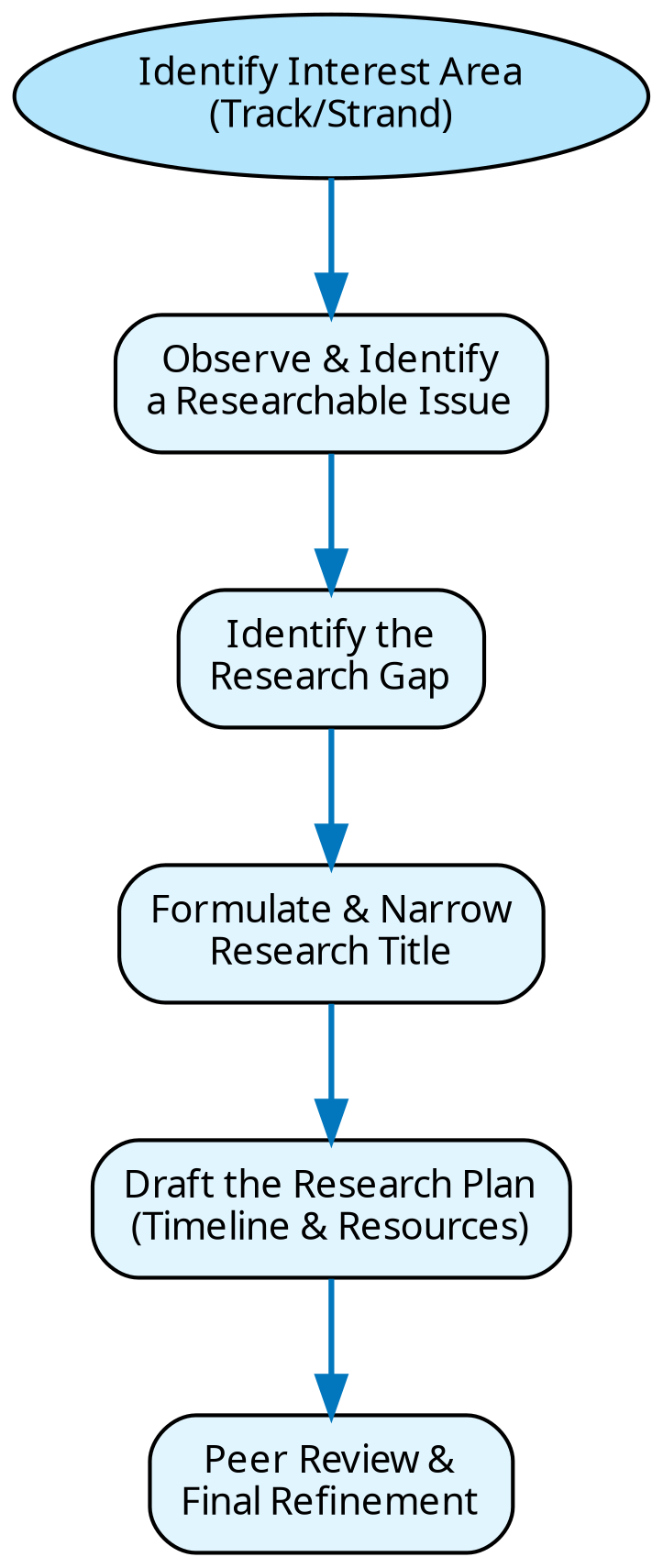
- Concept Analysis:
- Feasibility: Can it be done within the time and budget?
- Novelty: Is it providing a new perspective?
- Ethics: Does it protect the participants?
W – Widen
Pair Activity: Peer Pitching
- Directions: Each student presents their initial research plan to a partner.
- Questions for the partner:
- Is the issue clear and focused on your track?
- Is the timeline realistic for a 1-semester immersion?
- What resources are missing from the plan?
SESSION 4: SYNTHESIS AND DRAFTING
- Motivation: Present a case study of a failed research project due to poor planning.
- Activity: Drafting the formal Research Plan document using the school's prescribed template.
- Teacher Coaching: One-on-one consultation with students to finalize their focus.
SESSION 5: REFLECTION AND COMMITMENT
- Motivation: "The Immersion Vow." Students share one commitment they will make to ensure their research is finished.
- Evaluate: Reflective Essay
- "Why is planning the most critical stage of the Inquiries, Investigation, and Immersion journey?"
Learning Resources
Print Resources
- DepEd 3Is Curriculum Guide.
- Research Plan Templates and Rubrics.
- Sample Research Abstracts from previous cohorts.
- Worksheets on Narrowing Research Topics.
Visual/Digital Resources
- Gantt Chart Templates (Excel/Canva).
- Graphic Organizers (Mind Maps for Issue Identification).
- Digital Library access (e.g., Google Scholar, DOAJ).
Assessment
Formative Assessment:
- Session 1: Issue Identification Worksheet.
- Session 3: Peer Review Checklist.
- Session 4: Draft Research Plan (Submission for Initial Feedback).
Summative Assessment:
- Final Research Plan: A multi-page document including the Title, Rationale, Statement of the Problem, Methodology, and Gantt Chart.
- Reflective Essay: Scored based on the depth of understanding of the planning process.
Ways Forward
Extended Learning Opportunities:
Learners are encouraged to visit their local community or target immersion site to validate if the identified "Issue" is truly a felt need. They should document these observations in a Research Logbook.
Reflections:
- What parts of the planning process did students find most difficult?
- Did the peer-review session help in narrowing down broad topics?
- Which research tracks (STEM/ABM/HUMSS) require more specialized planning tools?