Generated with Monsha
Taylor Series and Polynomial Approximations
Lesson Plan · Grade 12 · English
Taylor Series and Polynomial Approximations
1. At a Glance
Lesson Title: Mastering Taylor Series and Polynomial Approximations
Grade Level: 12 (AP Calculus BC)
Duration: 60 Minutes
Subject Area: Mathematics (Calculus)
Lesson Overview:
Students will transition from understanding power series to constructing Taylor and Maclaurin polynomials to approximate transcendental functions. The lesson covers the general Taylor formula, derivation of common series (e.g.,
,
,
), and an introduction to the Lagrange Error Bound.Learning Objectives:
- Derive the general formula for a Taylor polynomial centered at .
- Construct Taylor polynomials for common functions and recognize their Maclaurin counterparts.
- Visualize how higher-degree polynomials provide better local approximations of functions.
- Estimate the accuracy of an approximation using error bounds.
Materials Needed:
- Graphing calculators or Desmos.
- Guided notes template for common series.
- Exit ticket slips.
2. Standards Addressed
AP Calculus BC Curriculum Framework (Unit 10: Infinite Sequences and Series):
- LIM-8.A: Represent a function at a point as a Taylor polynomial.
- LIM-8.B: Approximate a function value using a Taylor polynomial.
- LIM-8.C: Determine the error bound associated with a Taylor polynomial approximation (Lagrange Error Bound).
- LIM-8.G: Represent common functions (e.g., ) as Taylor series centered at 0 (Maclaurin series).
3. Key Concepts
The Taylor Series Formula
A Taylor Series represents a function
as an infinite sum of terms centered at
:
- When the center , the series is called a Maclaurin Series.
- A Taylor Polynomial of degree , denoted, is the partial sum of the firstterms.
Common Maclaurin Series to Memorize
Function | Maclaurin Expansion | Interval of Convergence |
|---|---|---|
| | |
| | |
| | |
| | |
Convergence and Error
- Radius of Convergence (R): Found using the Ratio Test: .
- Lagrange Error Bound: If for allbetweenand, then the remaindersatisfies:
4. Instructional Sequence (60 Minutes)
I. Introduction & Hook (10 Minutes)
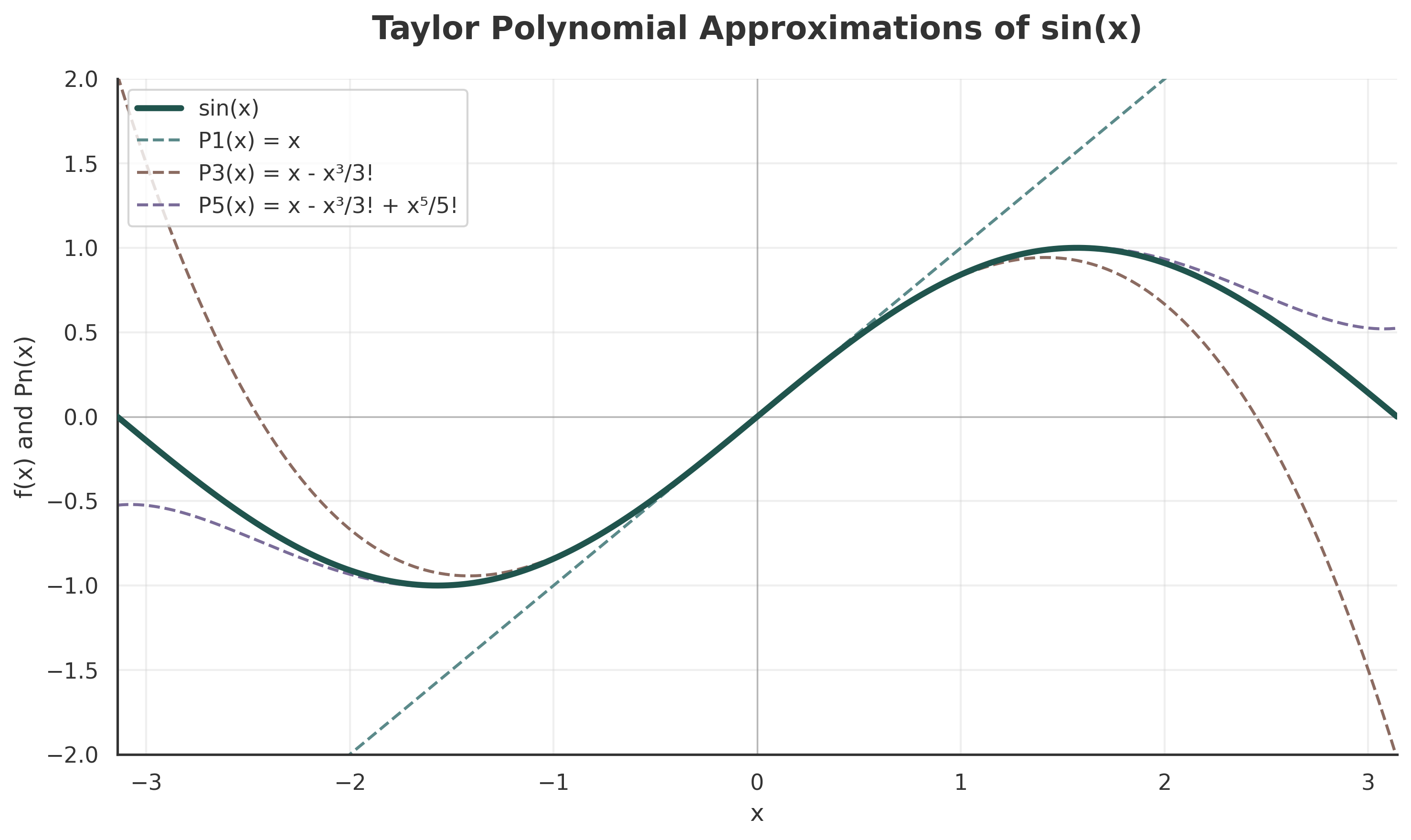
- Visual Discovery: Display the following chart showing and its Taylor approximations.
- Discussion: Ask students to observe how each successive polynomial () "hugs" the actual sine curve over a wider interval.
II. Derivation & Procedure (15 Minutes)
- Explain that a Taylor polynomial is designed so that its value and the values of its first derivatives match those of the function at the center.
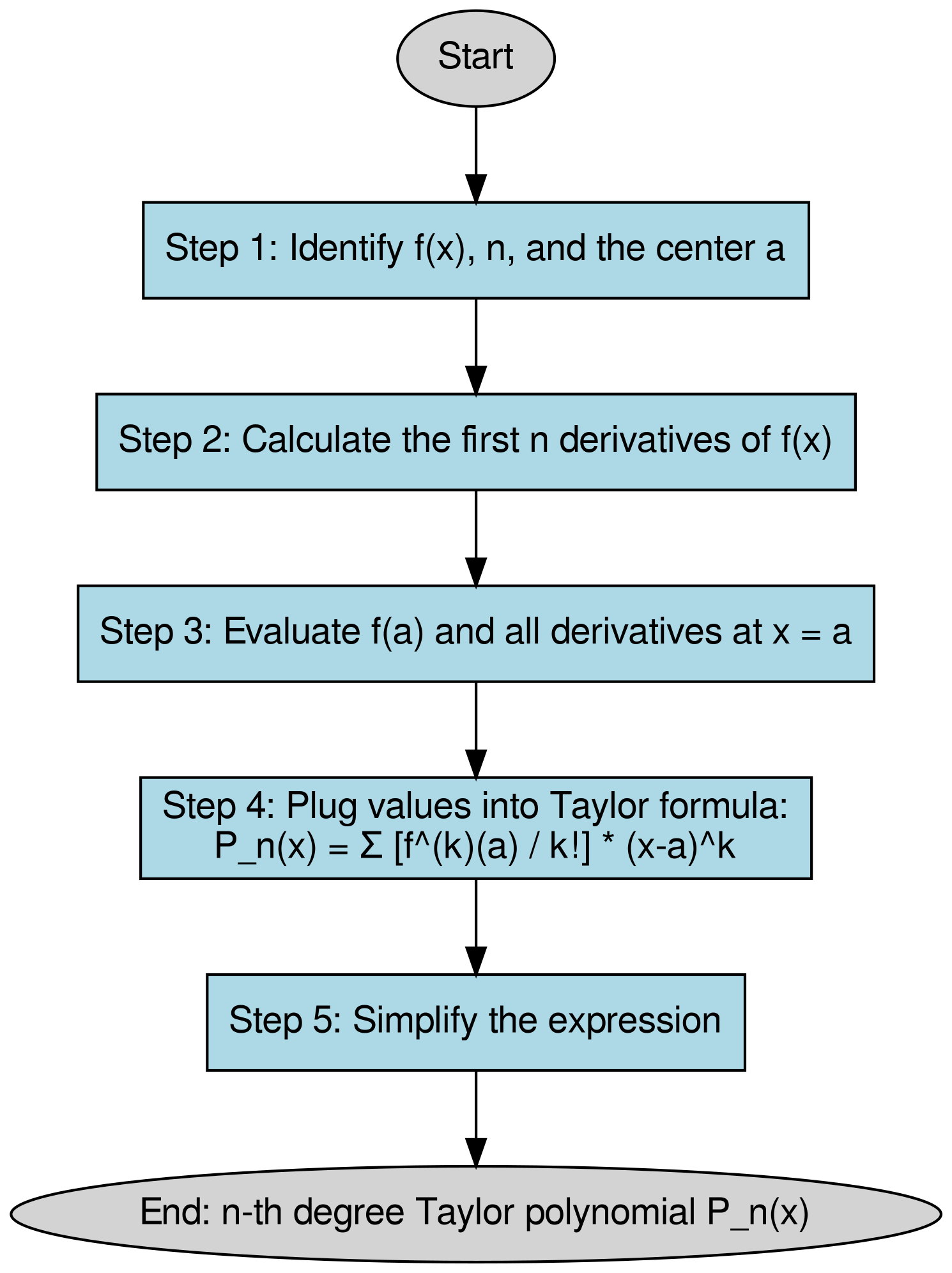
- Present the step-by-step process for constructing these polynomials.
III. Building Common Series (15 Minutes)
- Group Work: Divide the class into three groups. Assign each group one function (,, or) and have them calculate the first four non-zero terms using the flowchart steps.
- Synthesis: Have each group present their findings and record the general terms on the board.
IV. Guided Practice: Error Bounds (15 Minutes)
- Problem Walkthrough: Use forcentered atto approximate.
- Error Analysis: Demonstrate how to use the Lagrange Error Bound to prove that the approximation is accurate within a specified tolerance (e.g., ).
V. Closure & Exit Ticket (5 Minutes)
- Exit Ticket: Ask students to write the 4th degree Maclaurin polynomial for and state why the 3rd degree and 4th degree polynomials for this specific function are identical.
5. Assessment and Evaluation Plan
Formative Assessment:
- Think-Pair-Share: During the introductory hook, assess student understanding of "local linearity" vs. "local polynomial approximation."
- Whiteboard Check: During the derivation phase, have students show the calculation for the 3rd derivative of at.
Summative Assessment:
- Homework Assignment: AP-style multi-part questions requiring the construction of a Taylor series from a table of values and an error bound calculation.
- Unit Quiz: A section of the upcoming Unit 10 exam will focus on manipulating known series (e.g., find the series for by substitution).
6. Differentiation Strategy
For Students Requiring Support (Scaffolding):
- Provide a "Cheat Sheet" containing the first four derivatives of common functions.
- Use a structured template for the Taylor formula where students only fill in the values.
- Focus on Maclaurin series (center ) before moving to general Taylor series.
For Advanced Learners (Enrichment):
- Challenge students to find the Taylor series for centered atand determine its interval of convergence using the Ratio Test.
- Ask students to use Taylor series to evaluate an indeterminate limit, such as .
7. 21st Century Skills / College & Career Readiness Skills
- Critical Thinking and Problem Solving: Students must determine which degree of a polynomial is sufficient to meet a required precision in engineering or scientific contexts.
- Information Literacy: Using graphing software (like Desmos) to verify mathematical theory against visual data.
- Mathematical Modeling: Understanding how complex transcendental functions used in computing and physics (like sine and exponential functions) are actually computed by processors using polynomial approximations.
- Persistence in Precision: Developing the meticulousness required to handle multi-step algebraic derivations and factorial divisions accurately.