Generated with Monsha
Mastering Integration: Class 12 Mathematics
Anything · Class 12 · English
Mastering Integration: Class 12 Mathematics
Integration: A Comprehensive Guide for Class 12
Slide 1: Introduction to Integration
Integration is essentially the reverse process of differentiation. Instead of finding the rate of change, we are finding the original function when its derivative is known.
- Definition: If
then,
- Here, is the integrand,is the variable of integration, andis the constant of integration (representing the family of curves).
Slide 2: Geometric Interpretation
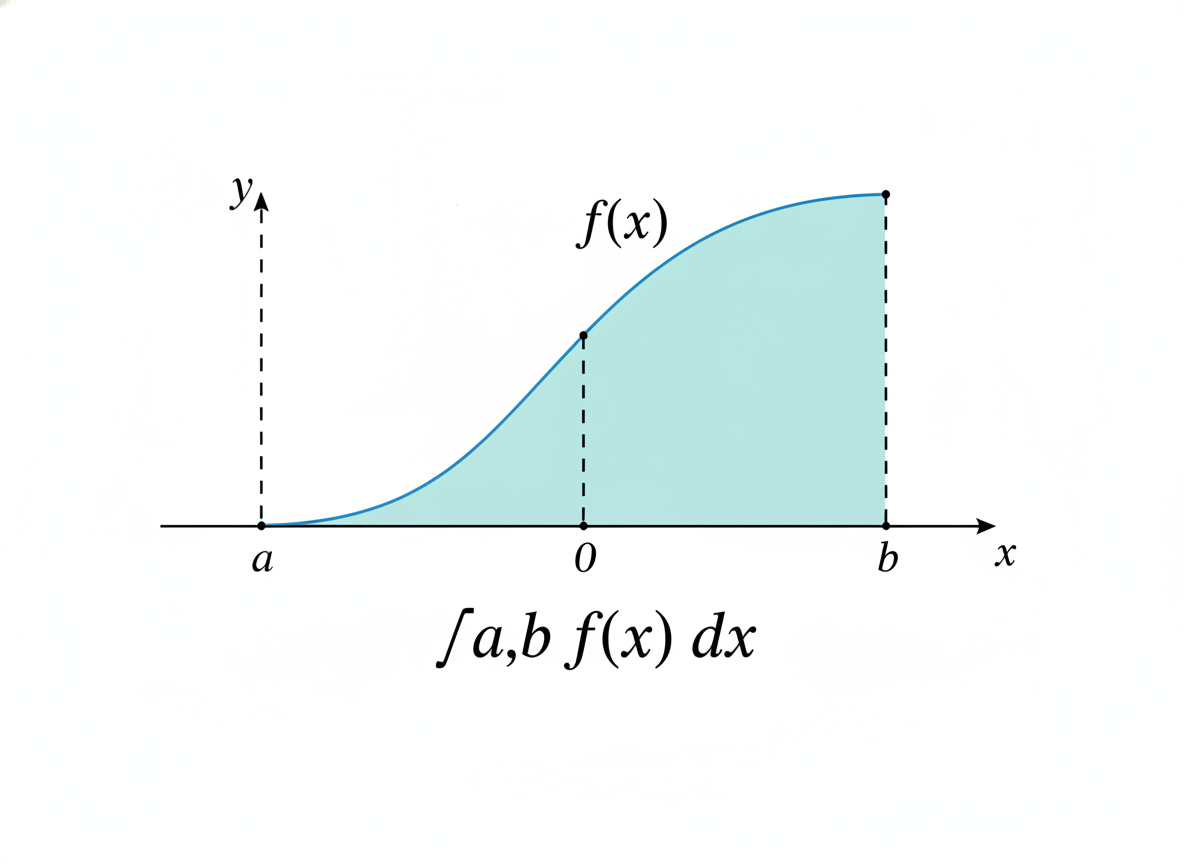
Geometrically, the definite integral of a function represents the net signed area between the graph of the function and the x-axis over a specific interval
.
Slide 3: Standard Integration Formulas
To solve integration problems, you must memorize these fundamental formulas:
- Power Rule: (where)
- Exponential:
- Trigonometric:
-
-
-
- Logarithmic:
Slide 4: Methods of Integration
In Class 12, we explore several systematic techniques to evaluate integrals that do not fit standard formulas directly.

Slide 5: Integration by Substitution
This method is used when the integrand contains a function and its derivative.
Steps:
- Substitute .
- Differentiate to find .
- Rewrite the entire integral in terms of .
Example:
To find
, let
. Then
.
The integral becomes
.
Slide 6: Integration by Parts
Used for the product of two functions:
.Formula:
The ILATE Rule: To choose which function is
(the first function), follow this priority:- Inverse Trigonometric
- Logarithmic
- Algebraic
- Trigonometric
- Exponential
Slide 7: Definite Integrals & FTC
The Fundamental Theorem of Calculus (FTC) links indefinite and definite integrals:
Unlike indefinite integrals, definite integrals result in a numerical value, representing a specific area or quantity.
Slide 8: Properties of Definite Integrals
These properties are essential for solving complex definite integrals efficiently:
- Change of Variable:
- Interchange of Limits:
- Splitting the Integral:
- King's Property:
- Even/Odd Functions: If is even,. If odd, the result is 0.
Slide 9: Practice Problems
Try solving these to test your understanding:
- Evaluate using partial fractions.
- Find the value of using properties.
- Integrate using Integration by Parts.