Generated with Monsha
Save this resource to edit, expand, or export it, or create more resources for free.
Exploring Human Anatomy: Systems and Structures
Worksheet
Grade 8
English
Exploring Human Anatomy: Systems and Structures
Exploring Human Anatomy: Systems and Structures
Name: __________________________________
Date: ___________________
Grade: 8
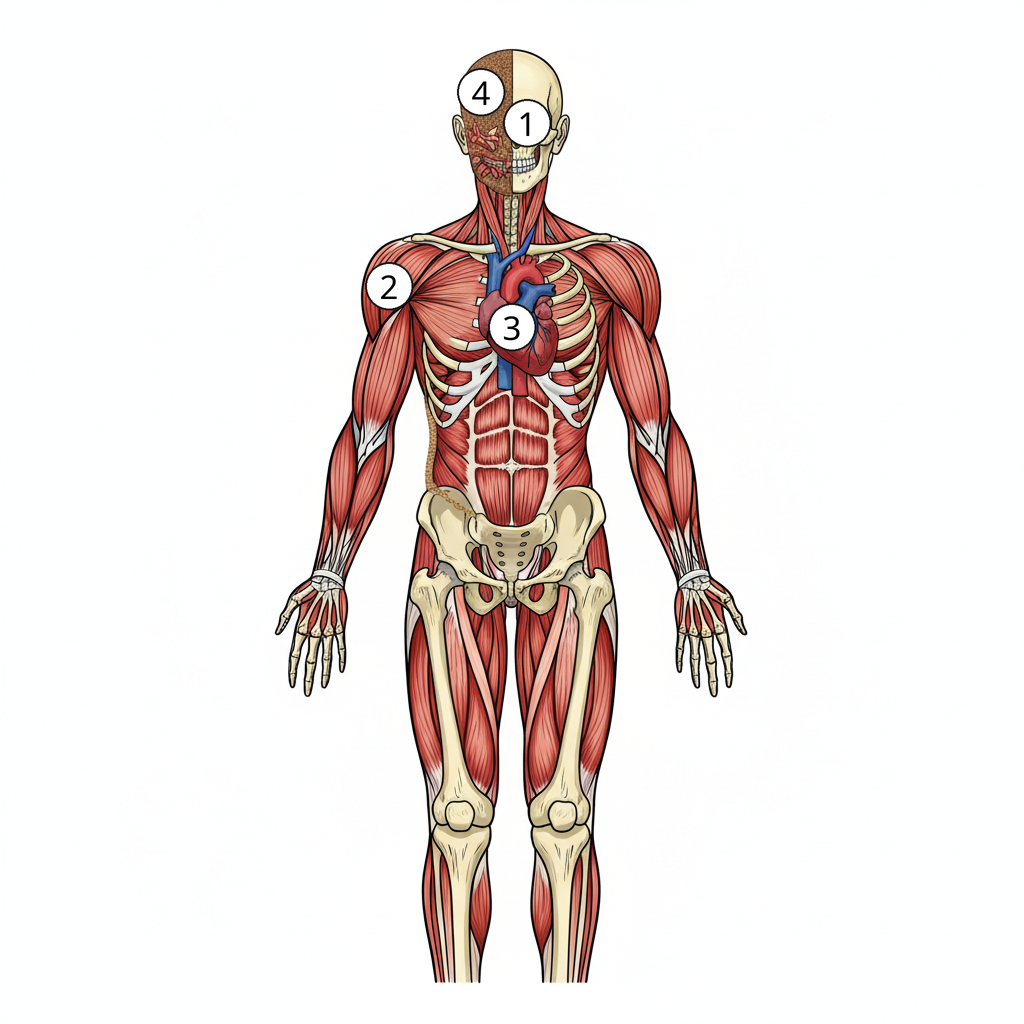
Activity 1: Label the Anatomy Diagram
Instructions: Examine the diagram of the human body below. Identify the major parts and systems indicated by the numbers 1 through 4. Write your answers in the spaces provided below the image.
-
-
-
-
Activity 2: Fill-in-the-Gaps
Instructions: Use the terms from the word bank to complete the sentences below. Each word is used only once. Ensure the sentence makes anatomical sense.
Word Bank:
Tissues — Organ System — Cells — Organs — Skeleton
- The basic building blocks of all living things are called ____________________, which work together to form more complex structures.
- When groups of similar cells perform a specific function, they are classified as ____________________.
- The ____________________ provides the structural framework for the body and protects internal components like the brain and lungs.
- Heart, lungs, and kidneys are examples of ____________________, which are made of different types of tissues working together.
- A group of organs that work together to perform a major body function, such as digestion or circulation, is known as an ____________________.
Activity 3: Anatomy Vocabulary Challenge
Instructions: Choose the best answer for each question. Circle the correct letter (A, B, C, or D).
1. Which type of tissue is responsible for body movement and maintaining posture?
A. Connective tissue
B. Epithelial tissue
C. Muscle tissue
D. Nerve tissue
2. What is the primary role of the human skeleton besides providing support?
A. Pumping blood through the body
B. Protecting vital internal organs
C. Controlling chemical reactions
D. Transmitting electrical signals
3. Which of the following is an example of an organ system?
A. The Stomach
B. Cardiac Muscle
C. The Nervous System
D. A Red Blood Cell
4. Muscles are attached to bones by tough connective tissues called:
A. Tendons
B. Ligaments
C. Cartilage
D. Neurons
5. Which organ is responsible for filtering waste from the blood to produce urine?
A. Liver
B. Heart
C. Kidney
D. Lung