Generated with Monsha
Living Things: Groups, Structures, and Survival
Handout · grade 5 · English
Living Things: Groups, Structures, and Survival
The Amazing Living World: A Comprehensive Guide
Welcome to our exploration of the millions of organisms that call Earth home! From the tallest redwood trees to the tiniest bacteria living in a drop of water, the diversity of life is truly staggering. To make sense of this variety, scientists use a system of organization called classification.
In this handout, you will learn how we group living things, the specialized structures they have developed to survive, and how they adapt to extreme environments like scorching deserts and swampy wetlands.
1. The Science of Classification
Why Do We Classify?
Imagine walking into a library where every book was thrown into one giant pile. Finding a book on dinosaurs would be impossible! Scientists face the same problem with life. There are over 8.7 million species on Earth. Classification is the process of grouping organisms based on their similar characteristics.
- Organization: It creates a universal language so scientists in different countries can study the same animal.
- Connections: It helps us see how different living things are related (for example, how a house cat is related to a tiger).
- Discovery: When we find a new species, we compare it to known groups to understand its diet, habitat, and life cycle.
The Hierarchy of Life
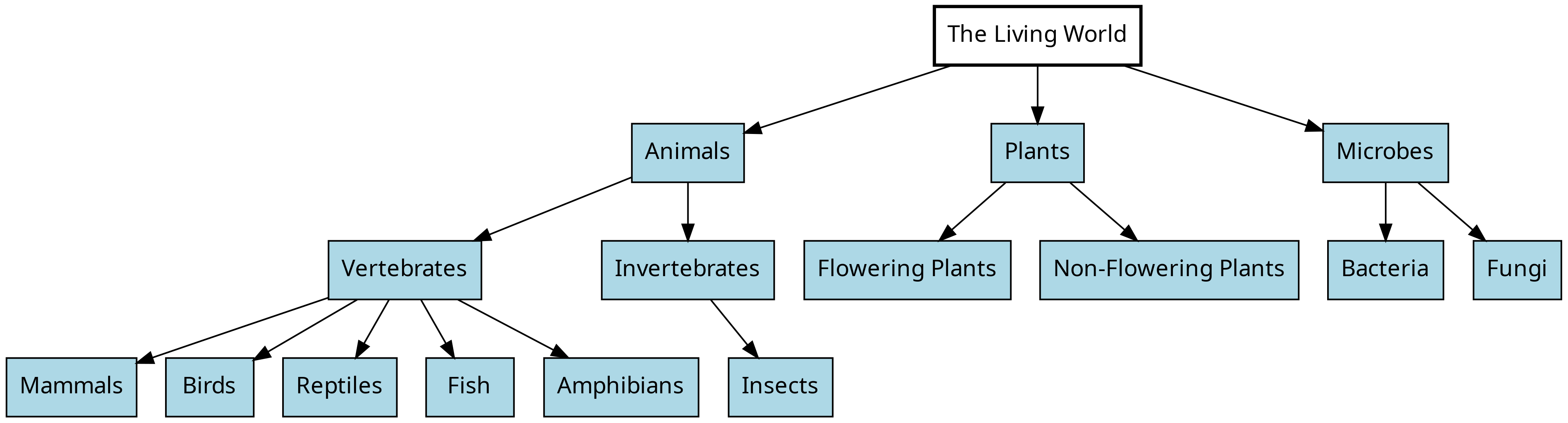
Life is organized from very broad groups down to very specific ones. While you might know the "Five Kingdoms," scientists often start by looking at whether a cell has a nucleus or not. In this guide, we focus on the three main categories you'll see in nature: Animals, Plants, and Microorganisms.
2. The Animal Kingdom: Vertebrates and Invertebrates
The Animal Kingdom is divided into two major groups: those with backbones and those without.
The Vertebrates
Vertebrates are animals that have a spinal column or backbone. They are further divided into five famous classes:
1. Mammals
- Traits: Have hair or fur, are warm-blooded, give birth to live young, and feed their babies milk.
- Examples: Humans, Dogs, Whales, Bats.
2. Birds
- Traits: Have feathers, beaks, and lay hard-shelled eggs. Most can fly, though some (like penguins) swim!
- Examples: Eagles, Penguins, Robins.
3. Reptiles
- Traits: Have dry, scaly skin and are cold-blooded. They usually lay leathery eggs on land.
- Examples: Snakes, Turtles, Crocodiles.
4. Fish
- Traits: Live entirely in water, have scales, and breathe using gills. They are cold-blooded and lay eggs in water.
- Examples: Shark, Salmon, Goldfish.
5. Amphibians
- Traits: Their name means "double life." They start in water (with gills) and move to land (with lungs). They have moist, permeable skin.
- Examples: Frogs, Toads, Salamanders.
The Invertebrates: Focus on Insects
Invertebrates make up about 97% of all animal species! They have no backbone. The largest group of invertebrates is the Insects.
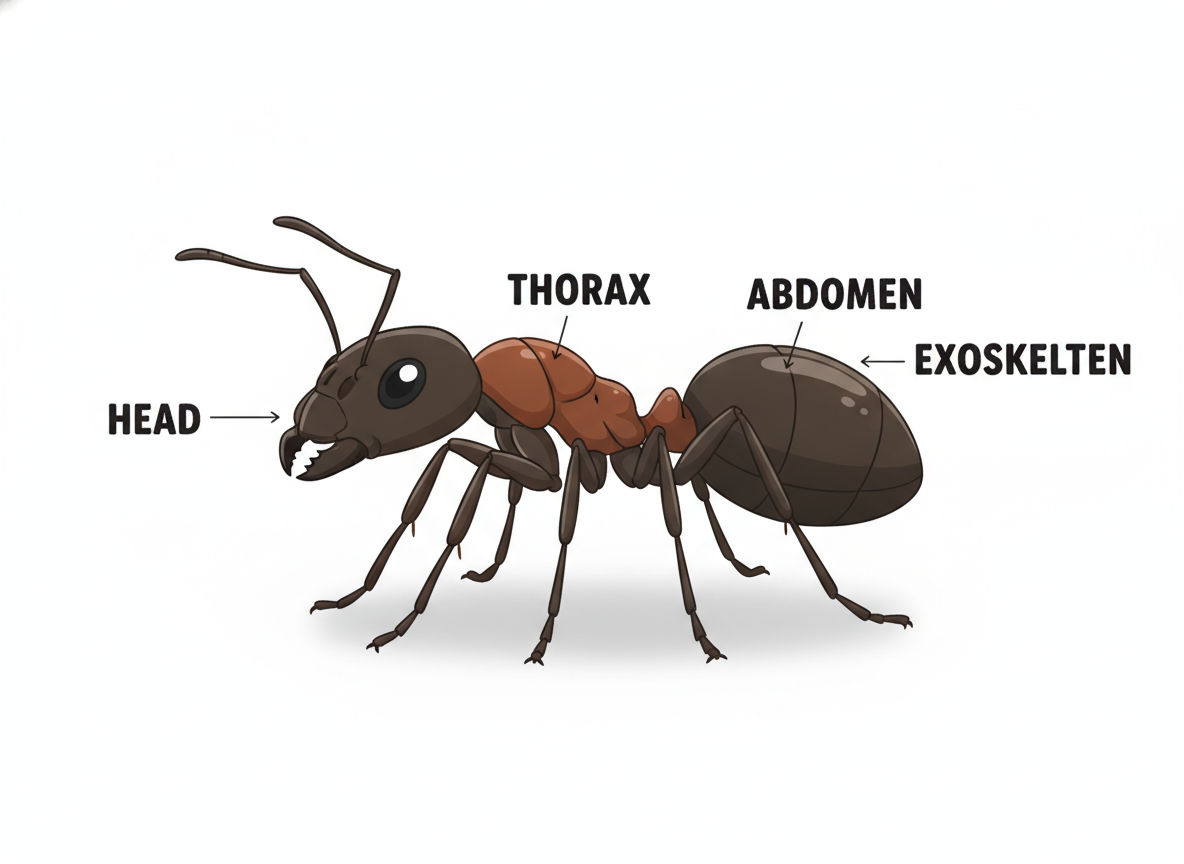
Insects are highly successful because of their specialized anatomy:
- Exoskeleton: A hard outer shell that protects their internal organs and prevents them from drying out.
- Three Body Segments: The Head (for sensing), the Thorax (where legs and wings attach), and the Abdomen (for digestion and reproduction).
- Six Legs: All adult insects have exactly six jointed legs.
3. The Plant Kingdom: Structures for Growth
Plants are primary producers—they use sunlight to make food. We classify them mainly by how they reproduce.
Flowering vs. Non-Flowering
- Flowering Plants (Angiosperms): These plants produce flowers and seeds. The seeds are often protected inside a fruit (like an apple or a pea pod).
- Non-Flowering Plants: These do not have flowers. Some, like Conifers (pine trees), use cones to protect their seeds. Others, like Ferns and Mosses, use tiny dust-like particles called spores to reproduce.
Specialized Underground Structures
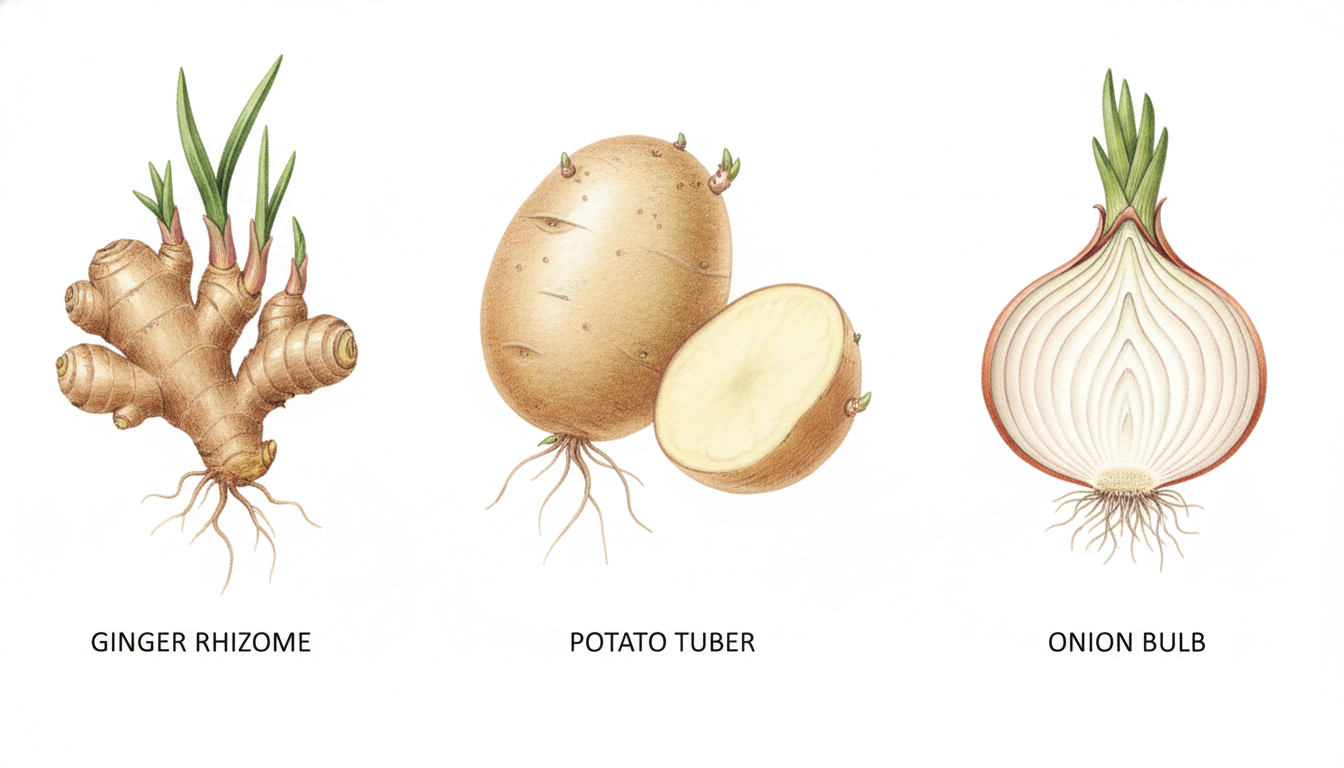
Many plants have developed "secret" underground parts to store energy or spread to new areas. These are often mistaken for roots, but they are actually modified stems or leaves!
- Rhizomes: These are horizontal underground stems. They grow sideways and send out new shoots and roots at intervals. If you cut a piece of ginger and plant it, it can grow a whole new plant!
- Tubers: These are thick, fleshy parts of an underground stem. They are used for storing starch (energy). Potatoes are the most famous tubers; the "eyes" on a potato are actually buds that can grow into new stems.
- Bulbs: A bulb is a short stem surrounded by thick, fleshy leaves that store food. Onions and Tulips are common examples. The layers you see when you cut an onion are the food-storage leaves.
Protection: Thorns and Spines
Plants can't run away from hungry animals, so they use physical defenses. Thorns are sharp, pointed branches or stems (like on a rose bush). They discourage herbivores from eating the plant's delicate tissues.
4. Aerial Roots and Extreme Survival
Not all roots stay underground! Some plants have developed Aerial Roots that grow above the soil. These serve several critical purposes:
- Support: Large trees like the Banyan grow roots from their branches that reach down to the ground. These act like pillars to support heavy limbs.
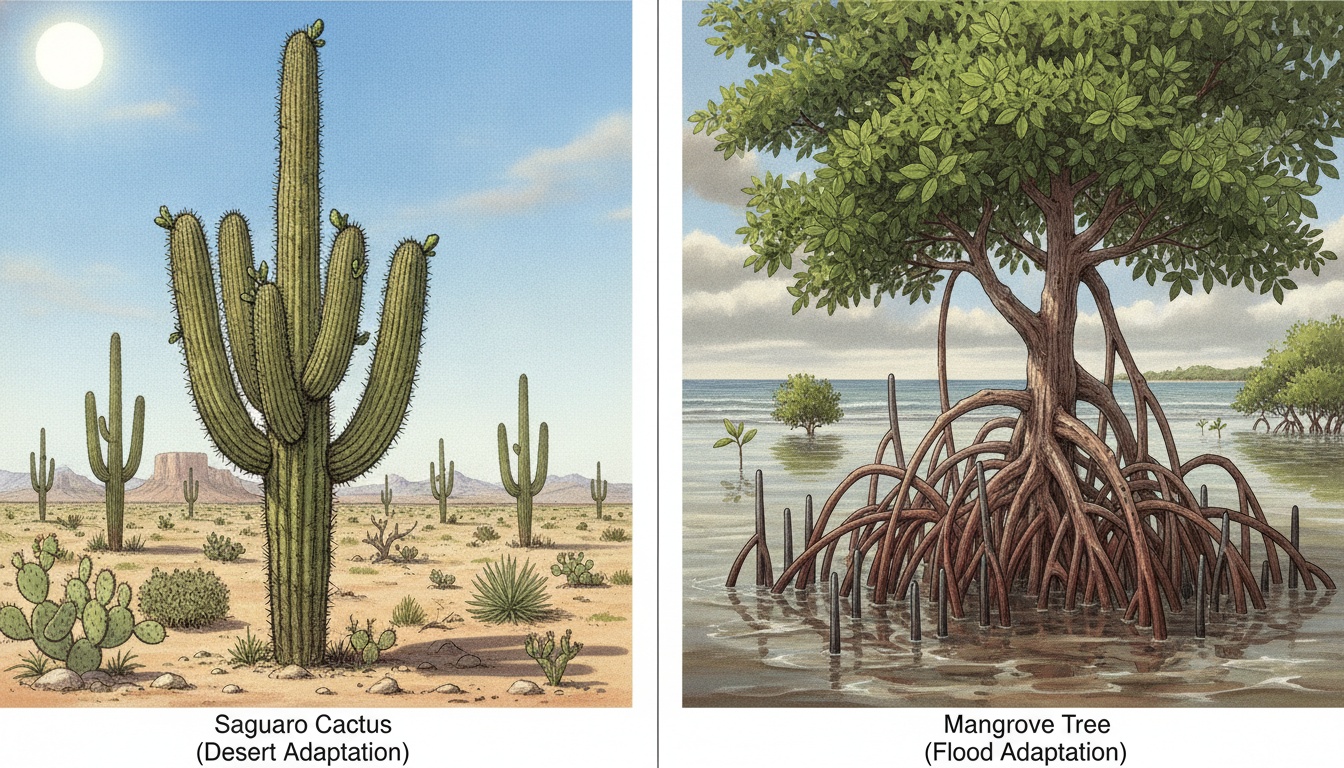
- Breathing (Pneumatophores): In swampy areas where the soil is thick with mud and lacks oxygen, trees like Mangroves grow roots upward. These roots act like snorkels, pulling oxygen from the air for the tree to "breathe."
- Climbing: Some vines use small aerial roots to cling to walls or other trees to reach the sunlight.
Adapting to Environmental Extremes
Living things must adapt or they will perish. Adaptation is a physical feature or behavior that helps an organism survive in its environment.
Scenario A: Too Little Water (Drought)
In the desert, plants like the Saguaro Cactus have adapted by:
- Having waxy skin to prevent water evaporation.
- Replacing leaves with spines to reduce water loss and provide shade.
- Having fleshy stems (succulence) to store large amounts of water for dry months.
Scenario B: Too Much Water (Floods)
In wetlands, plants like Water Lilies have adapted by:
- Developing air sacs in their leaves so they can float on top of the water to get sunlight.
- Having wide, flat leaves to maximize photosynthesis while floating.
5. The Microscopic World
Not all living things can be seen with the naked eye. Microorganisms are single-celled or simple multicellular organisms that play massive roles in our world.
Bacteria
Bacteria are found everywhere—on your skin, in the soil, and even in the air.
- The Good: Helpful bacteria in your digestive system help you break down food and produce vitamins.
- The Bad: Pathogenic bacteria can cause illnesses like strep throat or food poisoning.
Fungi
Fungi include mushrooms, molds, and yeasts. Unlike plants, they cannot make their own food. They are the decomposers of the world. They release chemicals to break down dead plants and animals, recycling nutrients back into the soil so new plants can grow.
Summary & Key Terms
- Classification: Grouping life by similar traits.
- Vertebrate: An animal with a backbone (Mammals, Birds, Reptiles, Fish, Amphibians).
- Invertebrate: An animal without a backbone (e.g., Insects).
- Rhizome: A horizontal underground stem (e.g., Ginger).
- Tuber: A fleshy underground energy storage stem (e.g., Potato).
- Aerial Roots: Roots that grow above ground for support or breathing.
- Adaptation: A feature that helps an organism survive its environment.
Quick Review Questions
- How many legs does an insect have, and what are its three body segments?
- What is the difference between a flowering plant and a non-flowering plant like a fern?
- Why do Mangrove trees need roots that grow above the water?
- How does a waxy coating help a desert plant survive?
Sources:
- National Geographic Education - Classification of Living Things
- Encyclopedia Britannica - Plant Structures and Adaptations
- Biology Online - Vertebrates and Invertebrates Characteristics