Generated with Monsha
Mastering Doubles and Near-Doubles
Lesson Plan · Grade 1 · English
Mastering Doubles and Near-Doubles
Lesson Overview
Grade Level: 1
Duration: 45 Minutes
Subject: Mathematics - Operations and Algebraic Thinking
Objective
Students will be able to demonstrate fluency in addition within 10 (and up to 20) by identifying and using the doubles and near-doubles (doubles plus one) strategies.
CCSS Alignment
- 1.OA.C.6: Add and subtract within 20, demonstrating fluency for addition and subtraction within 10. Use strategies such as counting on; making ten; decomposing a number leading to a ten; using the relationship between addition and subtraction; and creating equivalent but easier or known sums (e.g., adding by creating the known equivalent).
Materials List
- Standard 6-sided dice (1 pair per student/pair)
- Set of dominoes
- Two-color counters (20 per student)
- Whiteboards and markers
- "Doubles Fact" Anchor Chart
- Embedded Fact Fluency Worksheet
Lesson Procedure
1. The Hook: Dice-and-Dominoes (10 Minutes)
- Activity: Give each student or pair a set of dice or dominoes.
- Goal: Students roll two dice. If they roll the same number (a "double"), they shout "DOUBLE!" and calculate the sum as fast as possible on their whiteboards.
- Domino Twist: If using dominoes, students flip a tile. If the number of dots on both sides matches, they record the equation (e.g., ).
- Connection: Explain that today, we are going to learn why doubles are "power numbers" that help us solve harder problems in a snap.
2. Modeling: The Power of Doubles (10 Minutes)
- Direct Instruction: Show the class the visual below. Explain that a double is when we add the same number to itself.
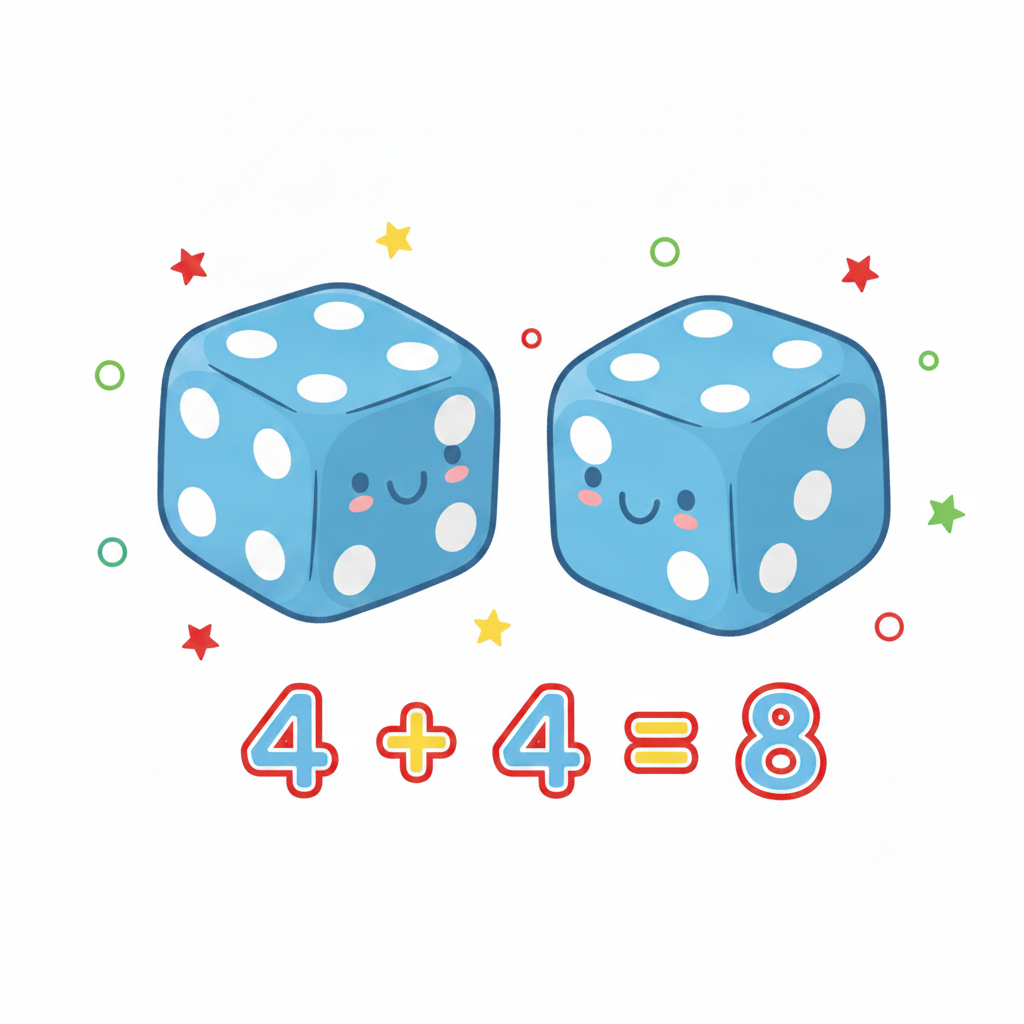
- Action: Build a "Doubles Ladder" on the board:
-
-
-
-
-
- Total Body Response: Have students use their fingers to show the doubles as you recite them together (e.g., hold up 2 fingers on each hand for ).
3. Guided Practice: Near-Doubles Strategy (10 Minutes)
- Concept: Introduce "Near-Doubles" (Doubles Plus One).
- Scenario: Write on the board.
- Think-Aloud: "I don't know instantly, but I know. I see that 4 is just one more than 3. So,must be one more than 6!"
- Practice: Use counters to show 3 red and 3 yellow. Then add one more yellow to show .
- Guided Task: Solve these together on whiteboards:
- If , then
- If , then
4. Independent Practice & Differentiation (10 Minutes)
Students will complete the Fact Fluency Worksheet (embedded below).
Differentiated Tiers:
- Beginning: Use two-color counters for every problem. Focus strictly on sums up to 10 (Doubles 1-5).
- Intermediate: Complete the worksheet using the "Think of the Double" strategy. Use the anchor chart for support.
- Advanced: Introduce "Doubles Minus One." (e.g., is like). Solve 3 challenge problems with sums up to 20 (e.g.,).
- EL Scaffold: Use sentence frames:
- "I know ."
- "So, is one more. It is."
5. Exit Ticket: 5-Fact Check (5 Minutes)
Students write the sums for these 5 facts on a post-it note or small slip:
-
-
-
-
-
Fact Fluency Worksheet: Doubles & Near-Doubles
Name:
Date:
Double It Up!
Use your doubles to help you solve the near-doubles!
Part 1: The Doubles
1. 1 + 1 = ______
2. 2 + 2 = ______
3. 3 + 3 = ______
4. 4 + 4 = ______
5. 5 + 5 = ______
Part 2: Near-Doubles (+1)
6. 1 + 2 = ______
7. 2 + 3 = ______
8. 3 + 4 = ______
9. 4 + 5 = ______
10. 5 + 6 = ______
Mental Math Challenge:
If 6 + 6 = 12, then 6 + 7 = ______