Generated with Monsha
Stage 6 Mathematics: The Number System and Sequences
Worksheet · Primary Stage 6 · English
Stage 6 Mathematics: The Number System and Sequences
Stage 6 Mathematics: Checkpoint-Style Revision
Name: ____________________________
Date: _____________________________
Class: ____________________________
Instructions:
- Answer all questions.
- Use a pen for writing and a pencil for any drawings.
- Calculators are not allowed.
- Pay attention to the marks available for each question.
Section 1: Place Value
- Write the value of the digit 7 in the number 213.807. [1 mark]
- Write the number Twelve thousand and forty-five point zero six in figures. [1 mark]
- What is the value of the digit 9 in the number 809.46? [1 mark]
- Complete the number sentence:
________________ [1 mark]
- Write down the number that is ten times bigger than 0.01. [1 mark]
- Write the terms of this partition in order of size, starting with the highest place value:
[2 marks]
- Look at the digit cards below:
[ 2 ] [ 4 ] [ 6 ] [ 0 ] [ . ]
What is the smallest number, greater than 1, that you can make using all five cards?
[2 marks]
- Use the place value grid below to show the number made of: 3 Tens, 1 One, 5 Tenths, and 8 Thousandths.
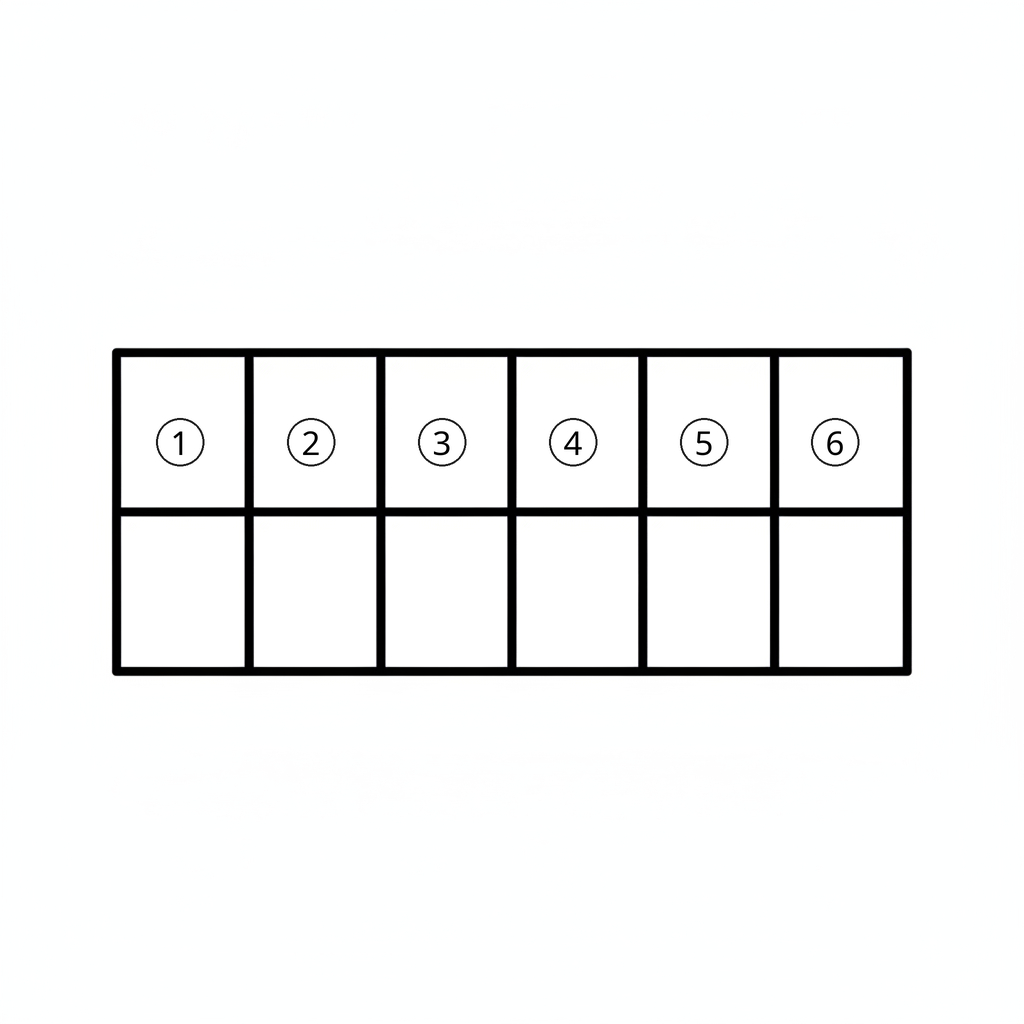
[2 marks]
- Find the 'odd one out' from these four values. Explain your answer.
- 1.234
- 1234 thousandths
- 12.34
- 123.4 hundredths
Odd one out: ____________________________________
Explanation: ____________________________________
[2 marks]
- Petra is regrouping decimal numbers. She spills ink on her work. What number is under the ink blot?
💧 [2 marks]
- Fill in the missing numbers to complete the calculations:
a) ____________ b)____________ [2 marks]
- Fill in the missing numbers:
a) ____________ b)____________ [2 marks]
- Mira divides a number by 10, then by 10 again, and then by 10 again. Her final answer is 0.005. What number did she start with? [2 marks]
- Work out the value of in this number sentence:[2 marks]
- Look at these number cards: [ A: 1200 ] [ B: 1.2 ] [ C: 12000 ] [ D: 0.12 ]
Write the letter of the card that is:
a) One thousand times bigger than 12: ________
b) One hundredth of 12: ________
[2 marks]
- Write down a number with three decimal places where the value of the thousandths digit is half the value of the tenths digit. [2 marks]
- Circle the calculation that has the same answer as .|||[2 marks]
Section 2: Rounding Decimal Numbers
- Round 6.2 m to the nearest whole metre. [1 mark]
- Round 12.36 cm to the nearest tenth. [1 mark]
- Round to the nearest dollar. [1 mark]
- Circle the number that rounds to 5 when rounded to the nearest whole number. 4.35 | 4.05 | 5.5 | 5.05 [1 mark]
- Write down the smallest number with one decimal place that rounds to 100 when rounded to the nearest whole number. [2 marks]
- Tick (✓) the numbers that round to 7.5 when rounded to the nearest tenth. [ ] 7.49 [ ] 7.55 [ ] 7.51 [ ] 7.56 [2 marks]

-
- An athlete runs a race in 13.9 seconds (measured to one decimal place). What is the slowest time the athlete could have run if their time was originally measured to two decimal places? [2 marks]
- Jasper says, "7.97 is 8 when rounded to the nearest whole number and is also 8 when rounded to the nearest tenth." Is Jasper correct? Show your working or explain. [2 marks]
- Correct the following false statement: "3.04 is 3 when rounded to the nearest whole number and 3.1 when rounded to the nearest tenth." Corrected version: _________________________________________________ [2 marks]
- A rectangle has sides measuring 5.4 cm and 6.7 cm. Round each measurement to the nearest whole centimetre and then estimate the perimeter. Rounded sides: ________ and ________ Estimated perimeter: ________ cm [2 marks]
- Choose the smallest number from this list that rounds to 1: 0.55 | 0.99 | 1.9 | 1.45 | 0.5 | 1.05 | 0 [2 marks]
- Round these measures to the nearest tenth: a) 55.55 litres -> ________ b) 12.22 metres -> ________ [2 marks]
- Round 456.702 to: a) the nearest whole number: ________ b) the nearest tenth: ________ [2 marks]
- A bag of flour weighs 1.45 kg. What is this weight to the nearest whole kilogram? [1 mark]
- Which of these numbers rounds to 3.9 when rounded to the nearest tenth? 3.84 | 3.95 | 3.86 | 4.0 [1 mark]
- Write down a number with two decimal places that rounds to 10 when rounded to the nearest whole number AND to the nearest tenth. [2 marks]
Section 3: Number and Sequences
- Find the missing numbers in this sequence which increases by equal amounts each time: 3, [ ], [ ], 15 [2 marks]
- A sequence starts at 15 and counts back in steps of 0.4. Write the next three terms: 15, 14.6, 14.2, _____, _____, _____ [2 marks]
- Samira counts on from 20 in steps of 1.001. 20, 21.001, 22.002, 23.003... What is the first number Samira says that is bigger than 30? [2 marks]
- Look at the position-to-term table below:
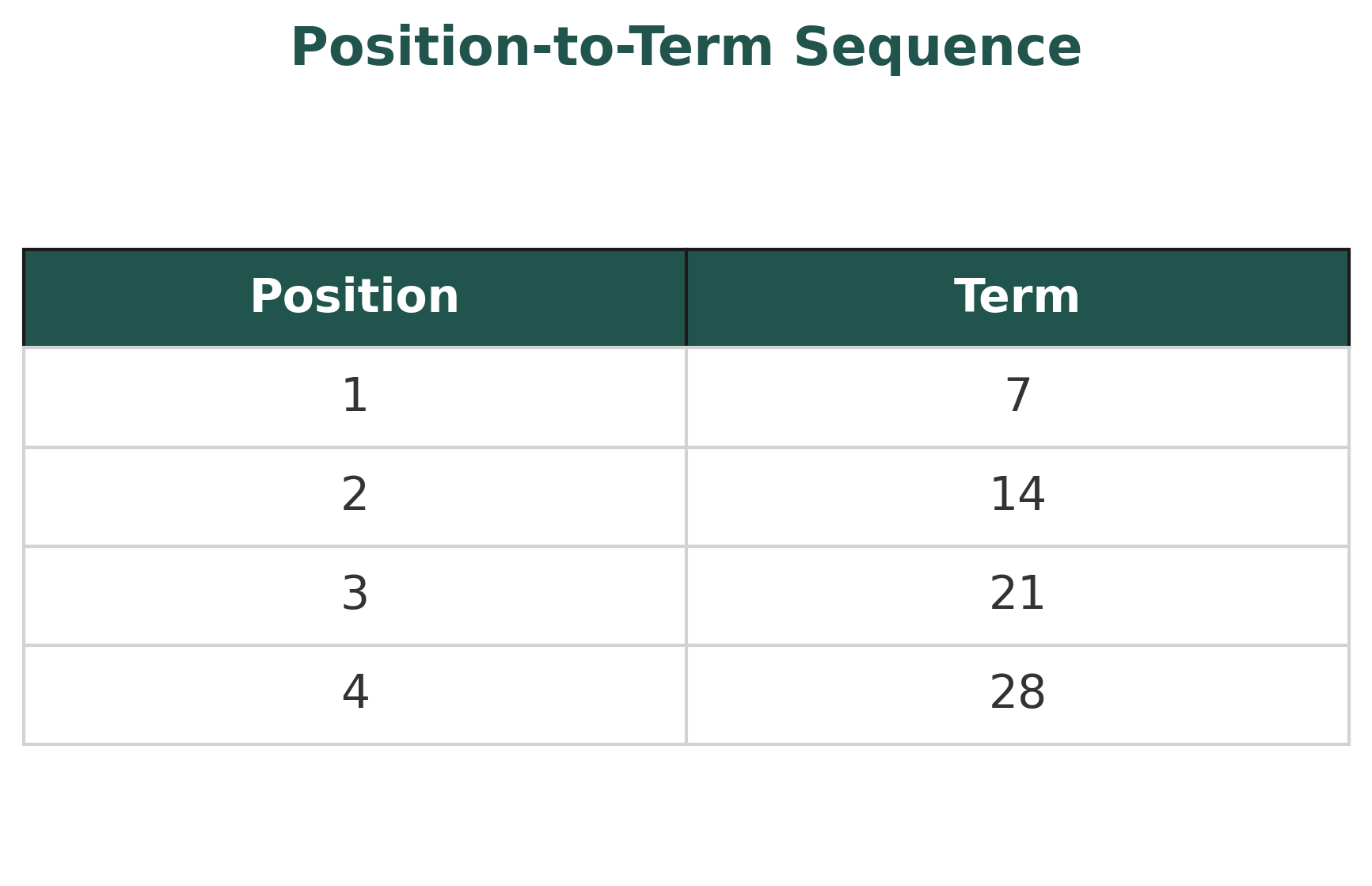
a) What is the position-to-term rule? ______________________
b) What is the 10th term in this sequence? ________________
[2 marks]
- Hassan counts back from 0 in steps of . Circle the numbers that Hassan would say: -1 | -1.2 | -2 | -2.5 | -4 [2 marks]
- Pablo counts up in quarters. He starts at . Write the missing numbers in his sequence:,,, 1, _____, _____, 2 [2 marks]
- A sequence has the rule: multiply the position by 4 and then add 2. What is the term for position 5? [2 marks]
- Ollie says, "In my sequence 15, 14.6, 14.2, 13.8..., the number 1.5 cannot be in the sequence." How do you know Ollie is correct without counting back? [3 marks]
- Complete the table for a sequence where the term is three times the position plus one.
Position | Term |
|---|---|
1 | 4 |
2 | ____ |
5 | ____ |
____ | 31 |
[3 marks] |
- A sequence of constant size has a first term of 1 and a fifth term of 1.04. Work out the second, third, and fourth terms. 1, ________, ________, ________, 1.04 [3 marks]
- Draw the next pattern in this sequence:
- Pattern 1: 1 dot
- Pattern 2: 4 dots (in a 2x2 square)
- Pattern 3: 9 dots (in a 3x3 square)
(Draw Pattern 4 below)
How many dots will be in Pattern 10? ________
[3 marks]
- A sequence increases by 0.25 each time. The 4th term is 2. What is the 1st term? Show your working. [3 marks]
- Write the position-to-term rule for the sequence: 6, 12, 18, 24... Rule: ___________________________________________ Find the 50th term: __________________________ [3 marks]
- Match each sequence to its term-to-term rule:
- 2, 4, 6, 8... • Add 0.5
- 10, 9.5, 9, 8.5... • Multiply by 2
- 1, 2, 4, 8... • Subtract 0.5
- 0.5, 1, 1.5, 2... • Add 2 [3 marks]
- Look at this pattern of triangles:
- Shape 1 uses 3 straws.
- Shape 2 uses 5 straws.
- Shape 3 uses 7 straws.
How many straws are needed for Shape 20? Explain your method.
[3 marks]
- Jodi makes a sequence where the 10th term is 30. Give two possible position-to-term rules Jodi could be using. Rule 1: _________________________________________ Rule 2: _________________________________________ [3 marks]
- In the Northumberland Woods, there are 10 trees. Each tree has 10 branches. Each branch has 10 twigs. Each twig has 10 flowers. Each flower has 10 petals.
Sofia takes 1 petal, 1 flower, 1 twig, and 1 branch.
How many petals are left in the woods?
[3 marks]