Generated with Monsha
Reading Practice Packet: Grade 3-4 Weekly Reading Comprehension and Genre Study
Smart Worksheet · Grade 4 · English
Reading Practice Packet: Grade 3-4 Weekly Reading Comprehension and Genre Study
4-Week Reading Practice Packet
Grade Level: Grade 3–4
Objective: Master key reading standards (Main Idea, Inference, Theme, and Figurative Language) across different genres.
Week 1: Fiction Story
Pacing Guide:
- Monday: Read the passage carefully. Highlight words you don't know.
- Tuesday–Thursday: Answer Questions 1–4.
- Friday: Complete the Short Constructed Response (Question 5).
The Midnight Visitor
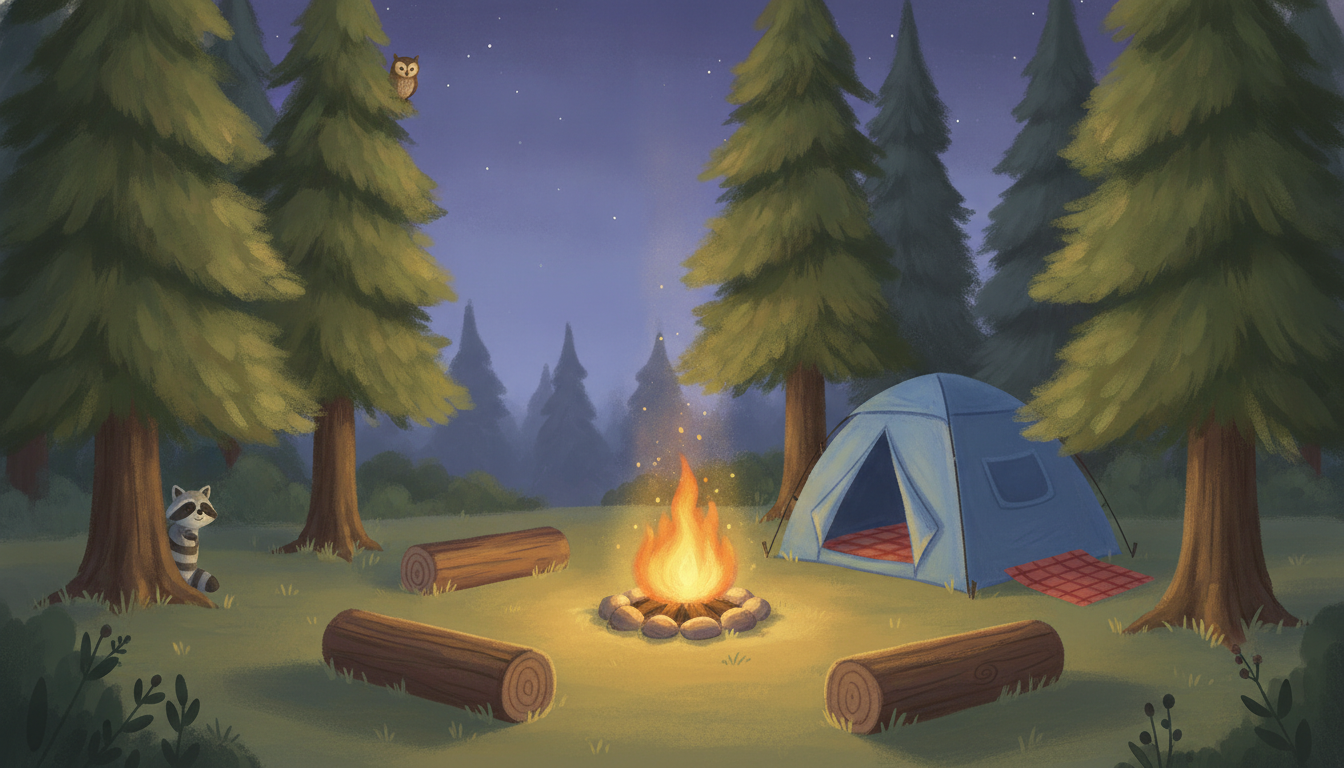
Leo zipped his sleeping bag all the way to his chin. Outside the tent, the pine trees swayed in the cool night wind, making a soft whoosh sound. This was Leo’s first time camping in the Deep Forest with his dad, and every sound seemed ten times louder than it did back home.
"Are you asleep, Leo?" his dad whispered from the other side of the tent.
"Almost," Leo replied, though his eyes were wide open.
Just as he was starting to drift off, he heard it—a heavy thump followed by the sound of something dragging across the dirt. Scritch, scratch, crunch. Leo froze. Was it a bear? He imagined a massive, furry creature sniffing around their campsite, looking for the graham crackers they had eaten earlier.
Leo reached out and poked his dad’s sleeping bag. "Dad! Something is outside!"
His dad sat up and grabbed the flashlight. The beam of light sliced through the darkness as he unzipped the tent flap just a tiny bit. Leo held his breath.
"Take a look," his dad whispered, handing Leo the flashlight.
Leo peeked out. Instead of a giant bear, he saw a small raccoon with a black mask around its eyes. It was busy trying to pull a shiny silver spoon out of the campfire pit. The raccoon looked up, its eyes glowing in the flashlight beam, and then scurried away into the bushes with a frustrated chitter.
Leo let out a long breath and laughed. "I guess he wanted to help with the dishes, Dad."
🔦 Skill Spotlight: Main IdeaThe main idea is what a story is mostly about. To find it, look at the title, the first and last sentences, and repeating details. Ask yourself: "What is the most important point the author wants me to know?"
Week 1 Questions
- What is the main idea of 'The Midnight Visitor'? A. A boy learns that raccoons like shiny objects. B. Leo overcomes his fear of a strange noise while camping. C. Leo's dad teaches him how to use a flashlight safely. D. Camping in the Deep Forest is dangerous because of bears.
- How does Leo feel at the beginning of the story? A. Angry and cold B. Nervous and alert C. Excited and energetic D. Bored and tired
- Which detail from the story best shows that Leo was imaginative? A. He laughed after seeing the raccoon. B. He was camping in the Deep Forest. C. He imagined a massive bear looking for crackers. D. He zipped his sleeping bag to his chin.
4. Two-Part Evidence Question
Part A: How does Leo’s mood change by the end of the story?
Part B: Which sentence from the text supports your answer in Part A?
5. Short Constructed Response (Friday)
Describe the setting of the story. Use at least two details from the text to explain how the setting affected Leo’s feelings.
Week 2: Nonfiction Article
Pacing Guide:
- Monday: Read the article. Underline the three main ingredients of gunpowder.
- Tuesday–Thursday: Answer Questions 1–4 and label the diagram.
- Friday: Complete the Short Constructed Response (Question 5).
The History of Fireworks
Did you know that the first fireworks weren't actually colorful rockets in the sky? Over 2,000 years ago in China, people discovered that if they threw fresh bamboo stems into a fire, the air inside the bamboo would heat up and expand. This caused the bamboo to burst with a loud BANG! People called these "baozhu," which means "exploding bamboo." They believed the loud noise would scare away evil spirits.
Around the year 800 AD, Chinese scientists accidentally discovered something even more powerful. They were mixing different minerals to try and find a medicine that would make people live forever. Instead, they created gunpowder! This mixture was made of saltpeter, sulfur, and charcoal.
Soon, people began stuffing this gunpowder mixture into paper tubes or bamboo. They attached these tubes to arrows and launched them with bows. These were the world's first rockets! By the 12th century, the Chinese military was using "fire arrows" in battle. Later, during the Song Dynasty, fireworks became popular for celebrations like weddings and the New Year. European explorers, like Marco Polo, eventually brought the secret of gunpowder back to Europe, where scientists figured out how to add different metals to create colors like red, green, and blue.
🔦 Skill Spotlight: InferenceMaking an inference means using clues from the text plus what you already know to figure out something the author didn't say directly. Text Clue + My Knowledge = Inference
Week 2 Activity: Label the Ancient Fire Arrow
Look at the diagram below of an early Chinese fire arrow. Use the word bank to label the parts. Then, match the numbers to the correct labels in the spaces below.
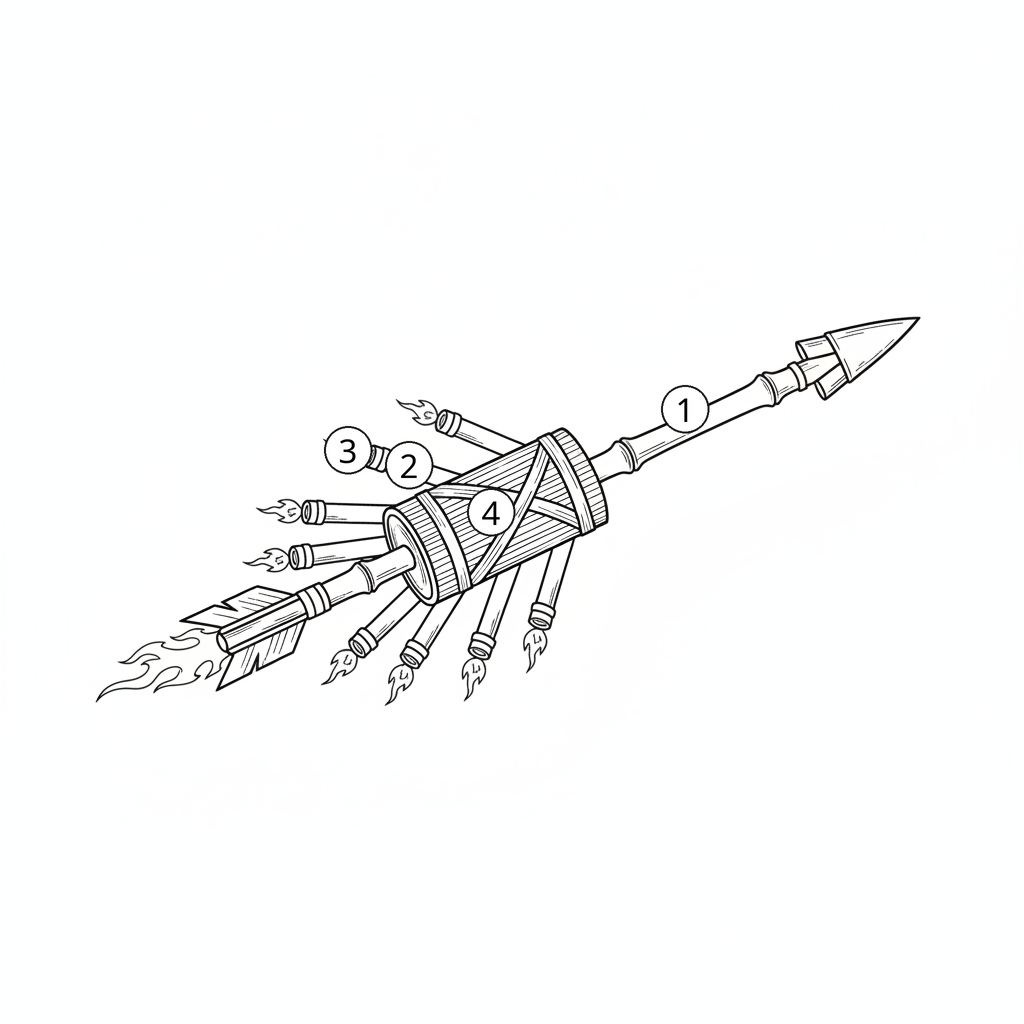
Word Bank:
- Bamboo tube
- Arrow shaft
- Gunpowder mixture
- Fuse
1. __________________________
2. __________________________
3. __________________________
4. __________________________
Week 2 Questions
- According to the text, why did people first use 'baozhu'? A. To celebrate weddings B. To scare away evil spirits C. To send signals to the military D. To create colorful light shows
- Based on the article, what can you infer about the discovery of gunpowder? A. It was discovered by throwing paper into a fire. B. It was a total accident while looking for medicine. C. It was stolen from European explorers. D. It was carefully planned by the military.
- How did the use of gunpowder change over time in China? A. It was used for noise, then for weapons, then for celebrations. B. It was used for hunting, then for building, then for art. C. It was used for light, then for heat, then for cooking. D. It was used for medicine, then for food, then for toys.
4. Two-Part Evidence Question
Part A: Why were colors added to fireworks later in history?
Part B: Which sentence from the text supports your answer in Part A?
5. Short Constructed Response (Friday)
Explain how the first "fireworks" (exploding bamboo) were different from the fireworks we see today. Use information from the text to support your answer.
Week 3: Aesop Fable Retelling
Pacing Guide:
- Monday: Read the fable. Circle the characters.
- Tuesday–Thursday: Answer Questions 1–4.
- Friday: Complete the Short Constructed Response (Question 5).
The Lion and the Mouse
A Great Lion was asleep in the heat of the afternoon. A tiny Mouse, scurrying through the grass, accidentally ran right over the Lion's nose. The Lion woke up with a loud roar and trapped the Mouse under his huge paw.
"Please, King of the Jungle!" cried the Mouse. "Let me go, and I promise I will help you one day."
The Lion laughed so hard his mane shook. "You? A tiny Mouse helping the King of the Jungle? That is the funniest thing I have ever heard!" But because he was in a good mood, he lifted his paw and let the little Mouse run away.
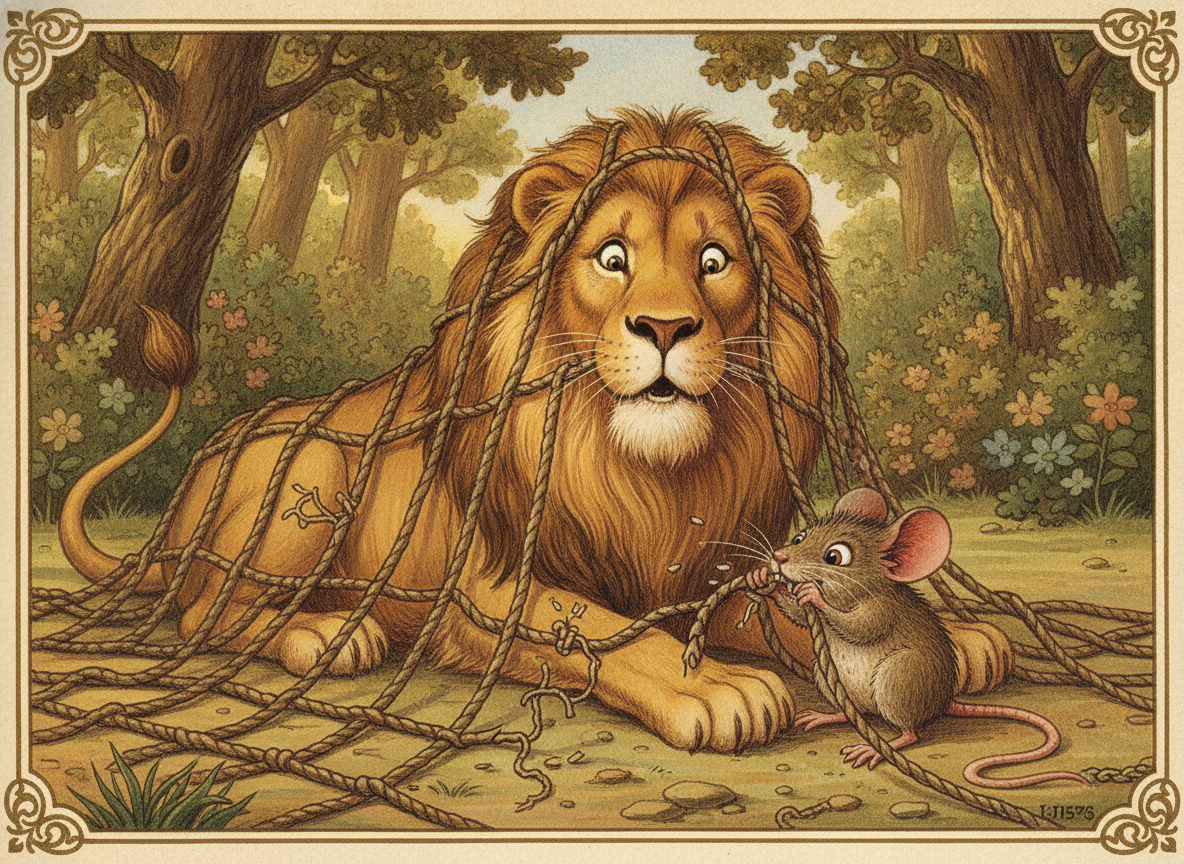
A few weeks later, the Lion was roaming the forest when he walked into a hunter’s trap. A thick rope net fell over him, pinning him to the ground. He roared for help, but none of the big animals came to his rescue.
Suddenly, the little Mouse appeared. Without a word, she began to gnaw at the thick ropes with her sharp teeth. She chewed and chewed until the ropes snapped, and the Lion was able to crawl out of the net.
"You laughed when I said I could help you," said the Mouse. "But now you see that even a tiny Mouse can help a Great Lion."
🔦 Skill Spotlight: Theme or MoralThe theme or moral is the life lesson the author wants you to learn. It is a big idea that applies to everyone, not just the characters in the story. Common themes include "honesty is the best policy" or "hard work pays off."
Week 3 Questions
- What is the moral of this fable? A. Always carry a net when hunting. B. Little friends can be great friends. C. Laughter is the best medicine. D. Don't wake up a sleeping lion.
- Why did the Lion let the Mouse go at the beginning? A. He didn't realize the Mouse was there. B. He was amused by the Mouse's promise. C. He thought the Mouse would taste bad. D. He was afraid of the Mouse's teeth.
- Which word best describes the Mouse's character? A. Loyal B. Forgetful C. Fearful D. Greedy
4. Two-Part Evidence Question
Part A: How did the Lion’s opinion of the Mouse change from the beginning to the end?
Part B: Which sentence from the text supports your answer in Part A?
5. Short Constructed Response (Friday)
Think about the phrase "A kindness is never wasted." How does this apply to the Lion and the Mouse? Use details from the story to explain.
Week 4: Poetry
Pacing Guide:
- Monday: Read the poem aloud. Listen for the rhythm.
- Tuesday–Thursday: Answer Questions 1–4.
- Friday: Complete the Short Constructed Response (Question 5).
The Whispering Woods
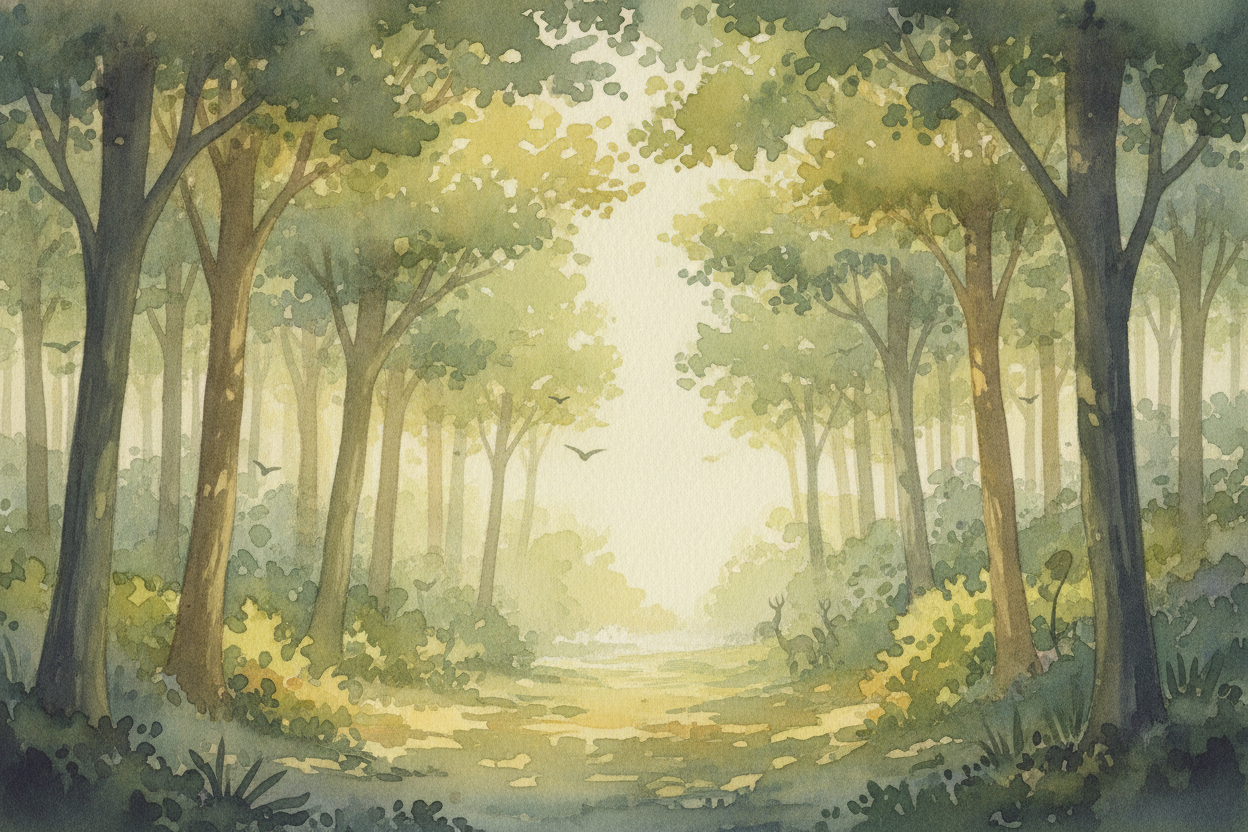
The tall pines reach for the silver moon,
And hum a low and sleepy tune.
The wind, a ghost, slips through the trees,
To dance among the fallen leaves.
The brook is chattering to the stones,
In soft and liquid, bubbly tones.
The flowers wear their gowns of gold,
Against the creeping winter cold.
The forest is a quiet room,
Away from all the city’s boom.
It holds its secrets tight and deep,
While all the woodland creatures sleep.
🔦 Skill Spotlight: Figurative LanguageAuthors use figurative language to make their writing more interesting.
Week 4 Questions
- In the second stanza, what is the brook doing? A. Sleeping quietly B. Freezing into ice C. Talking to the stones D. Running away from the forest
- The poet calls the wind a 'ghost.' This is an example of: A. A simile B. A metaphor C. Rhyme D. Onomatopoeia
- What is the overall mood of the poem? A. Busy and loud B. Sad and lonely C. Scary and dark D. Calm and peaceful
4. Two-Part Evidence Question
Part A: What does the poet mean by saying the flowers wear "gowns of gold"?
Part B: Which line from the poem explains why the flowers might be wearing these gowns?
5. Short Constructed Response (Friday)
Identify one example of personification in the poem. Explain why the poet chose to use that human quality to describe a part of nature.