Generated with Monsha
Save this resource to edit, expand, or export it, or create more resources for free.
Smart Money Habits: Financial Literacy Vocabulary Worksheet
Worksheet
Grade 8
English
Smart Money Habits: Financial Literacy Vocabulary Worksheet

Introduction
Managing your money effectively is one of the most important life skills you can learn. Whether it's choosing how to spend your allowance or saving up for a new phone, understanding these key terms will help you make better financial decisions.
Activity 1: Financial Vocabulary Match-Up
Instructions: Draw a line to match each financial term on the left with its correct definition on the right.
Financial Term | Definition |
|---|---|
1. Income | A. Money that you owe to someone else or a bank. |
2. Expense | B. A written plan for how to spend and save your money. |
3. Savings | C. Extra money earned for keeping money in a bank or paid for borrowing. |
4. Interest | D. Putting money into something expecting to earn a profit later. |
5. Investment | E. Money you earn from work, allowance, or gifts. |
6. Debt | F. The money you spend on things you need or want. |
7. Budget | G. Money you set aside to use in the future. |
Activity 2: Jordan's Summer Project (Fill-in-the-Gaps)
Instructions: Read the story below and fill in the blanks using the terms from the word bank. Use each word only once.
Word Bank:
- Savings
- Investment
- Income
- Debt
- Interest
- Budget
- Expenses
Jordan decided to start a small business mowing lawns this summer. Every Saturday, he goes door-to-door. The total amount of money he gets paid each week is his ____________________.
However, he has to pay for gas and repairs for his mower. These costs are known as ____________________. To make sure he doesn't run out of money before the end of the month, Jordan creates a ____________________.
He decides to put half of what he makes into a ____________________ account at the bank. He is excited because the bank will pay him ____________________ just for keeping his money there.
Jordan also bought a new, faster lawnmower with his own money. He considers this an ____________________ because it allows him to finish more yards in one day and earn more money. He is proud that he didn't have to borrow any money, which means he has zero ____________________.
Activity 3: Multiple Choice Scenarios
Instructions: Circle the correct answer for each scenario.
1. Which of the following is an example of an "expense" for an 8th-grade student?
A) Receiving $20 for your birthday.
B) Getting paid for helping a neighbor with groceries.
C) Buying a movie ticket and popcorn with friends.
D) Finding a five-dollar bill on the sidewalk.
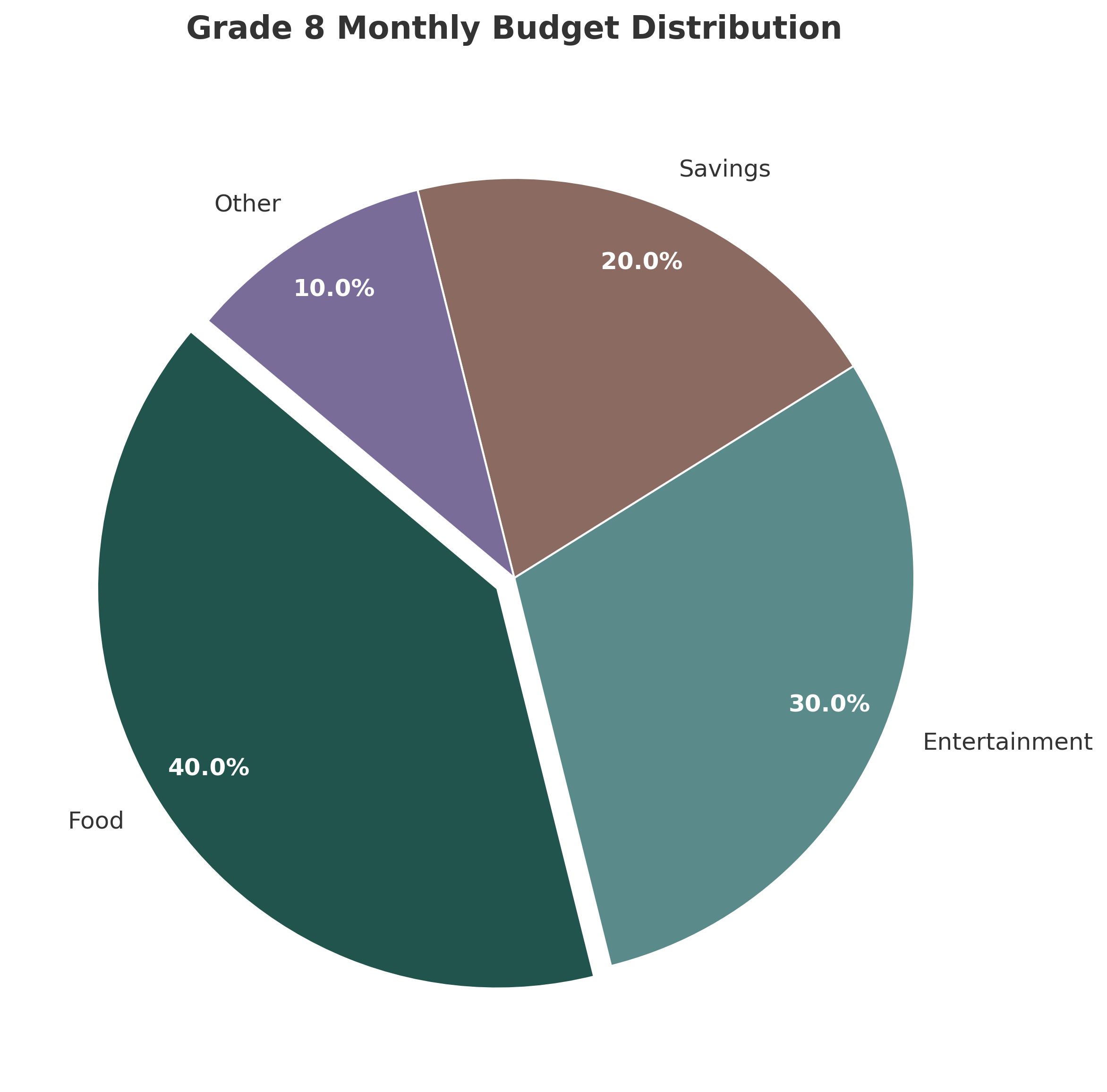
2. Look at the chart below (fig 2). If a student has a total monthly income of $100, how much money does their budget allocate for "Savings"?
A) $10
B) $20
C) $30
D) $40
3. Which statement best describes "Interest" in a savings account?
A) You earn extra money over time for keeping your money in the bank.
B) It is a penalty fee you must pay every month to the bank.
C) It is the amount of money you owe the bank for your debit card.
D) It is a one-time gift given to you when you first open an account.
4. Why is creating a "Budget" considered a smart financial move?
A) It allows you to buy everything you want without thinking.
B) It guarantees that you will never have to work a job.
C) It is a list of all the things you have already bought in the past.
D) It helps you ensure you have enough money for your needs and your goals.