Generated with Monsha
JSS 1 Music: Dotted Notes and Values
Lesson Plan · Nigerian · English
JSS 1 Music: Dotted Notes and Values
Component 1: Objectives & Learning Outcomes
By the end of this 40-minute lesson, the JSS 1 students should be able to:
- Define a dotted note and describe the function of the dot in musical notation.
- Explain the mathematical rule of the dot (increasing a note's value by half).
- Calculate the beat values of dotted semibreves, minims, crotchets, and quavers using British terminology.
- Identify dotted notes within a given piece of music (e.g., the Nigerian National Anthem).
Component 2: Material & Resources Needed
To facilitate this lesson, the following materials are required:
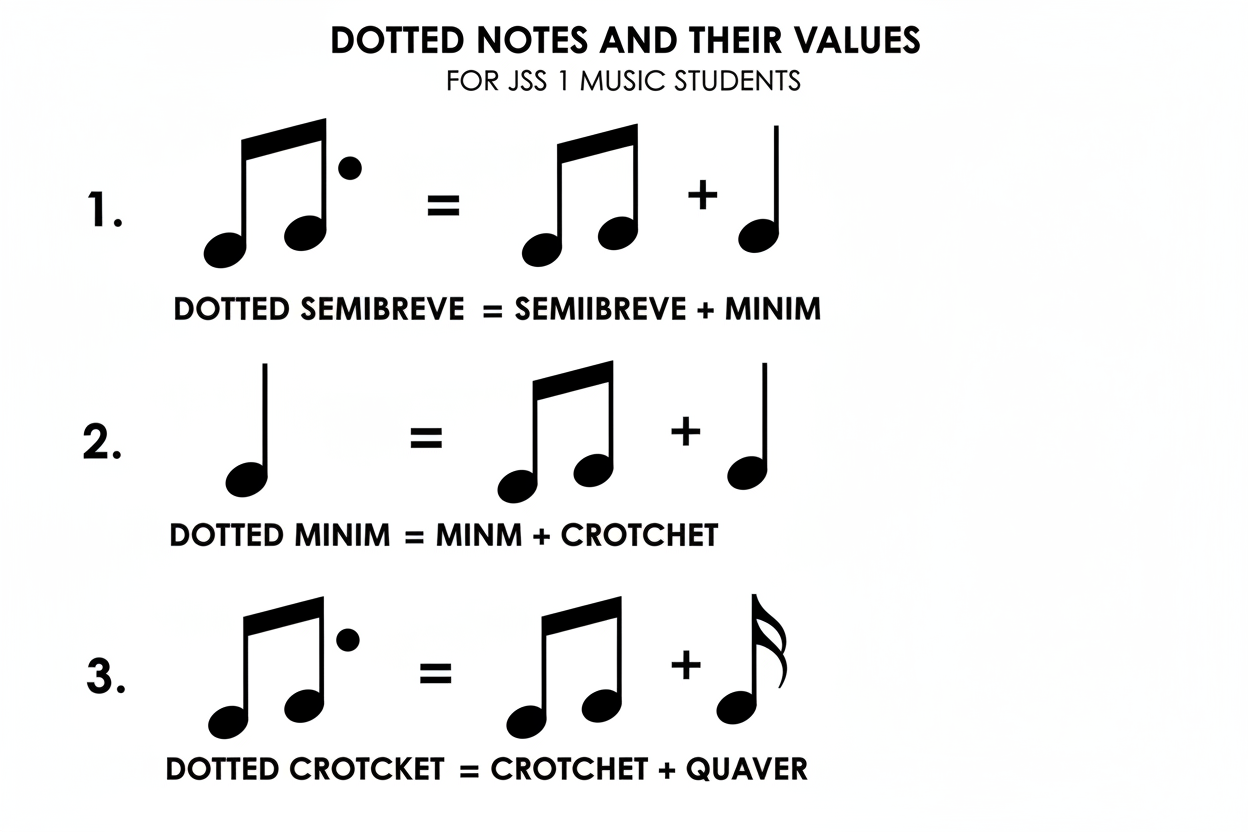
- Visual Aid: A chart showing the breakdown of dotted notes (see Fig 1 below).
- Instruments: A keyboard or pitch pipe for demonstration, and percussion instruments (clappers/drums) for rhythm exercises.
- Textbook: A Handbook of Music for Schools and Colleges or similar NERDC-approved curriculum text.
- Audio: Recording of "Arise, O Compatriots" to demonstrate dotted rhythms.
Lesson Note: Dotted Notes and Values
1. Definition
A dotted note is a musical note with a small dot placed immediately to its right. This dot is not merely decorative; it is a sign of augmentation that changes the duration of the note.
2. Explanation (The Rule of the Dot)
The rule of the dot states that a dot placed after a note increases its original value by exactly half.
Mathematically, the value of a dotted note can be expressed as:
For example, if a note originally lasts for 2 beats, the dot adds 1 beat (half of 2), making the total duration 3 beats.
3. Types and Values of Dotted Notes
In our curriculum, we use British terminology. Below are the common dotted notes and their equivalent values:
- Dotted Semibreve:
- Original (Semibreve) = 4 beats
- Dot = 2 beats
- Total = 6 beats
- Dotted Minim:
- Original (Minim) = 2 beats
- Dot = 1 beat
- Total = 3 beats
- Dotted Crotchet:
- Original (Crotchet) = 1 beat
- Dot = beat
- Total = 1.5 beats (often written as )
- Dotted Quaver:
- Original (Quaver) = beat
- Dot = beat
- Total = 0.75 beats (often written as )
Component 3: Assessment and Evaluation Plan
To ensure students have mastered the concept, the following assessment strategies will be used:
1. Formative Assessment (During Lesson):
- Rhythmic Clapping: The teacher claps a 4-beat measure containing a dotted minim and a crotchet; students must repeat it accurately.
- Quick Math: Verbal quiz asking students, "If a Minim is 2 beats, how many beats is a Dotted Minim?"
2. Summative Evaluation (Class Work):
- Calculation Exercise: Students will complete a worksheet with the following equations:
-
-
- How many beats are in a Dotted Semibreve?
- Identification Task: Using a sheet of the Nigerian National Anthem, students will circle all the dotted crotchets they can find in the first four bars.
3. Performance Task:
- Groups of 4 students will be asked to compose a 2-bar rhythm in 4/4 time that must include at least one dotted note, then perform it using desks as drums.
JSS 1 Music: Comprehensive Lesson Plan on Dotted Notes and Values
Component 1: Objectives & Learning Outcomes
By the end of this 40-minute lesson, JSS 1 students will be able to:
- Define a dotted note and a dotted rest as signs of augmentation in music.
- Apply the "Rule of the Dot" to calculate the rhythmic duration of semibreves, minims, crotchets, and quavers.
- Demonstrate the correct placement of a dot on a musical staff (distinguishing between notes on lines and notes in spaces).
- Identify and Perform dotted rhythms found in popular Nigerian folk songs such as "Iṣẹ l'ogun Iṣẹ" or "Iwe Kiko."
- Analyze a short musical excerpt and correctly circle all dotted notes and rests.
Component 2: Material & Resources Needed
To successfully execute this lesson, the following materials are required:
- Visual Aids:
- Fig 1: Mathematical breakdown of dotted notes.
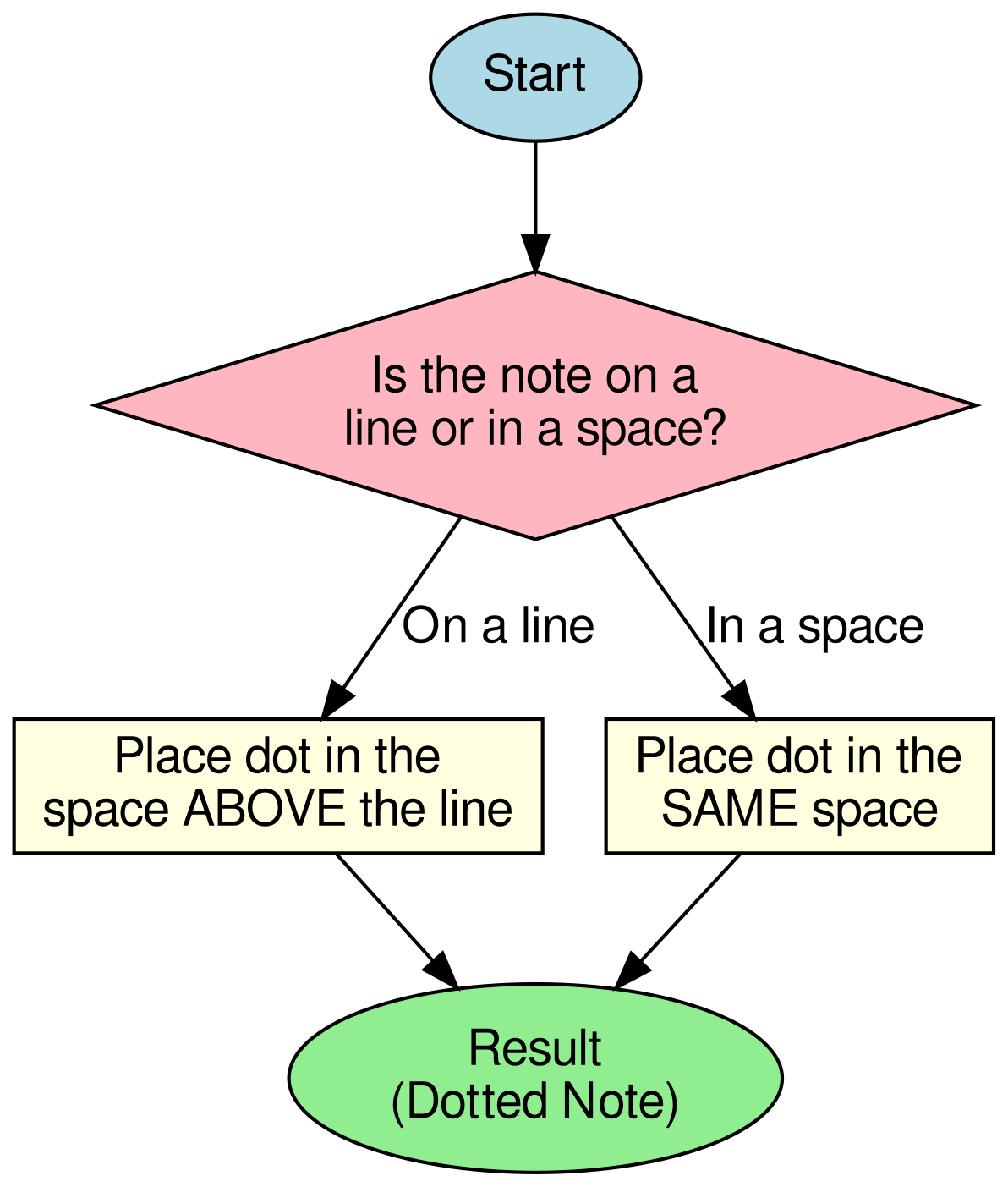
- Fig 2: Flowchart for the "Placement of the Dot" rule.
- Musical Instruments: A keyboard for pitch demonstration and a talking drum or woodblock for rhythmic pulse.
- Audio Resources: Recordings of the Nigerian National Anthem and the folk song "Iṣẹ l'ogun Iṣẹ."
- Board Materials: Manuscript paper (staff paper) drawn on the chalkboard/whiteboard.
Detailed Lesson Note: Dotted Notes and Values
1. Definition
In music theory, a dot placed to the right of a note or rest increases its duration. It is a way to create rhythms that are not strictly powers of two (like 1, 2, or 4 beats).
2. The Rule of the Dot
The dot adds exactly half of the original value of the note/rest to itself.
3. Values of Dotted Notes and Rests (British Terminology)
Note/Rest Name | Original Value | Value of Dot | Total Dotted Value |
|---|---|---|---|
Dotted Semibreve | 4 beats | 2 beats | 6 beats |
Dotted Minim | 2 beats | 1 beat | 3 beats |
Dotted Crotchet | 1 beat | beat | 1 beats |
Dotted Quaver | beat | beat | beat |
4. Placement of the Dot (Staff Rules)
When writing music on a staff, the placement of the dot is critical for clarity. Music teachers in Nigeria follow these standard rules:
- Notes in Spaces: The dot is placed in the same space as the notehead.
- Notes on Lines: The dot is placed in the space above the line to ensure it is not obscured by the staff line.
5. Practical Musical Examples
- "Iwe Kiko" (Yoruba Folk Song): The rhythm of the words "I-we ki-ko" often uses a dotted crotchet followed by a quaver, giving the song its characteristic "skipping" feel.
- National Anthem: "Arise, O Compatriots" — the word "A-rise" uses a dotted rhythm to provide energy and forward motion.
Component 3: Assessment and Evaluation Plan
1. Classroom Drills (Formative - 10 mins):
- Dot Placement Drill: The teacher draws a Minim on the 2nd line (G) and 3rd space (C). Students must come to the board and place the dot in the correct position.
- The Dot Addition Game: The teacher calls out a note (e.g., "Semibreve!") and the students must shout back the value of its dot ("Two!").
2. Written Quiz (Summative - 10 mins):
- Question 1: Calculate the total beats for: One Dotted Minim + Two Crotchets. (Answer: beats).
- Question 2: True or False? A dot after a rest works the same way as a dot after a note. (Answer: True).
- Question 3: If a Quaver is worth a beat, what is the value of a Dotted Quaver? (Answer:beat).
3. Practical Performance Assessment (Evaluation):
- Rhythmic Dictation: The teacher claps a 4-beat rhythm (e.g., Dotted Minim, Crotchet). Students must identify which beat the dot occurred on.
- Singing Task: Students sing the first stanza of "Iṣẹ l'ogun Iṣẹ" while tapping their feet to the pulse. They must raise their hand every time they sing a word that falls on a dotted note.
JSS 1 Music: Rests and Values (Week 5)
Component 1: Objectives & Learning Outcomes
By the end of this 40-minute lesson, the JSS 1 students should be able to:
- Define a musical rest and distinguish it from a musical note.
- Explain why silence is important in music performance and composition.
- Identify and draw the five basic types of rests (Semibreve, Minim, Crotchet, Quaver, and Semiquaver).
- Assign the correct beat values to each rest according to the British terminology used in the Nigerian curriculum.
- Differentiate between the placement of a Semibreve rest and a Minim rest on the musical staff.
Component 2: Material & Resources Needed
To facilitate an engaging learning environment, the following resources are required:
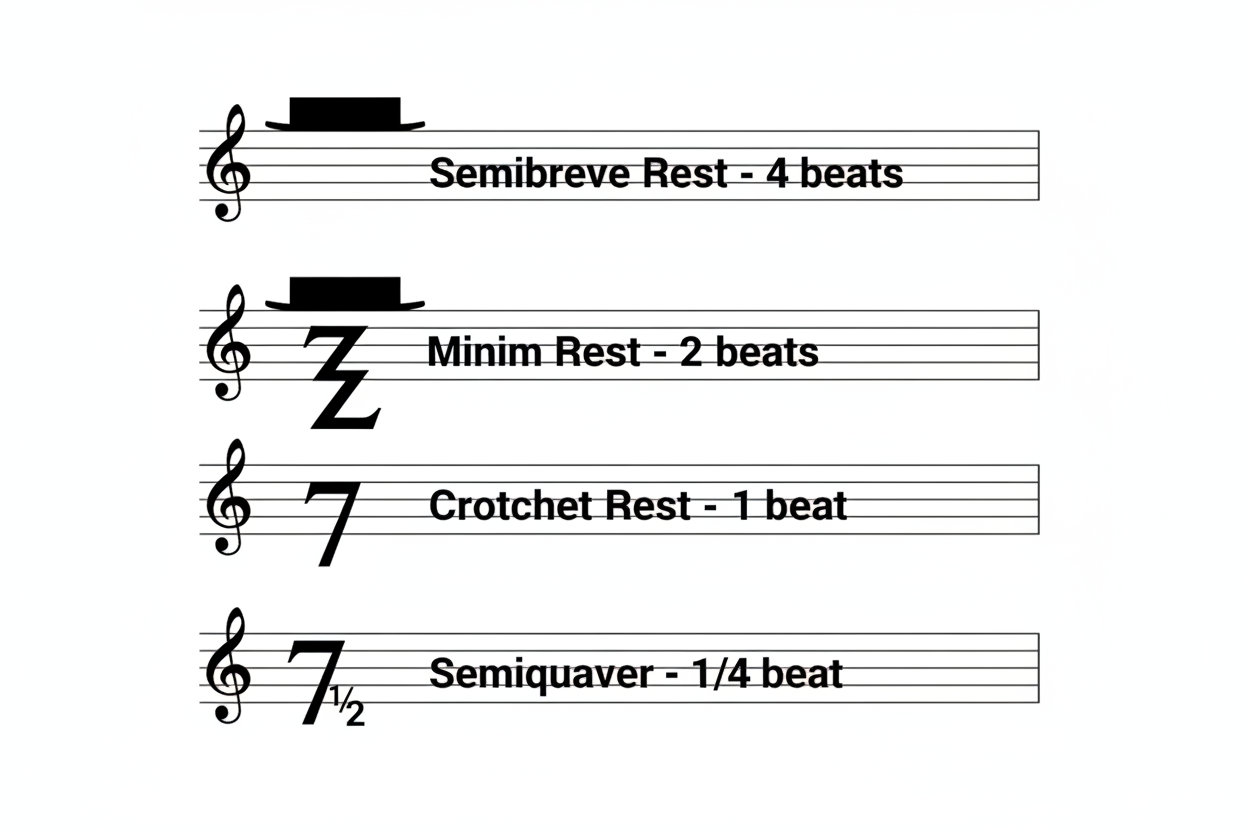
- Visual Aid: A wall chart or projection of Fig 1 showing rest symbols and their names.
- Manuscript Paper: Staff paper for students to practice drawing symbols.
- Audio/Percussion: A metronome or woodblock to demonstrate "beats of silence."
- Memory Aids: Diagrams comparing the Semibreve rest to a "hole" and the Minim rest to a "hat."
Lesson Note: Rests and Values
1. Definition
A rest is a sign of silence in music. Just as a musical note tells a performer when to make a sound, a rest tells the performer exactly how long to remain silent. In a musical score, silence is just as important as sound.
2. Explanation
In music, rhythm is made up of both sound and silence. Rests are measured in "beats," just like notes. When a musician sees a rest, they continue to count the pulse in their head but do not play their instrument or sing until the rest duration is over.
3. Types of Rests
In the Nigerian curriculum, we use British terminology to name these rests:
- Semibreve Rest: A small filled rectangle that hangs below the 4th line of the staff. It looks like a "hole in the ground."
- Minim Rest: A small filled rectangle that sits on top of the 3rd line of the staff. It looks like a "hat on a man's head."
- Crotchet Rest: A squiggly vertical symbol that looks like a "lightning bolt" or a "flying bird."
- Quaver Rest: A symbol with a small stem and one flag (or hook) at the top.
- Semiquaver Rest: A symbol with a small stem and two flags (or hooks) at the top.
4. Values of Musical Rests
The duration of silence is exactly equal to the duration of its corresponding note. Below are the values in a standard 4/4 time signature:
Rest Name | Note Equivalent | Value in Beats |
|---|---|---|
Semibreve Rest | Semibreve (4) | 4 Beats (Full bar silence) |
Minim Rest | Minim (2) | 2 Beats |
Crotchet Rest | Crotchet (1) | 1 Beat |
Quaver Rest | Quaver (1/2) | 1/2 Beat |
Semiquaver Rest | Semiquaver (1/4) | 1/4 Beat |
Component 3: Assessment and Evaluation Plan
1. Formative Assessment (During Lesson - 10 mins):
- Visual Identification: The teacher draws a rest on the board and points to a student to name it and provide its value.
- Silence Drill: The teacher claps a 4-beat rhythm (e.g., Clap - Rest - Clap - Clap). Students must identify where the rest occurred and for how many beats.
2. Summative Evaluation (Class Work - 15 mins):
- Drawing Task: On their manuscript paper, students must draw five measures. In each measure, they must draw one type of rest in its correct position on the staff.
- Math Quiz: Students solve the following "Rhythmic Equations":
- Minim Rest + Crotchet Rest = ____ beats? (Ans: 3)
- Semibreve Rest - Minim Rest = ____ beats? (Ans: 2)
- Two Quaver Rests = ____ Crotchet Rest? (Ans: 1)
3. Practical Exit Ticket (5 mins):
- Before leaving the class, each student must name one difference between a Minim rest and a Semibreve rest (e.g., "One sits on the 3rd line, the other hangs from the 4th").
JSS 1 Music: Rests and Values (Week 5) - Proper Symbols
Component 1: Objectives & Learning Outcomes
By the end of this 40-minute lesson, the JSS 1 students should be able to:
- Define a musical rest as a sign of silence and duration.
- Explain the importance of silence in rhythmic composition and performance.
- Identify and Draw the proper symbols for five basic musical rests (Semibreve, Minim, Crotchet, Quaver, and Semiquaver) with correct staff placement.
- Calculate the relative values of each rest in a standard 4/4 time signature using British terminology.
- Differentiate between a Semibreve rest and a Minim rest based on their position on the 5-line staff.
Component 2: Material & Resources Needed
To facilitate this lesson, the following materials are required:
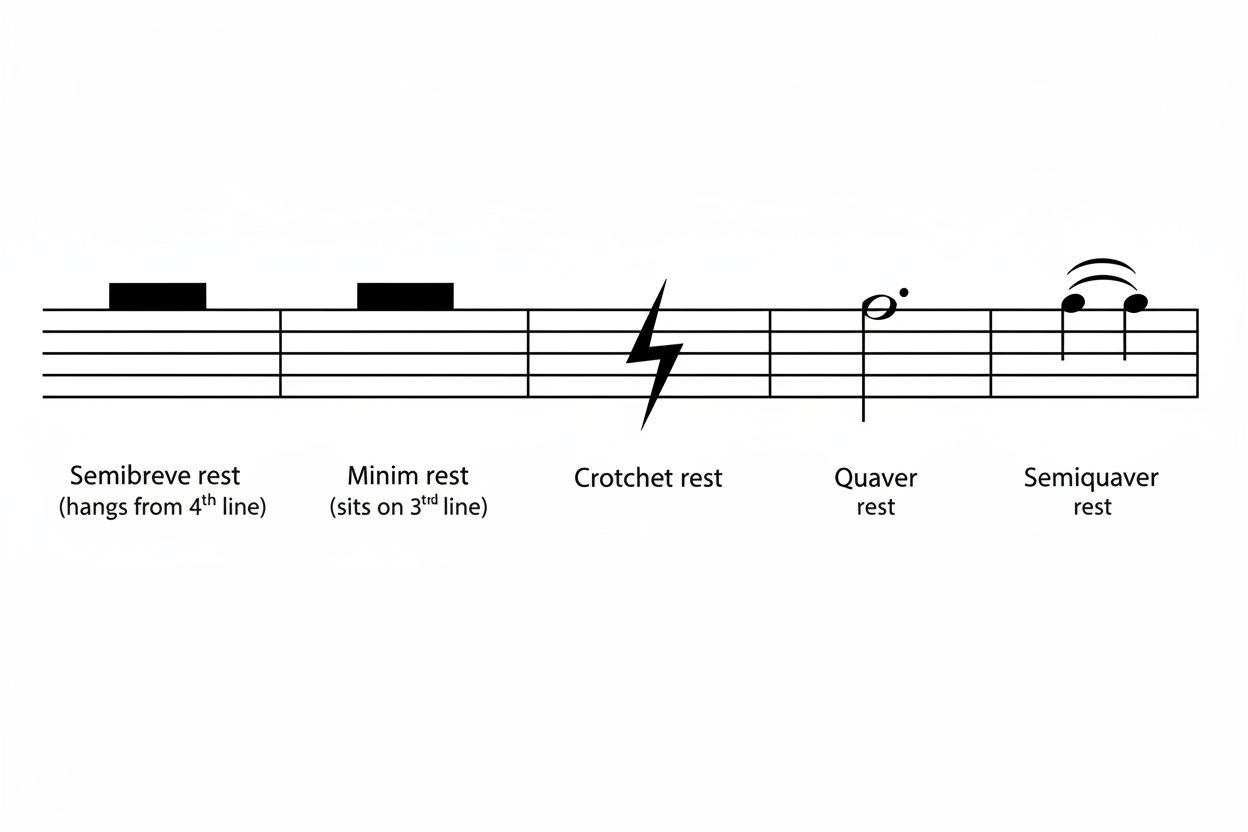
- Visual Chart: A diagram showing the exact staff placement of rests (see Fig 1 below).
- Chalkboard & Staff Stencils: For demonstrating the "lightning bolt" drawing technique for the crotchet rest.
- Manuscript Paper: Staff paper for students to practice drawing the symbols.
- Textbook: Cultural and Creative Arts for Junior Secondary Schools (NERDC-compliant).
- Metronome/Drums: To demonstrate the pulse during periods of musical silence.
Lesson Note: Rests and Values
1. Definition
A rest is a musical symbol that indicates a specific duration of silence. Just as notes represent sound, rests represent the absence of sound. In music, we count these periods of silence using the same pulse (beats) that we use for notes.
2. Explanation
In a performance, when a musician sees a rest, they must stop playing for the exact number of beats specified by that symbol. This creates space and structure in the music. If a song has no rests, it becomes difficult for wind players and singers to breathe, and the rhythm can become cluttered.
3. Types of Rests and Their Proper Symbols
To draw rests properly, certain rules must be followed to ensure they are not confused with other symbols:
- Semibreve Rest (The Whole Rest): Drawn as a solid rectangular block hanging down from the 4th line of the staff. It occupies the top half of the 3rd space.
- Minim Rest (The Half Rest): Drawn as a solid rectangular block sitting on top of the 3rd line of the staff. It occupies the bottom half of the 3rd space.
- Crotchet Rest (The Quarter Rest): Drawn in the "lightning bolt" or "squiggly" style. To draw it properly, imagine a slanted letter 'z' joined to a small letter 'c' at the bottom.
- Quaver Rest (The Eighth Rest): Consists of a thin stem with one hook attached to the top. The hook must always point to the left.
- Semiquaver Rest (The Sixteenth Rest): Consists of a thin stem with two hooks attached to the top. Both hooks must point to the left.
4. Values of Musical Rests
In the Nigerian curriculum, we use the British system to calculate these values. In a 4/4 time signature, the values are as follows:
Rest Name | Symbol Description | Value (Beats) |
|---|---|---|
Semibreve Rest | Block hanging from 4th line | 4 Beats |
Minim Rest | Block sitting on 3rd line | 2 Beats |
Crotchet Rest | Lightning bolt symbol | 1 Beat |
Quaver Rest | Stem with one hook (left) | 1/2 Beat |
Semiquaver Rest | Stem with two hooks (left) | 1/4 Beat |
Component 3: Assessment and Evaluation Plan
1. Formative Assessment (Practical Drill - 10 mins):
- Board Exercise: Several students will be called to the board to draw a specific rest (e.g., "Draw a Minim rest on the staff"). The class will evaluate if it is sitting on the correct line.
- Naming Drill: The teacher shows cards with different rest symbols, and the class must shout out the British name and the beat value simultaneously.
2. Summative Evaluation (Written Quiz - 20 mins):
- Drawing Test: On their manuscript paper, students must draw a 5-line staff and place the following symbols correctly:
- A Crotchet rest in the middle of the staff.
- A Semibreve rest hanging from the 4th line.
- A Semiquaver rest with hooks pointing left.
- Rhythmic Math: Students must answer the following questions:
- Two Quaver rests = ____ Crotchet rest? (Answer: 1)
- One Semibreve rest minus one Minim rest = ____ beats? (Answer: 2)
- How many beats are in a Crotchet rest? (Answer: 1)
3. Evaluation Task (Reflective - 10 mins):
- Critical Thinking: "Why is the semibreve rest placed differently from the minim rest if they are both solid blocks?" (Answer: To distinguish between 4 beats of silence and 2 beats of silence at a glance).