Generated with Monsha
Copy of 5th-8th Grade Squat Handout- Sophia LaRe
Anything · Grade 6 · English
The Squat: Technique, Anatomy, and Movement Guide
The Squat: Technique, Anatomy, and Movement Guide
The Squat: Intermediate Movement Guide
What Is a Squat?
A squat is a fundamental human movement pattern that utilizes the coordinated action of the hips and knees to lower and raise the body. Rather than just bending down, an effective squat requires balance, motor control, and proper joint alignment. Mastered correctly, the squat develops lower-body strength, enhances athletic performance, and reinforces safe movement habits for everyday life.
The 4 Points of Performance
Every repetition should be executed in accordance with the four foundational points of performance:
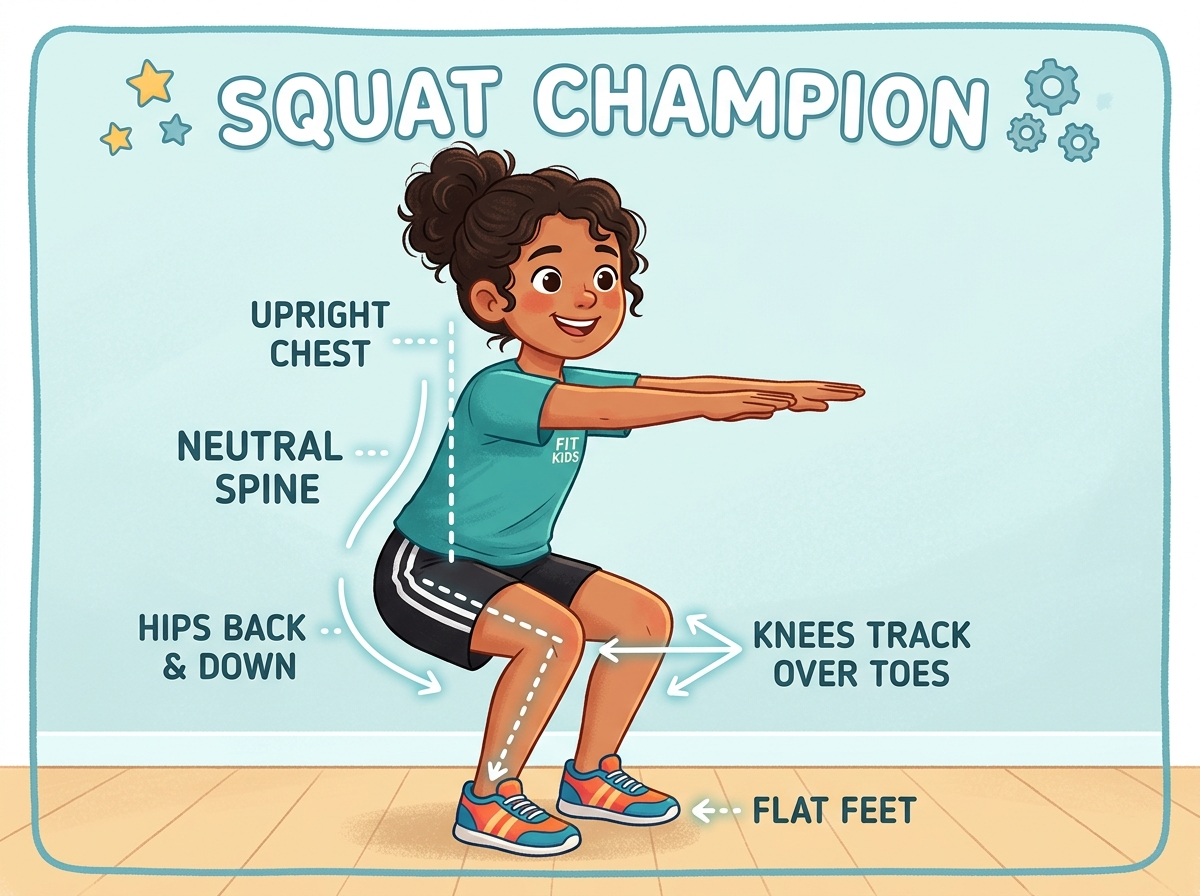
1. Keep Your Entire Foot on the Ground
- Set-Up: Stand with your feet slightly wider than hip-width (roughly shoulder-width apart) and angle your toes slightly outward (about 15–30 degrees).
- Contact & Balance: Maintain complete, three-point contact ("tripod foot") through your heel, the base of the big toe, and the base of the pinky toe. Do not let your heels rise or your toes curl up off the floor.
- Mental Cue: “Keep your whole foot planted.”
2. Maintain a Strong, Neutral Back
- Spine Alignment: Preserve your natural lumbar (lower back) curve throughout the entire repetition. Avoid allowing the lower back to round outward into a curved "C" shape.
- Upper Body Stability: Keep your chest proud and controlled without hyper-extending the spine. Brace your core muscles to protect the vertebral column.
- Mental Cue: “Strong back, controlled body.”
3. Keep Your Knees Tracking With Your Toes
- Directional Alignment: As you descend and ascend, push your knees outward along the same angle as your angled toes.
- Avoid Collapse: Prevent valgus knee collapse (the inward caving or knocking of the knees), which places unnecessary stress on the knee ligaments.
- Mental Cue: “Knees follow toes.”
4. Control Your Squat Depth
- Target Depth: Lower your hips under full control until the hip crease drops just below the top of the patella (knee joint).
- Quality Over Depth: Depth must never come at the expense of posture. If your heels lift, your knees cave, or your back rounds, stop just above that threshold and work on mobility.
- Mental Cue: “Control the way down.”
The illustration below shows how a balanced squat combines an upright torso, aligned knees, and full foot contact throughout the movement.
3 Key Verbal Cues
When coaching yourself or a partner during practice, use these concise, actionable technical cues:
- 👣 “Whole foot down!” — Ensures full floor contact through the heel, ball of the foot, and toes.
- 🦵 “Knees track your toes!” — Keeps the knees aligned over the feet, avoiding inward collapse.
- ⬇️⬆️ “Control down, stand tall!” — Emphasizes smooth deceleration during the descent and explosive, complete extension to finish standing.
Common Faults and Corrections
Common Fault | What It Looks Like | Why It Happens | Correction Cue |
|---|---|---|---|
Heels Lifting | The heels come off the ground and weight shifts completely to the balls of the feet and toes. | Lack of ankle dorsiflexion mobility or shifting weight too far forward. | “Drive weight through the midfoot and keep your whole foot planted.” |
Knee Collapse (Valgus) | Knees buckle or collapse inward toward each other during the descent or initial drive upward. | Weak hip abductors/glutes or poor foot stability. | “Spread the floor apart and push your knees toward your toes.” |
Lower Back Rounding | The lower back loses its natural arch and curves forward into a rounded "C" shape. | Inactive core bracing, tight hamstrings, or descending past comfortable mobility. | “Brace your core, keep your chest upright, and maintain a strong, neutral back.” |
Biomechanics: How the Body Moves
Plane of Motion
- Sagittal Plane: The squat moves primarily within the sagittal plane, dividing the body into right and left halves. The primary actions are forward-and-backward bending (flexion) and straightening (extension).
Joint Actions Across Phases
- Descending Phase (Lowering):
- Hips: Flexion (hips hinge backward and downward)
- Knees: Flexion (knees bend to lower the center of gravity)
- Ankles: Dorsiflexion (shins travel forward over the ankles)
- The Bottom Position (Transition):
- Hip crease sits at or slightly below knee level.
- Back maintains its natural inward curve.
- Whole foot remains firmly in contact with the ground.
- Knees remain actively tracking directly over the toes.
- Ascending Phase (Rising):
- Hips: Extension (hips drive forward and upward)
- Knees: Extension (knees straighten as the body rises)
- Ankles: Plantarflexion return (returning to neutral standing posture)
Anatomy: Muscles Involved
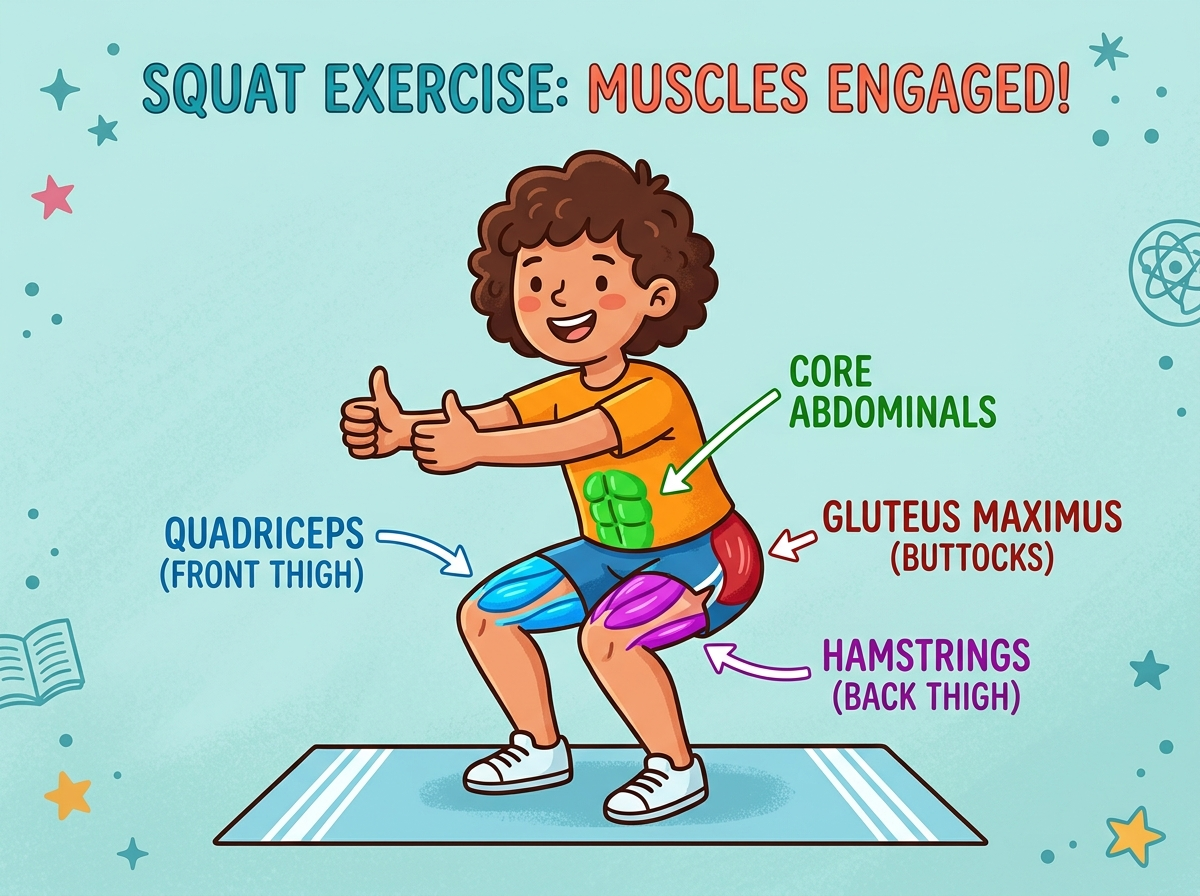
Understanding the major muscle groups engaged in the squat helps you visualize which areas generate force and provide stability.
Muscle Group | Anatomical Location | Primary Role in the Squat |
|---|---|---|
Quadriceps (Rectus Femoris, Vastus Lateralis, Vastus Medialis, Vastus Intermedius) | Front of the thigh | Contracts strongly to extend (straighten) the knee joints during the ascent. |
Gluteus Maximus | Buttocks (posterior hip) | The primary hip extensor; drives the hips forward and upward out of the bottom of the squat. |
Hamstrings (Biceps Femoris, Semitendinosus, Semimembranosus) | Back of the thigh | Acts as an antagonist and stabilizer; assists in hip extension and controls knee flexion during descent. |
Core Musculature (Rectus Abdominis, Obliques, Transverse Abdominis, Erector Spinae) | Trunk and abdominal wall | Stabilizes the spine, maintains intra-abdominal pressure, and prevents torso collapse. |
Types of Muscle Contraction
During a complete squat repetition, your skeletal muscles work through three distinct phases of contraction:
- Eccentric Contraction (Lowering Phase):
- The muscles are active while lengthening under tension.
- Example: The quadriceps and glutes lengthen to control gravity and manage the downward descent smoothly.
- Isometric Contraction (Bottom Stabilization Phase):
- The muscles generate tension without changing length.
- Example: The core musculature and hip stabilizers hold maximum tension at the bottom turn-around to maintain posture without moving.
- Concentric Contraction (Rising Phase):
- The muscles shorten while producing force against resistance.
- Example: The quadriceps and gluteus maximus contract and shorten to push against the floor and return the body to a standing position.
Student "I Can" Self-Assessment Checklist
Use this checklist during peer evaluation or personal practice to assess your form:
- I can maintain complete foot contact (heel, big toe, pinky toe) throughout the entire movement.
- I can preserve a strong, neutral spine with my chest upright and no "C" curve in my lower back.
- I can track my knees directly over my toes without allowing them to buckle inward.
- I can lower into the squat with smooth, controlled speed rather than dropping quickly.
- I can return to a standing position by driving simultaneously through hip and knee extension.
- I can recognize and correct common squat faults such as heel lifting, knee cave, or back rounding.
- I can explain to a peer that the squat operates primarily within the sagittal plane.