Generated with Monsha
Save this resource to edit, expand, or export it, or create more resources for free.
Solving Linear Equations
Anything
Age 12–13
English
Solving Linear Equations
Introduction to Linear Equations
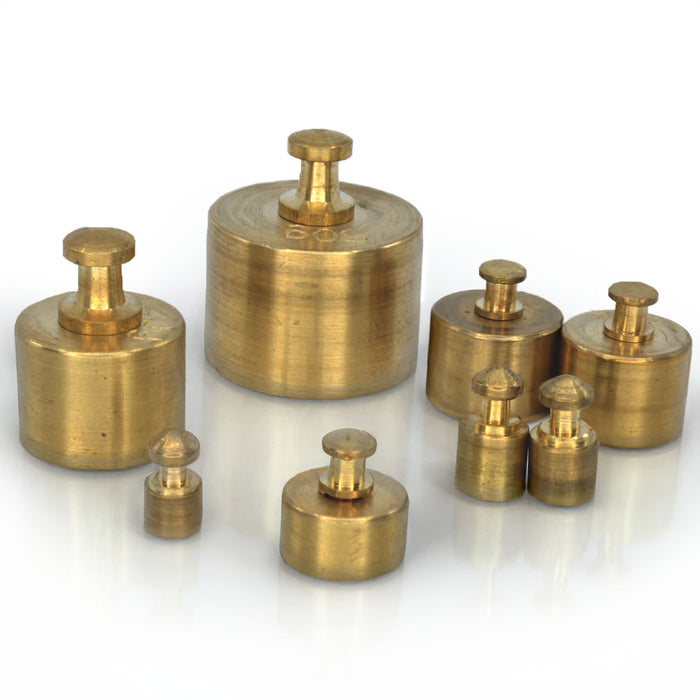
In mathematics, an equation is a statement that two expressions are equal. You can think of an equation like a balanced scale. To keep the scale balanced, whatever you do to one side, you must also do to the other.
Key Vocabulary
- Variable: A letter (like or) that represents an unknown number.
- Constant: A number that stays the same (like 5 or -10).
- Coefficient: The number multiplied by a variable (in , 4 is the coefficient).
- Inverse Operation: The operation that reverses another operation (e.g., subtraction is the inverse of addition).
Solving One-Step Equations
To solve a one-step equation, you only need to perform one inverse operation to isolate the variable (get it by itself).
1. Addition and Subtraction
To undo addition, subtract the same amount from both sides. To undo subtraction, add the same amount.
- Example 1: Solve
- Subtract 5 from both sides:
- Solution:
- Example 2: Solve
- Add 8 to both sides:
- Solution:
2. Multiplication and Division
To undo multiplication, divide both sides. To undo division, multiply both sides.
- Example 3: Solve
- Divide both sides by 4:
- Solution:
- Example 4: Solve
- Multiply both sides by 3:
- Solution:
Solving Two-Step Equations
A two-step equation requires two operations to solve. Generally, you should follow these steps in order:
- Undo Addition or Subtraction first.
- Undo Multiplication or Division second.
- Example: Solve
- Step 1: Subtract 1 from both sides:
- Step 2: Divide both sides by 2:
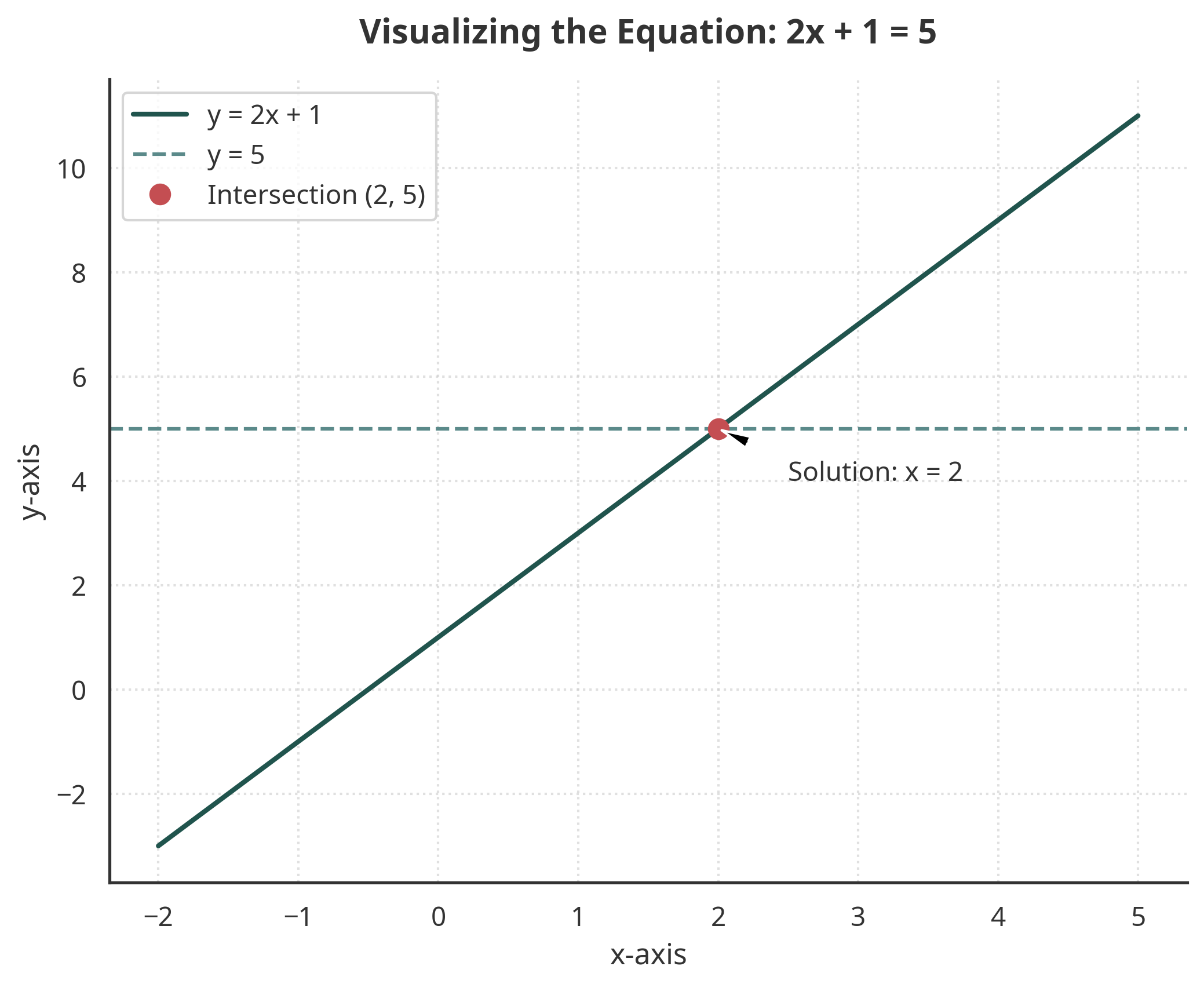
Visualizing the Solution
When we solve
, we are looking for the value of
where the line
crosses the horizontal line
.
How to Check Your Answer
Always plug your solution back into the original equation to see if it works!
If
for the equation
:- Substitute:
- Simplify:
- Check: (Correct!)
Practice Quiz
Multiple Choice Questions
- What is the first step to solve the equation ? A) Divide by 5 B) Subtract 3 C) Multiply by 3 D) Add 3
- Solve for in the equation:A)B)C)D)
- Which value of makes the equationtrue? A)B)C)D)
Short Answer Questions
- Solve the following equation and show your steps: .
- A plumber charges a flat fee of $50 plus $30 per hour worked. If a customer's total bill is $140, write and solve an equation to find how many hours the plumber worked.