Generated with Monsha
Earth's Internal Structure: Journey to the Center
Lesson Plan · 6 · English
Earth's Internal Structure: Journey to the Center
Lesson Overview
Topic: Layers of the Earth
Grade Level: 6
Duration: 45 Minutes
1. Objectives & Learning Outcomes
By the end of this lesson, students will be able to:
- Identify and name the four primary layers of the Earth: Crust, Mantle, Outer Core, and Inner Core.
- Describe the physical properties (state of matter, composition) of each layer.
- Compare the relative thickness and temperature of the layers.
2. Key Concepts
Understanding the Earth's interior requires looking at how heat and pressure change as we go deeper.
- The Crust: The outermost, thinnest layer. It is solid rock and divided into continental crust (land) and oceanic crust (under the ocean).
- The Mantle: The thickest layer (about 2,900 km thick). It is made of semi-solid, hot rock that flows slowly like thick syrup or putty.
- The Outer Core: A liquid layer composed mostly of iron and nickel. Its movement creates Earth's magnetic field.
- The Inner Core: The center of the Earth. Even though it is the hottest layer (≈ ), it is a solid ball of iron and nickel due to the intense pressure from the layers above.
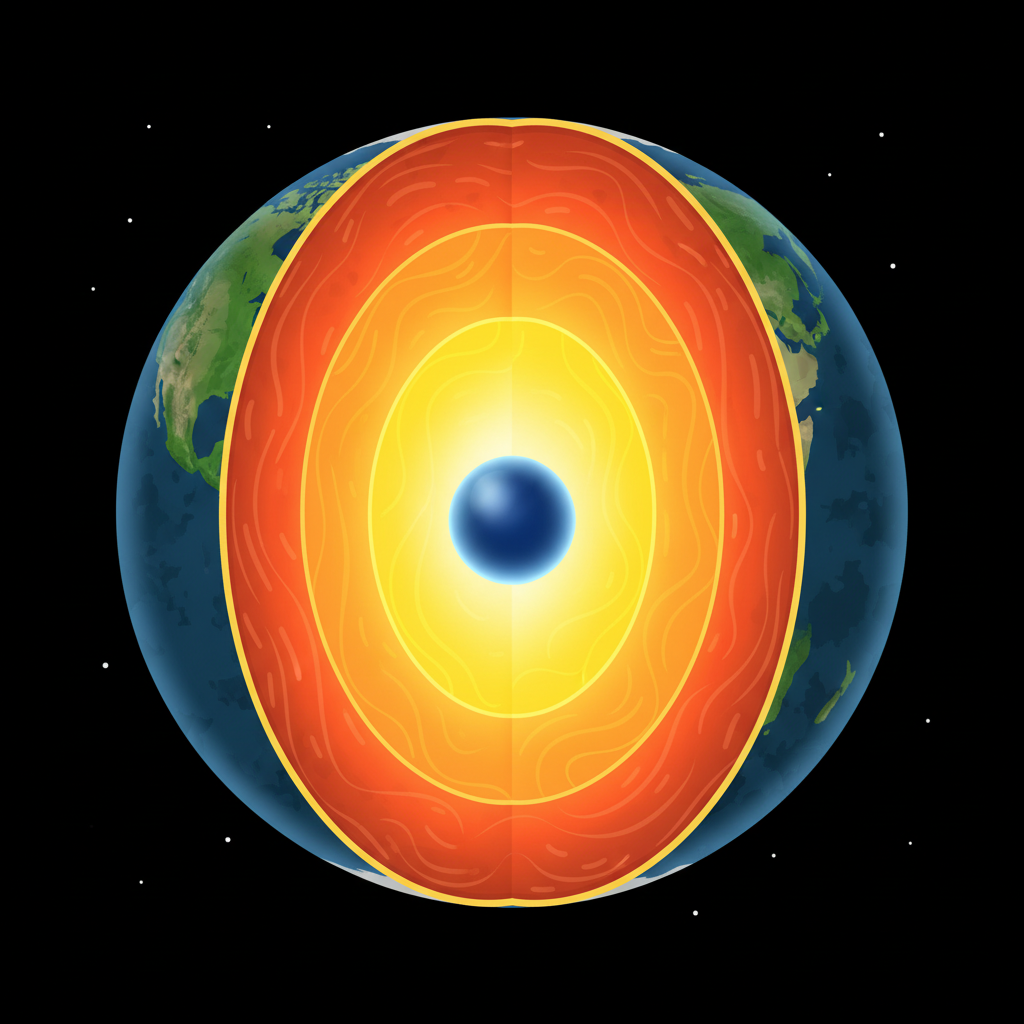
3. Material & Resources Needed
- Visual Aid: Diagram of Earth's Layers (see Fig 1).
- Analogy Item: A hard-boiled egg (to demonstrate layers: shell, white, yolk).
- Student Supplies: Science journals, colored pencils, and rulers.
- Exit Tickets: Small slips of paper for the final assessment.
4. Instructional Sequence
Introduction: The Hook (5 Minutes)
- Show the class a hard-boiled egg. Ask: "If this egg represented the Earth, which part would be the ground we walk on?"
- Gently crack the shell to show the "Crust," slice it in half to reveal the "Mantle" (white) and "Core" (yolk). Explain that today we are going on a journey to the center of the Earth.
Direct Instruction (15 Minutes)
- Display Figure 1. Walk through each layer starting from the outside in.
- Discussion Points:
- Why is the Inner Core solid if it's so hot? (Answer: Pressure).
- Which layer is the thinnest? (Answer: Crust).
- Mention that the Mantle moves in "convection currents," which is what moves the continents.
Guided Practice: Mapping the Earth (15 Minutes)
- Students draw a large cross-section of the Earth in their science journals.
- Task: Color each layer a different color (e.g., Brown for Crust, Red for Mantle, Orange for Outer Core, Yellow for Inner Core).
- Labeling: Beside each layer, students must write one key fact (e.g., "Outer Core = Liquid").
Closure (10 Minutes)
- Quick-fire review: "I'm thinking of a layer that is liquid iron... which one am I?"
- Distribute Exit Tickets.
5. Assessment and Evaluation Plan
Formative Assessment:
- Observation: Monitor student journals during the "Mapping the Earth" activity to ensure layers are in the correct order and characteristics are accurate.
- Check for Understanding: Use "Thumbs Up/Down" during direct instruction to gauge student comprehension of the state of matter (solid vs. liquid) for each layer.
Summative Assessment:
- Exit Ticket: Students must answer the following three questions before leaving:
- List the four layers of the Earth in order from the surface to the center.
- Which layer is the thickest?
- What is the main difference between the Outer Core and the Inner Core?