Generated with Monsha
Class 7 Physics: Electricity - Circuits and Components Assessment
Questions · 7 · English
Class 7 Physics: Electricity - Circuits and Components Assessment
Section A: Objective Type Questions
1. Which of the following symbols represents a combination of two or more cells?
A. A single long line and a short thick line
B. Multiple pairs of long thin lines and short thick lines
C. A wavy line with a circle
D. A straight line with a break in the middle
2. An electric fuse is a safety device based on which effect of electric current?
A. Magnetic effect
B. Chemical effect
C. Heating effect
D. Lighting effect
3. Assertion (A): An electromagnet is a temporary magnet.
Reason (R): It loses its magnetism as soon as the current through its coil is switched off.
A. Both A and R are true and R is the correct explanation of A.
B. Both A and R are true but R is NOT the correct explanation of A.
C. A is true but R is false.
D. A is false but R is true.
Section B: Short Answer Questions - I (2 Marks Each)
4. Draw the standard circuit symbols for the following components:
- (a) An electric bulb
- (b) A switch in 'OFF' position
5. What do you understand by the 'heating effect of electric current'? Name one material used for making the heating element in appliances.
6. Why is a fuse wire made of a material that has a low melting point? Explain its importance in a circuit.
Section C: Short Answer Questions - II (3 Marks Each)
7. Differentiate between a 'cell' and a 'battery'. How should the terminals of four cells be connected to form a battery? (Draw a simple representation).
8. Briefly describe the components of an electric bell. What happens to the hammer when the circuit is completed?
9. Who discovered the magnetic effect of electric current? Describe the observation made when a compass needle is placed near a wire carrying current.
Section D: Case-Based Question (4 Marks)
10. Observe the following circuit diagram and answer the sub-questions that follow:
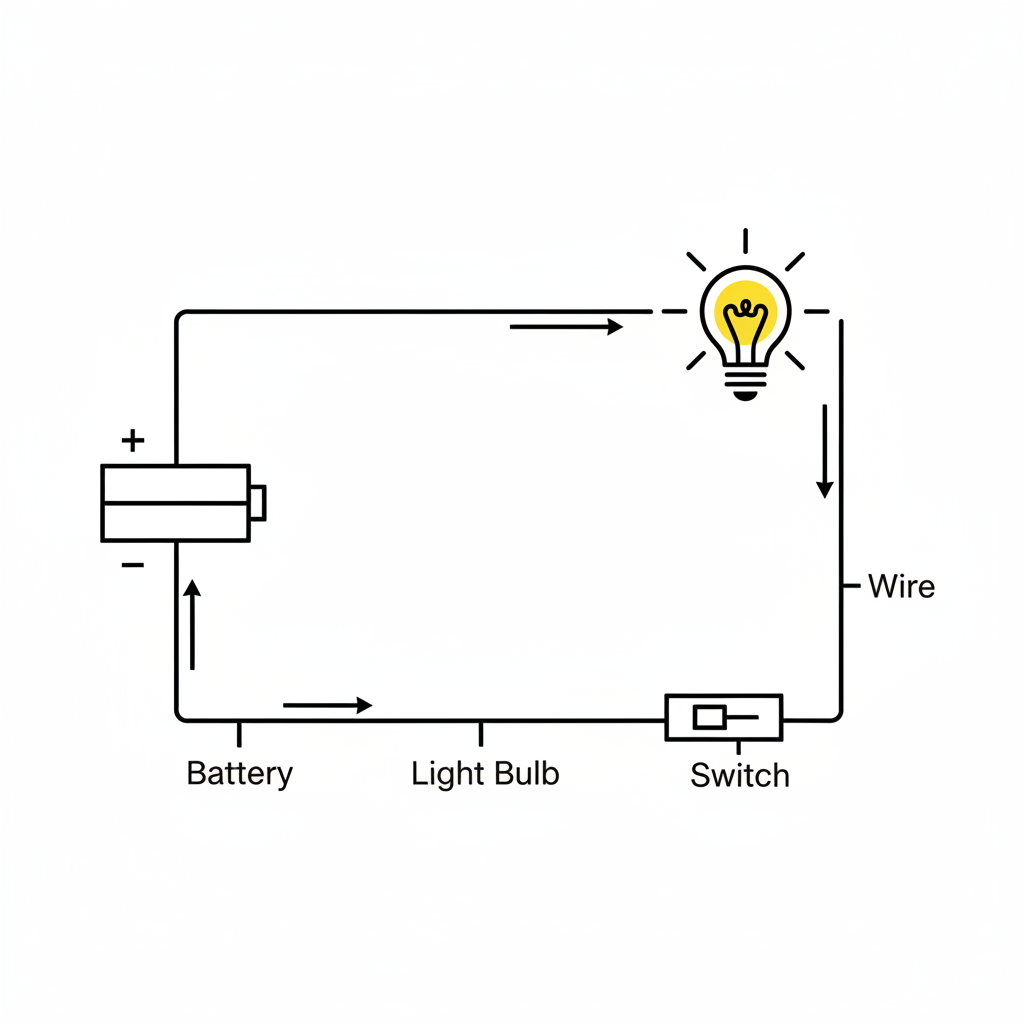
(a) Identify the source of electric energy in this circuit and state how many cells it contains.
(b) Is the circuit shown above 'Open' or 'Closed'? Give a reason for your answer.
(c) If the filament of the bulb breaks, will the other components still work? Explain why or why not.
(d) What change would you observe in the bulb if an additional cell is added to the battery in the same orientation?
Section E: Long Answer Question (5 Marks)
11. (a) What is an electromagnet?
(b) List any three factors on which the strength of an electromagnet depends.
(c) Mention two practical applications of electromagnets in our daily lives.
OR
(a) Explain the working of an electric fuse.
(b) Why are MCBs (Miniature Circuit Breakers) preferred over traditional fuses in modern buildings?
(c) Can we use a piece of copper wire as a fuse? Why or why not?