Generated with Monsha
Save this resource to edit, expand, or export it, or create more resources for free.
Character Trait Word Association: Look, Think, Choose, Prove!
Anything
Grade 4
English
Character Trait Word Association: Look, Think, Choose, Prove!
Character Trait Word Association Anchor Chart
“Evidence first, adjective second!”
Don’t start with the word—start with the character.
🌟 The 4-Step Strategy: Look ➔ Think ➔ Choose ➔ Prove
When we read about a character, we don’t just guess random descriptive words. We follow these four steps to find the trait that truly fits!
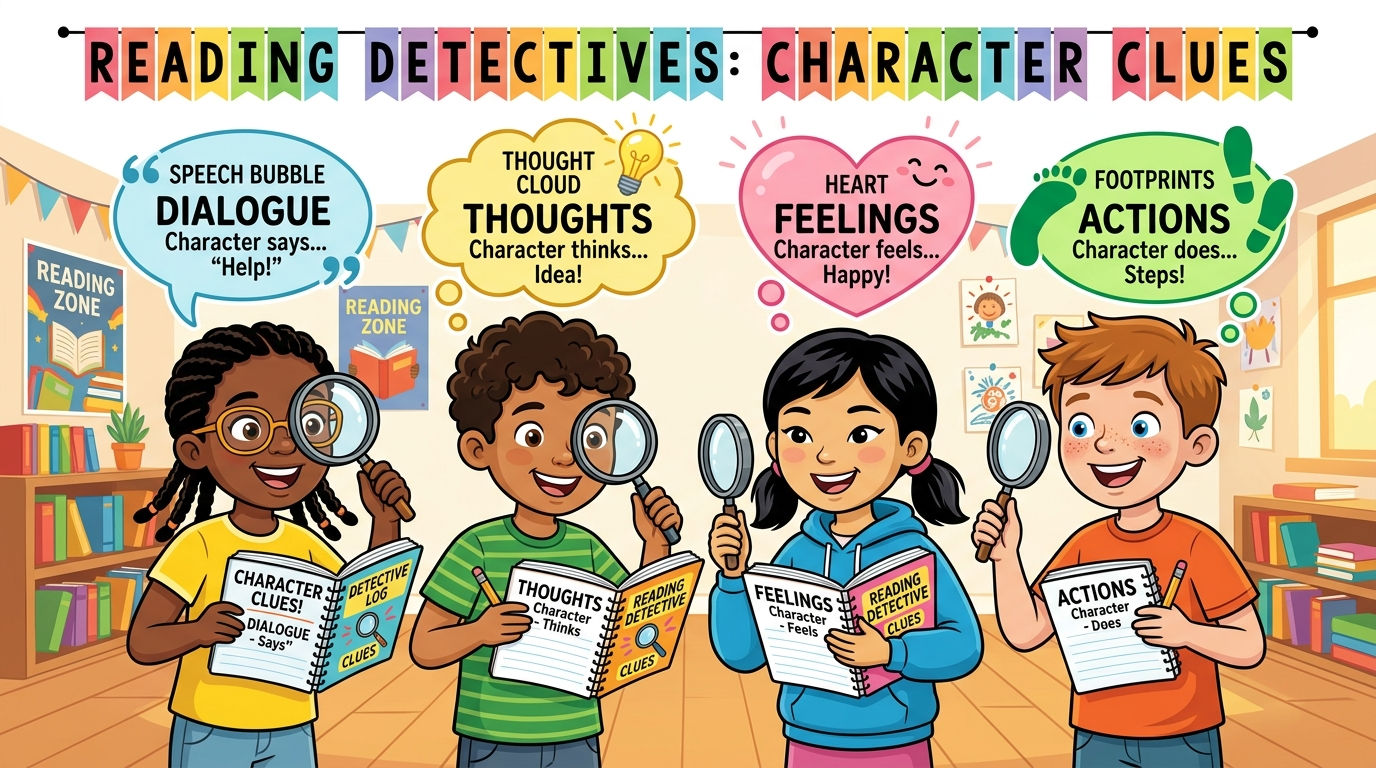
👀 Step 1: Look at the Character
Pay close attention to what the author shows you in the story:
- DO? ➔ What actions does the character take?
- SAY? ➔ What words do they speak aloud?
- THINK? ➔ What inner thoughts do they share?
- FEEL? ➔ What emotions are they experiencing?
- DO OVER & OVER? ➔ What patterns or habits do you notice?
🧠 Step 2: Make a Connection
Connect the character's behavior to real-life examples and mental pictures:
- “What person, animal, or situation does this remind me of?”
- If someone faces danger and doesn't run away ➔ think of a firefighter.
- If someone is searching for clues and asking questions ➔ think of a detective.
- Making a mental picture helps you discover the exact trait!
🎯 Step 3: Choose the Word That Fits
Take your time to pick the strongest, most accurate adjective:
- Ask yourself: “Which adjective BEST describes this character’s overall pattern?”
- Avoid this trap: ❌ “Which fancy adjective do I already know and want to use?”
- Pick the word that matches the evidence, not just the first word that pops into your head.
📖 Step 4: Prove It with Text Evidence
Back up your trait using details directly from the book:
- “My character is because .”
- “The character , which shows that he or she is .”
- “When the character , it proved they are because .”
🚫 Big Reminder: Don’t Force the Word!
❌ Don’t Do This
“I know the word brave, so I’m going to hunt through the book until I find something brave that the character did.”
(This forces a trait onto the character that might not actually fit the story!)
✅ Do This Instead
“The character keeps trying to solve the problem even after failing three times. What trait fits that repeated behavior? ➔ Determined!”
(This lets the author’s evidence lead you directly to the correct trait!)
🖼️ Make a Picture in Your Mind! Character Trait Association Guide
Use this reference table to connect adjectives to clear visual pictures and reasons:
Character Trait (Adjective) | Think of... (Visual Connection) | Why? (Clues in the Story) |
|---|---|---|
Courageous | 🦁 Lion / 🚒 Firefighter | They face real danger and choose not to back down or give up. |
Kind | 🤝 Someone helping a friend up | They show empathy, care about others, and offer support. |
Generous | 🎁 Someone sharing their favorite treat | They willingly give their time, belongings, or help to others. |
Determined | 🏃 A runner pushing across the finish line | They keep trying again and again, even when things get tough. |
Curious | 🔍 A detective examining clues / 🔬 Scientist | They ask questions and want to explore, investigate, and learn. |
Nervous | 🦋 Fluttering butterflies / 📝 Taking a huge test | They feel worried, restless, or unsure about what might happen. |
Proud | 🏆 Someone holding up a finished project or trophy | They feel deep satisfaction about something positive they accomplished. |
Frustrated | 🧩 Someone stuck on an impossible puzzle | A task is difficult, things aren't working, and they feel stuck. |
Joyful | 🎉 Someone celebrating with a huge smile | They are filled with genuine happiness, delight, and positive energy. |
Lonely | 🪑 Someone sitting by themselves on the bench | They feel left out and are longing for friendship and connection. |
Sneaky | 🥷 A ninja tiptoeing silently | They act secretly and try very hard not to be noticed or caught. |
Brave | 🦸 A superhero stepping into action | They do the right or difficult thing even when they feel afraid. |
💡 Pocket Reminder for Folders & Home Reading
Whenever you are reading your independent reading book in class or at home, keep the reader's mantra in mind:
- LOOK: What did the character say, do, think, or feel?
- THINK: What real-world picture does this remind me of?
- CHOOSE: Which adjective describes them best?
- PROVE: What page or sentence proves my trait is true?
Character Trait Word Association: Look, Think, Choose, Prove!
Character Trait Word Association Anchor Chart
“Evidence first, adjective second!”
Don’t start with the word—start with the character!
🌟 The 4-Step Strategy: Look ➔ Think ➔ Choose ➔ Prove
When identifying character traits, readers don't guess words out of thin air. Follow these four steps to find the exact adjective that fits your character best!
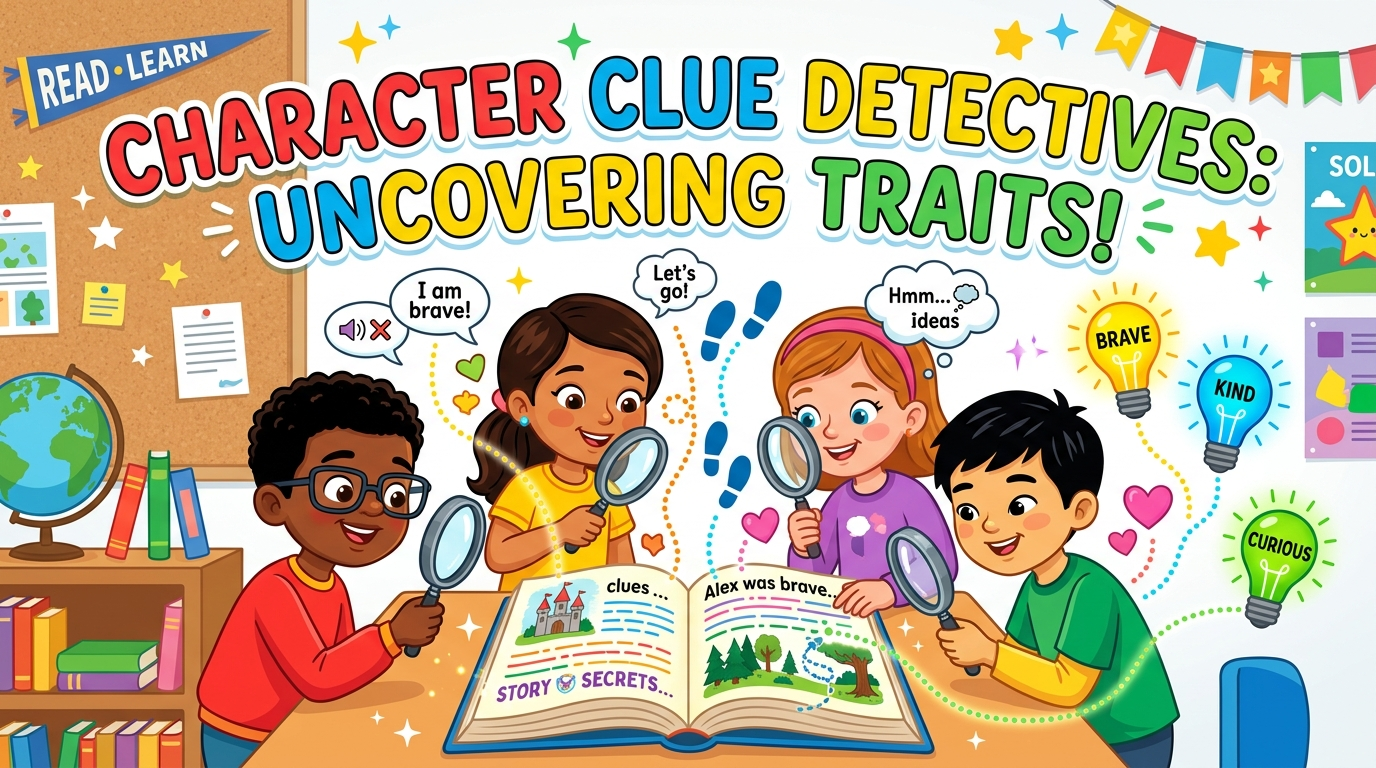
👀 Step 1: Look at the Character
Collect your clues from what the author shows:
- DO? ➔ What actions does the character take?
- SAY? ➔ What words come out of their mouth?
- THINK? ➔ What secret thoughts do they have?
- FEEL? ➔ What emotions are they experiencing?
- DO OVER AND OVER? ➔ What patterns of behavior do you notice?
🧠 Step 2: Make a Connection
Create a mental image in your mind:
- Ask yourself: “What person, animal, or situation does this remind me of?”
- If a character faces danger and stands tall ➔ think of a firefighter.
- If a character keeps trying after failing ➔ think of a marathon runner.
- If a character searches for clues ➔ think of a detective.
🎯 Step 3: Choose the Word That Fits Best
Select the most precise trait adjective:
- Ask yourself: “Which adjective BEST describes this character’s overall pattern?”
- Avoid this trap: ❌ “Which fancy adjective do I already know and want to use?”
- Let the evidence pick the word for you!
📖 Step 4: Prove It with Text Evidence
Back up your thinking with proof from the book:
- “My character is because .”
- “The character , which shows that he/she is .”
- “When the character , it proved they are .”
🚫 Big Reminder: Don't Force the Word!
❌ Don't Do This
“I know the word brave, so I am going to hunt through the book until I find something brave that the character did.”
(This forces a word onto a character, even if that's not who they really are!)
✅ Do This Instead
“The character keeps trying to solve the puzzle even after failing three times. What word fits that behavior? ➔ Determined!”
(This lets the author's clues lead you directly to the right adjective!)
🖼️ Make a Picture in Your Mind! Character Trait Association Guide
Keep this guide in your reading folder to help match character actions with rich descriptive traits:
Character Trait (Adjective) | Think of... (Visual Connection) | Why? (Story Evidence Clues) |
|---|---|---|
Courageous | 🦁 Lion / 🚒 Firefighter | They face real danger and choose not to give up. |
Kind | 🤝 Helping a friend up | They show empathy and care deeply about others. |
Generous | 🎁 Someone sharing a treat | They give freely of their time, snacks, or belongings. |
Determined | 🏃 Runner crossing the finish line | They keep trying again and again, even when it's hard. |
Curious | 🔍 Detective / 🔬 Scientist | They ask questions and want to explore and discover. |
Nervous | 🦋 Fluttering butterflies / 📝 Big test | They feel worried, jittery, or unsure about what might happen. |
Proud | 🏆 Someone holding a trophy | They feel good about something positive they accomplished. |
Frustrated | 🧩 Someone stuck on a puzzle | Something is very difficult and they don't know what to do next. |
Joyful | 🎉 Someone celebrating with friends | They are filled with genuine happiness and high spirits. |
Lonely | 🪑 Someone sitting by themselves | They feel left out and are wishing for friendship and connection. |
Sneaky | 🥷 A ninja tiptoeing silently | They act secretly and try very hard not to be noticed. |
Brave | 🦸 A superhero stepping into action | They do the right or difficult thing even when they feel afraid. |
💡 Pocket Reminder for Student Folders & Home Reading
Whenever you are reading in class or at home with your family, remember the classroom mantra:
- LOOK: What did the character do, say, think, or feel?
- THINK: What real-life person, animal, or picture does that remind you of?
- CHOOSE: Which adjective describes that behavior best?
- PROVE: What sentence or page number in your book proves it?