Generated with Monsha
Save this resource to edit, expand, or export it, or create more resources for free.
Understanding Carbon Bonding and sp3 Hybridization
Anything
Year 2
English
Understanding Carbon Bonding and sp3 Hybridization
Lesson Plan: Understanding Carbon Bonding
Course: Organic Chemistry
Lesson: 1.1 Understanding Carbon Bonding
Grade Level: Year 2 (Undergraduate/Higher Education)
Duration: 60 Minutes
Lesson Overview
This lesson explores the fundamental bonding characteristics of carbon, focusing on why carbon forms four bonds and how the concept of
hybridization explains the tetrahedral geometry of alkanes like methane (
).Learning Objectives
By the end of this lesson, students will be able to:
- Describe the ground-state electronic configuration of carbon.
- Explain the necessity of orbital hybridization for forming four equivalent bonds.
- Illustrate the tetrahedral geometry and bond angles associated with hybridized carbon.
- Identify (sigma) bonds in simple organic molecules.
Materials Needed
- Molecular model kits (one per pair of students).
- Whiteboard and colored markers.
- Projector for visual aids.
- Handout: "From Orbitals to Molecules: A Hybridization Guide."
Lesson Flow
1. Introduction & Hook (10 Minutes)
- The Carbon Paradox: Write the ground-state electron configuration of carbon on the board: .
- Challenge: Ask students, "Based on this configuration, how many bonds should carbon form?" (Expected answer: 2, due to two unpaired electrons in the subshell).
- The Reality: Note that in almost all organic compounds, carbon forms four bonds (tetravalency). Introduce the concept of "Excitation" where one electron moves from the to the emptyorbital.
2. Direct Instruction: sp3 Hybridization (20 Minutes)
- Mixing Orbitals: Explain that to form four equivalent bonds, the one orbital and threeorbitals must mix or "hybridize."
- Defining : Show the energy level diagram of four equivalenthybrid orbitals.
- Geometry: Explain that these four orbitals repel each other to be as far apart as possible, resulting in a tetrahedral shape.
- Visual Aid: Refer to the 3D model of methane.
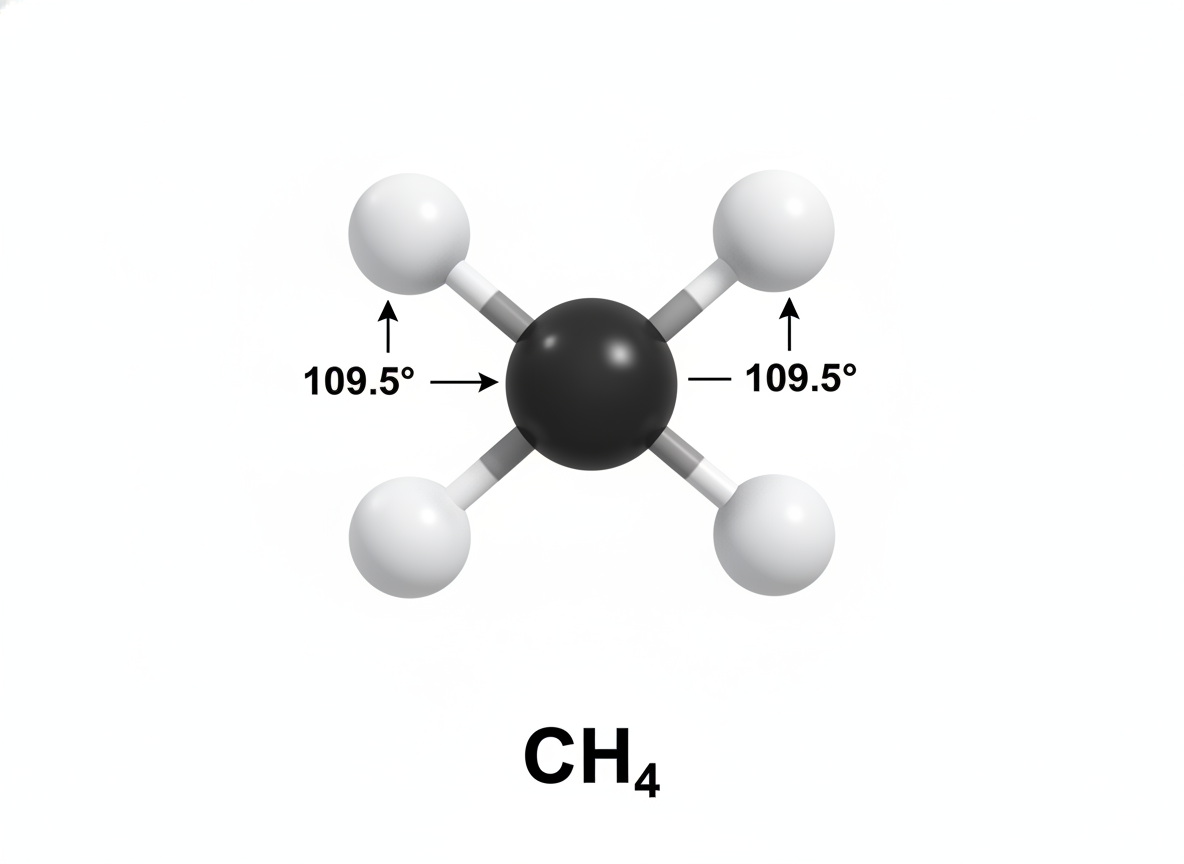
- Bonding: Define the (sigma) bond as the head-on overlap of orbitals (e.g., carbon'swith hydrogen's).
3. Guided Practice: Molecular Modeling (15 Minutes)
- Activity: In pairs, students use molecular model kits to build a model of methane () and ethane ().
- Task: Students must measure or identify the bond angles () and observe the "staggered" vs "eclipsed" orientations (briefly introducing the next topic of conformations).
- Circulate: Walk around to ensure students understand that every single bond in these alkanes is a bond formed byhybridized carbons.
4. Independent Practice & Assessment (10 Minutes)
- Sketching Task: Ask students to draw the orbital overlap diagram for Ethane (), specifically labeling thebond and thebonds.
- Quick Quiz Questions:
- What is the bond angle in a perfectly tetrahedral molecule? ()
- How many orbitals are involved in makinghybrids? (3)
5. Closing & Summary (5 Minutes)
- Key Takeaway: Carbon's ability to hybridize its orbitals allows for the vast structural diversity seen in organic chemistry.
- Preview: Mention that in the next lesson, we will look at how andhybridization lead to double and triple bonds in alkenes and alkynes.
Assessment / Exit Ticket
On a small slip of paper, students must write down the electron configuration of a carbon atom after it has undergone
hybridization but before it bonds with hydrogen.