Generated with Monsha
Exploring Matter: Properties, Volume, and Phase Changes
Lesson Plan · grade 5 · English
Exploring Matter: Properties, Volume, and Phase Changes
Objectives & Learning Outcomes
By the end of this lesson, students will be able to:
- Define and compare the properties of solids, liquids, and gases regarding their shape and volume.
- Measure liquid volume accurately using measuring cylinders and beakers in milliliters (mL) and liters (L).
- Identify and categorize real-world objects from home and the classroom into the three states of matter.
- Explain phase changes, describing how temperature increases or decreases cause matter to transition between states (melting, freezing, evaporation, condensation).
Key Concepts
- Matter: Anything that has mass and takes up space.
- States of Matter: The distinct forms that different phases of matter take on (Solid, Liquid, Gas).
- Volume: The amount of space an object or substance occupies.
- Definite vs. Indefinite: Whether a property (like shape or volume) remains constant or changes based on the container.
- Phase Change: A physical change from one state of matter to another, driven by thermal energy (heat).
Materials and Resources
- For the Teacher: Hot plate or electric kettle, ice cubes, clear glass beaker.
- For Student Groups:
- Set of 3 containers: a solid block (e.g., wooden cube), a small bottle of colored water, and an empty balloon.
- Measuring cylinders (100mL and 250mL) and beakers (500mL).
- Water and trays to catch spills.
- "States of Matter" Observation Log (handout).
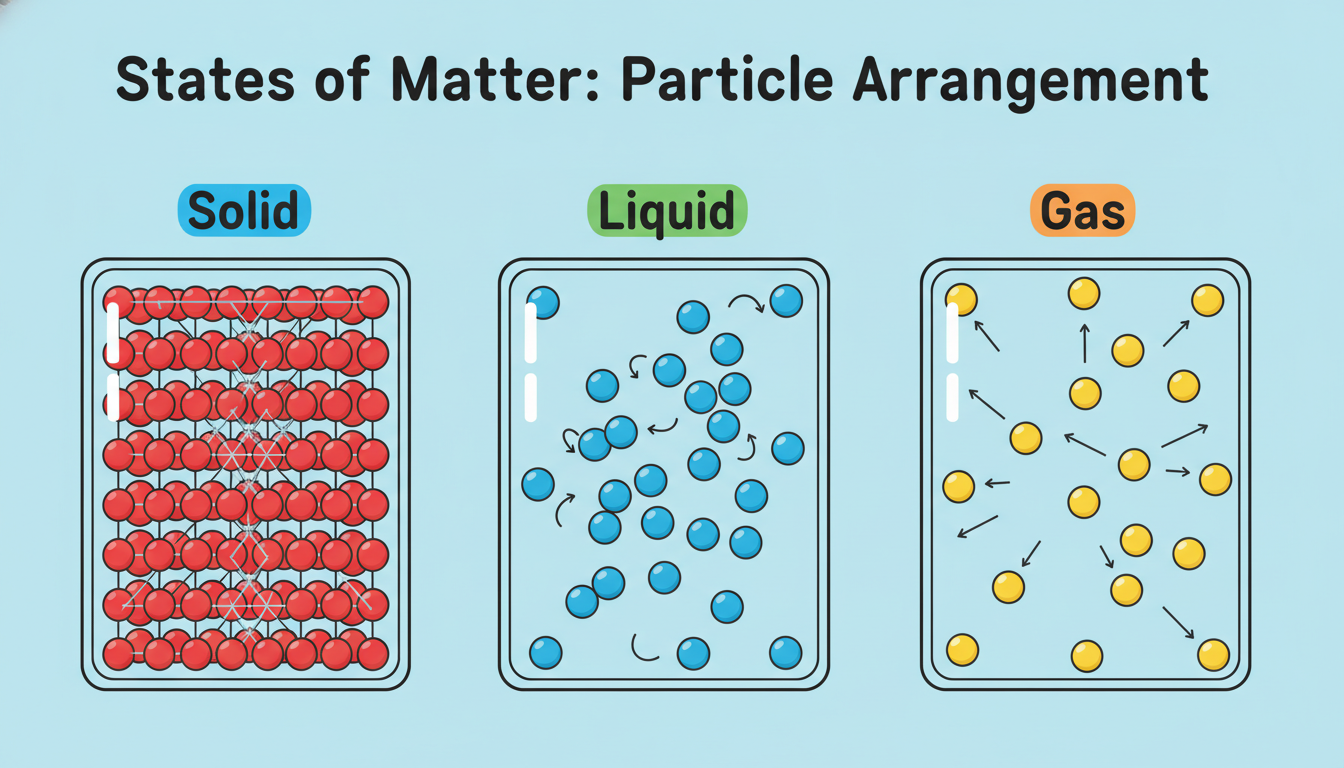
- Visual Aid: Particle arrangement diagram (see below).
5E Instructional Sequence (60 Minutes)
1. Engage (5 Minutes)
- The Mystery Disappearance: Place an ice cube on a warm plate at the front of the room. Ask students: "If I leave this here for our whole lesson, what will happen? Where does it go?"
- Quick Discussion: Have students turn and talk to a partner about whether the ice cube, the puddle, and the 'steam' (water vapor) are the same thing or different things.
- Formative Check: Use a 'Fist to Five' to see how many students already know the names of the three states of matter.
2. Explore (15 Minutes)
- Station Activity: Shape and Volume Investigation
- Solid Station: Students move a wooden block between different shaped containers. Does its shape change? Does it take up more or less space?
- Liquid Station (Math Integration): Students measure exactly 50mL of colored water in a measuring cylinder. They pour it into a wide beaker, then a tall thin flask.
- Task: Check the volume again. Did it stay 50mL? Did the shape change?
- Gas Station: Students blow air into balloons of different shapes. Does the air stay in one spot? Does it fill the whole balloon?
- Data Collection: Students record "Yes/No" for definite shape and definite volume for each state in their logs.
3. Explain (15 Minutes)
- The Particle Connection: Display the following diagram to explain why we saw those results in the exploration.
- Guided Discussion:
- Solids: Particles are tightly packed and vibrate in place (Definite Shape & Volume).
- Liquids: Particles are close but can slide past each other (No Definite Shape; Definite Volume).
- Gases: Particles move fast and are far apart (No Definite Shape or Volume).
- Vocabulary Check: Define milliliters (mL) and liters (L) as the standard units for measuring liquid volume. Emphasize reading the meniscus (the curve of the liquid) at eye level.
4. Elaborate (15 Minutes)
- Phase Change Demonstration: Use the hot plate to melt ice (Solid → Liquid) and then boil water (Liquid → Gas).
- Ask: "What are we adding to the water to make this happen?" (Heat/Energy).
- Discuss the reverse: What happens if we take heat away (Freezing/Condensation)?
- Real-World Scavenger Hunt: In small groups, students list 3 examples of each state they can find in the classroom right now and 3 examples they know from their homes (e.g., milk in the fridge, air in tires, a desk).
5. Evaluate (10 Minutes)
- Exit Ticket Quiz:
- Name one state of matter that has a definite volume but NO definite shape.
- If I pour 250mL of juice into a giant bucket, how many milliliters of juice do I have now?
- What happens to the particles of a liquid when you freeze them into a solid?
- Review: Briefly revisit the ice cube from the 'Engage' section. Ask a student to explain its journey using the new vocabulary (melting and evaporation).
Assessment and Evaluation Plan
Assessment Type | Method | Criteria for Success |
|---|---|---|
Formative | Station Observation Logs | Students correctly identify that solids have definite shape/volume, liquids only volume, and gases neither. |
Formative | Hands-on Measurement | Students accurately measure 50mL and 100mL of water within a +/- 2mL margin of error. |
Summative | Exit Ticket | Students achieve 3/3 on the summary questions regarding properties, volume conservation, and particle movement. |
Differentiation Strategy
- For Struggling Learners:
- Provide a "States of Matter" cheat sheet with icons (e.g., a brick for solids, a drop for liquids, a cloud for gas) to help with categorization during the scavenger hunt.
- Use pre-filled measuring cylinders for the measurement task to allow them to practice reading the units before pouring themselves.
- For Fast Finishers:
- The Plasma Challenge: Research and write a 2-sentence description of the "fourth state of matter" (Plasma) and where it can be found in the universe.
- Unit Conversion: Task them with converting their mL measurements into Liters (e.g., 500mL = 0.5L).