Generated with Monsha
Pythagoras' Law Smart Worksheet
Smart Worksheet · Grade 10 · English
Pythagoras' Law Smart Worksheet
Pythagoras' Law Fresh Worksheet
Activity 1: Stating and Visualizing Pythagoras' Law
Instructions:
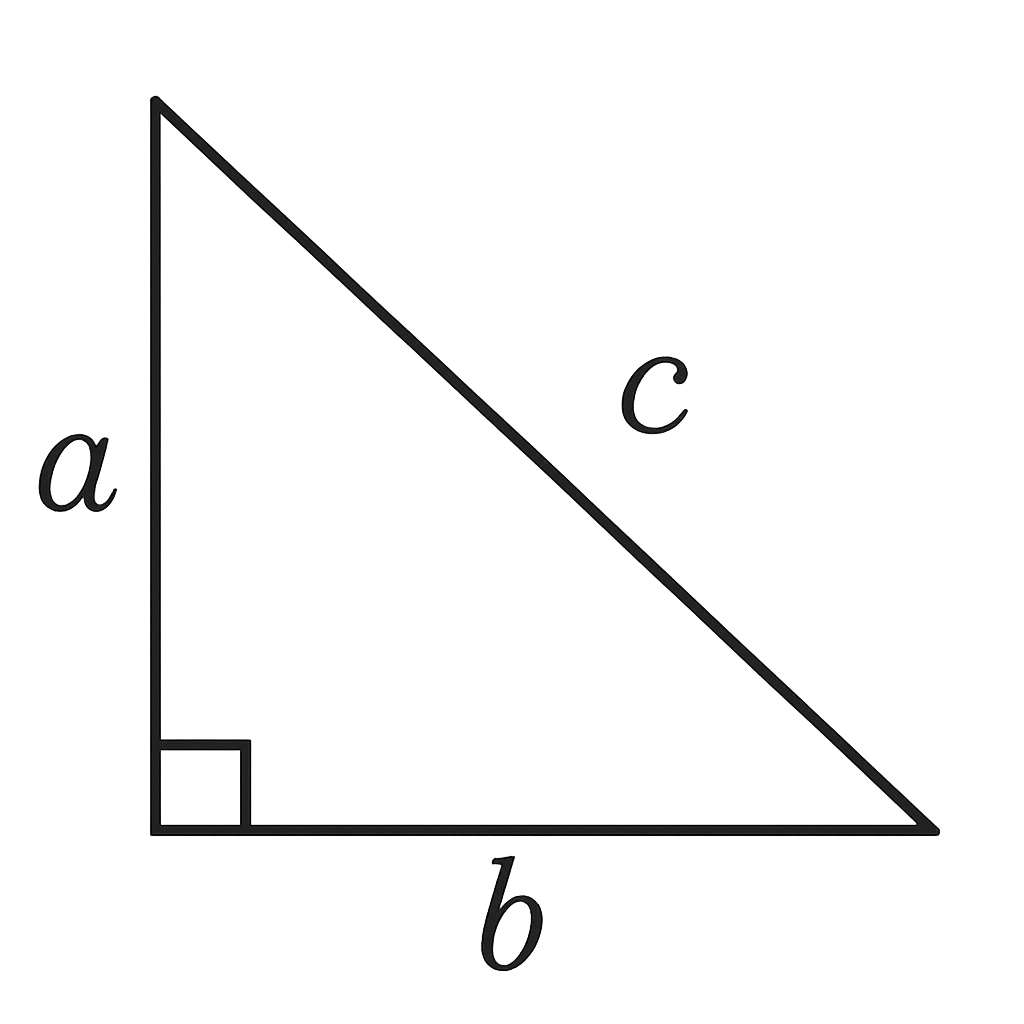
Carefully read the statement below, then write the Pythagoras' Law formula and illustrate a right-angled triangle labeling all sides.
In a right-angled triangle, the area of the square constructed on the hypotenuse is equal to the sum of the areas of the squares constructed on the other two sides.
Formula: ____________________________________________________________
[Image: Draw a right-angled triangle and label the sides as a, b, and c (where c is the hypotenuse)]
Activity 2: True or False
Instructions:
Decide whether each statement is true or false. If false, correct the statement.
- In any triangle, the Pythagoras' Law always applies.
- The hypotenuse is always the longest side in a right-angled triangle.
- If
, the triangle must be right-angled.
- Pythagoras' Law can be used to find the length of a missing side in a right-angled triangle.
Activity 3: Find the Missing Side
Instructions:
Use Pythagoras' Law to find the missing side in each triangle below. Show all your calculations.
- a = 6 cm, b = 8 cm, c = ?
Work:
- a = ?, b = 9 cm, c = 15 cm
Work:
- a = 20 m, b = ?, c = 29 m
Work:
Activity 4: Word Problems
Instructions:
Solve the following real-life problems using Pythagoras' Law. Show all your work and write your answers with correct units.
- A rectangular television screen measures 48 cm in height and 64 cm in width. What is the length of its diagonal?
Work:
- A tree casts a shadow of 12 meters. If the distance from the top of the tree to the end of the shadow is 20 meters, how tall is the tree?
Work:
Activity 5: Pythagorean Triples Investigation
Instructions:
A Pythagorean triple consists of three positive integers a, b, and c, such that
. Find two different sets of Pythagorean triples (other than those used in previous activities) and show your calculations.
Set 1:
a = _____, b = _____, c = _____
Work:
Set 2:
a = _____, b = _____, c = _____
Work:
Activity 6: Create and Solve
Instructions:
Create your own word problem that requires the use of Pythagoras' Law to solve. Write your problem and solve it, showing all your work and the answer.
My problem:
Solution: