Generated with Monsha
Mastering Nouns: Identification, Classification, and Usage
Lesson Plan · CBSE/Saudi Arabia/11/6 · English
Mastering Nouns: Identification, Classification, and Usage
At a Glance
This 90-minute lesson is designed to deepen Grade 6 students' understanding of Nouns within the CBSE and Saudi Arabian educational contexts. Moving beyond basic naming words, students will explore the nuances of noun classification—including common, proper, abstract, concrete, collective, countable, and uncountable nouns. Through collaborative games, visual hierarchy analysis, and creative writing, students will learn to use these grammar building blocks with precision and confidence.
Objectives & Learning Outcomes
By the end of this lesson, students will be able to:
- Define a noun and identify various types within complex sentences.
- Categorize nouns into seven distinct classifications: Common, Proper, Collective, Abstract, Concrete, Countable, and Uncountable.
- Evaluate the difference between abstract and concrete nouns using sensory logic.
- Apply proper capitalization rules for Proper nouns and identify appropriate quantifiers for Countable and Uncountable nouns.
- Construct a short narrative that utilizes at least four different types of nouns correctly.
Standards Addressed
- CBSE English Grammar: Focus on the Parts of Speech—Nouns and their classifications.
- CCSS.ELA-LITERACY.L.6.1: Demonstrate command of the conventions of standard English grammar and usage when writing or speaking.
- Standard English Conventions: Recognize and correct inappropriate shifts in noun usage and capitalization.
Material & Resources Needed
- Interactive Whiteboard or Projector.
- Noun Classification Hierarchy Chart (see below).
- "The Noun Scavenger Hunt" worksheets.
- Set of "Noun Type" flashcards for group activities.
- Digital quiz platform (e.g., Kahoot or Quizizz) or physical mini-whiteboards.
- Colored highlighters (Red, Blue, Green, Yellow).
Key Concepts
Nouns are the foundation of sentences. For Grade 6 mastery, we categorize them as follows:
- Common vs. Proper: Common nouns name general people, places, or things (e.g., city, teacher). Proper nouns name specific entities and always start with a capital letter (e.g., Riyadh, Mr. Ahmed).
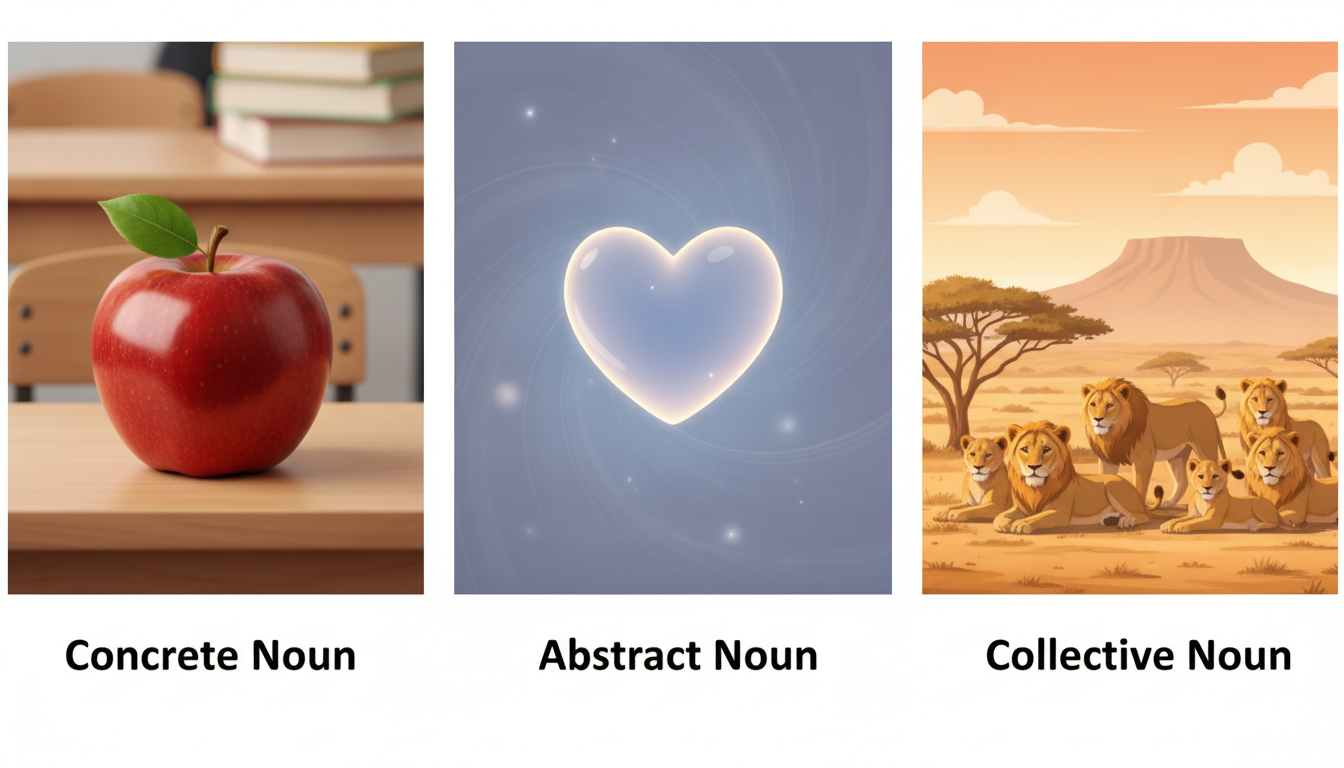
- Concrete vs. Abstract: Concrete nouns are physical things you can see, touch, hear, smell, or taste (e.g., sand, perfume). Abstract nouns are ideas, qualities, or emotions (e.g., bravery, childhood, happiness).
- Collective: Words that refer to a group of people or things as a single unit (e.g., a fleet of ships, a pride of lions, a class of students).
- Countable vs. Uncountable: Countable nouns can be counted and have plural forms (e.g., three books). Uncountable nouns cannot be counted individually and usually don't have plural forms (e.g., milk, air, information).

Instructional Sequence (90 Minutes)
1. The "Noun Detective" Hook (10 Minutes)
- Activity: Give students 2 minutes to list as many items as they can see in the classroom.
- Challenge: Now, ask them to list 3 things they cannot see but know exist in the room (e.g., air, friendship, learning).
- Transition: Explain that the first list contained concrete nouns, and the second contained abstract nouns. Both are essential for communication.
2. Deep Dive: Classification & Usage (25 Minutes)
- Direct Instruction: Use the Noun Classification Hierarchy to explain the relationship between the types.
- Visual Reinforcement: Show visual examples to clarify the abstract vs. collective concepts.
- Discussion: Why do we capitalize "Saudi Arabia" but not "country"? Why is "water" uncountable but "bottles" countable?
3. The Great Noun Sort: Collaborative Activity (25 Minutes)
- Group Work: Divide students into groups of four. Each group receives a bag of 20 word-cards (e.g., courage, school, herd, rice, Nile, happiness).
- Task: Groups must sort the cards into a large Venn diagram or table on chart paper.
- Peer Review: Groups rotate to a different table to check another group's sorting. If they disagree, they leave a "question mark" sticky note.
4. Independent Creative Application (20 Minutes)
- Writing Task: Students write a short paragraph (5–7 sentences) about a "Dream Vacation."
- Constraint: They must include:
- Two Proper nouns (Specific locations).
- One Collective noun (A group they travel with).
- One Abstract noun (A feeling they have).
- One Uncountable noun (Something they eat or drink).
- Coding: After writing, students use highlighters to color-code the specific noun types used.
5. Closure & Review (10 Minutes)
- Game: "Stand Up, Sit Down."
- Teacher says a word: If it's a Proper noun, stand up. If it's Abstract, put hands on head. If it's Collective, clap once.
- Exit Ticket: Write down one sentence that contains both a countable and an uncountable noun.
Assessment and Evaluation Plan
- Formative Assessment: Continuous monitoring during the "Great Noun Sort" to observe group logic and categorization skills.
- Summative Assessment: Grading the "Dream Vacation" paragraph based on the correct usage and coding of the required noun types.
- Peer Evaluation: Feedback provided during the group rotation activity using sticky notes.
Differentiation Strategy
- For Visual/Kinesthetic Learners: The "Stand Up, Sit Down" game and the physical sorting of cards provide movement and visual anchors.
- For Struggling Students: Provide a "Noun Toolkit" reference sheet with 5 examples for each category to use during the writing task.
- For Advanced Learners: Challenge them to identify nouns that can be either countable or uncountable depending on context (e.g., "I have some paper" vs. "I read the papers").
21st Century Skills/College & Career Readiness Skills
- Collaboration: Working in teams to negotiate and agree on noun classifications.
- Critical Thinking: Determining the classification of "edge cases" (like nouns that feel both concrete and abstract).
- Communication: Using precise grammar and vocabulary to convey specific meanings in writing.