Generated with Monsha
Master the Movement: Biomechanics and Technique of the Squat
Anything · Grade 9 · English
Master the Movement: Biomechanics and Technique of the Squat
Master the Movement: The Squat
What Is a Squat?
The squat is a fundamental functional movement that requires coordinated action across the hips, knees, and ankles while maintaining active control and proper skeletal alignment. Whether applied in athletic strength and conditioning or daily functional movement, the overarching objective is to perform the squat with consistent technique, stability, and controlled mechanics throughout the entire range of motion.
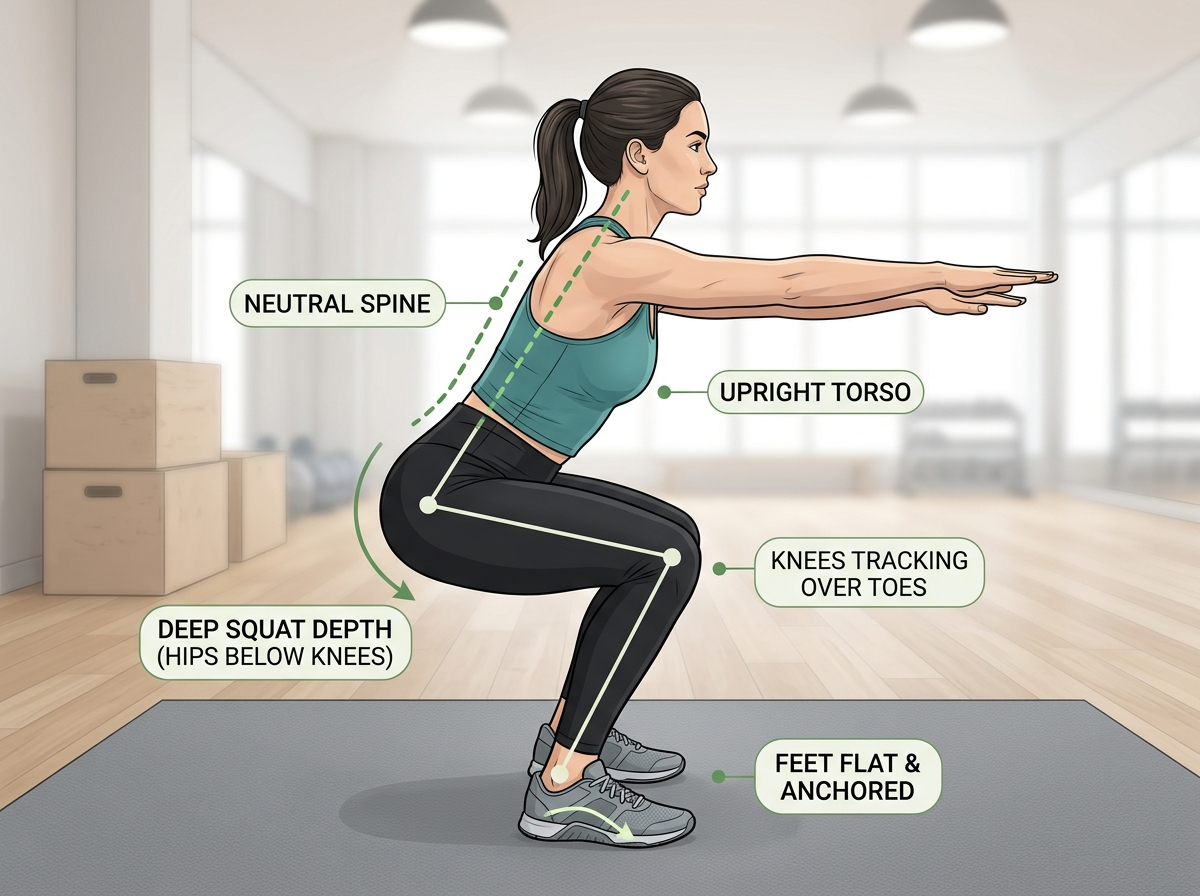
4 Points of Performance
1. Entire Foot in Contact With the Ground 👣
- Set-up & Mechanics: Establish a stance slightly wider than hip-width (approximately shoulder-width), with toes turned slightly outward.
- Execution: Distribute body weight across the entire foot structure throughout the full descent and ascent.
- Key Principle: Never allow the weight to shift completely onto the toes or back exclusively onto the heels. Full-foot engagement serves as the stable base that underpins every subsequent point of performance.
2. Maintain the Lumbar Curve 🧍
- Set-up & Mechanics: Preserve a natural, neutral lordotic curvature in the lumbar spine from starting position to full depth.
- Execution: Brace the trunk muscles to prevent the lumbar spine from rounding into a "C" shape (flexion), especially when reversing direction at the bottom position.
- Key Principle: Focus on maintaining a strong, braced, neutral trunk rather than arching or forcing the spine into unnatural rigidity.
3. Knees Track With Toes 🦵
- Set-up & Mechanics: Align the path of both knees directly over the longitudinal line of the feet throughout the movement.
- Execution: Actively resist knee valgus collapse (inward cave of the knee joint) during both lowering and rising phases.
- Key Principle: The knees must track symmetrically along the same angular line as the toes from start to finish.
4. Hips Descend Below the Knee Joint ⬇️
- Set-up & Mechanics: In a full-depth squat, lower the body until the crease of the hip passes below the top plane of the patella (knee joint).
- Execution: Achieve depth under muscular tension rather than relying on passive joint bottoming.
- Key Principle: Depth should never be prioritized at the expense of sound technique. If attempting greater depth causes heels to lift, the lower back to round, or the knees to collapse inward, correct mechanics must always take precedence over depth.
3 Critical Verbal Cues
Cue | Target Mechanic | Pedagogical Purpose |
|---|---|---|
"Whole foot connected." | Base of support | Reinforces constant three-point contact (heel, 1st metatarsal, 5th metatarsal) with the ground. |
"Knees track your toes." | Frontal plane stability | Prevents medial valgus collapse and protects internal knee ligaments. |
"Control the descent." | Eccentric muscle action | Ensures active deceleration while preserving the 4 primary points of performance. |
Common Faults and Corrections
+-----------------------------------------------------------------------------------------+| FAULT 1: Heels or Toes Lift Off the Floor || Deficit: Weight shifts excessively forward onto the forefoot or backward onto the heel. || Correction: Re-establish three-point contact across the entire foot base. || Coaching Cue: "Whole foot connected." |+-----------------------------------------------------------------------------------------+| FAULT 2: Knees Collapse Inward (Dynamic Valgus) || Deficit: Knees cave medially rather than following the trajectory of the feet. || Correction: Drive knees outward along the vector of the toes during ascent & descent. || Coaching Cue: "Knees track your toes." |+-----------------------------------------------------------------------------------------+| FAULT 3: Lumbar Spine Rounds ("Butt Wink" / Spinal Flexion) || Deficit: The lumbar region collapses into spinal flexion (a rounded "C" posture). || Correction: Reset the core brace and limit depth to active control range. || Coaching Cue: "Maintain a strong, neutral back." |+-----------------------------------------------------------------------------------------+
Biomechanical Analysis
Primary Joint Actions
⬇️ Lowering Phase (Descent)
- Hips: Flexion
- Knees: Flexion
- Ankles: Dorsiflexion
⬆️ Rising Phase (Ascent)
- Hips: Extension
- Knees: Extension
- Ankles: Plantarflexion (returning to neutral)
Plane of Motion
- Sagittal Plane: The squat operates primarily within the sagittal plane, involving forward-and-backward angular motion around coronal axes across the hip, knee, and ankle complexes.
Muscular Physiology & Roles
Primary Agonists (Prime Movers)
- Quadriceps (Rectus Femoris, Vastus Lateralis, Vastus Medialis, Vastus Intermedius): Located on the anterior thigh; primarily responsible for knee extension to drive the body upward during the rising phase.
- Gluteus Maximus: The largest muscle of the posterior hip complex; serves as the primary driver of hip extension when rising to a standing posture.
Synergists & Stabilizers
- Hamstrings (Biceps Femoris, Semitendinosus, Semimembranosus): Assist with hip extension and co-contract at the knee to contribute to lower-extremity joint integrity.
- Core Musculature (Rectus Abdominis, Transverse Abdominis, Obliques, Erector Spinae): Generates intra-abdominal pressure and provides isometric support to keep the spine rigid and neutral.
Functional Muscle Contractions
- Eccentric Contraction (Lowering Phase): The quadriceps, gluteus maximus, and calves lengthen under tension to decelerate the descent and control downward velocity.
- Concentric Contraction (Rising Phase): The primary movers actively shorten while generating force to extend the hip and knee joints back to an upright standing position.
- Isometric Contraction (Stabilization): Core and spinal erector musculature produce continuous tension without altering length, locking the trunk into a stable column.
Performance & Mastery Checklist
Use this rubric to assess technique, analytical understanding, and practical execution:
- Foot Contact: Maintains full-foot connection against the ground throughout the repetition.
- Spinal Alignment: Preserves a neutral lumbar curve without compensatory flexion or hyperextension.
- Knee Path: Knees track synchronously over the line of the toes without valgus deviation.
- Movement Tempo: Demonstrates a controlled eccentric lowering phase.
- Depth Standard: Achieves appropriate depth (hip crease below knee joint) without losing postural alignment.
- Lockout Mechanics: Completes controlled, synchronized hip and knee extension to a standing finish.
- Contraction Recognition: Accurately identifies the eccentric and concentric phases of movement.
- Anatomical Literacy: Correctly names the primary agonists (quadriceps, gluteus maximus) and stabilizers.
- Kinematic Context: Explains how joint movement primarily occurs within the sagittal plane.
- Fault Identification: Diagnoses common movement compensations and applies corrective cues immediately.