Generated with Monsha
Grade 12 English: Architecture and Heritage Vocabulary Worksheet
Worksheet · Grade 12 · English
Grade 12 English: Architecture and Heritage Vocabulary Worksheet
Part 1: Fill-in-the-Gaps
Instructions: Complete the sentences below using the most appropriate word or phrase from the randomized word bank. Ensure each word is used only once.
Word Bank:
- dilapidated
- formerly
- abandoned
- well preserved
- run-down
- fallen into decay
- renovating
- old stables
- ultra-modern
- the ruins
- trace
- After the family moved out and the economy crashed, the factory was __________ at the end of the century.
- The architecture firm is currently __________ the 18th-century manor to restore its original features.
- We found several vintage carriages tucked away in the __________, though they were covered in dust.
- Despite being over two hundred years old, the wooden floorboards were __________ and still gleamed.
- The garden, once the pride of the county, has __________ since the last owner left ten years ago.
- The city council issued a warning that the __________ house on the corner was becoming a structural hazard.
- Tourists often hike up the hill to photograph __________ of a medieval tower that overlooks the valley.
- The local community center is looking pretty __________ and is in desperate need of a fresh coat of paint.
- Historians spent years trying to __________ the history of the estate back to its original royal grant.
- The luxury penthouse features an __________ kitchen equipped with the latest smart-home technology.
Part 2: Multiple Choice & True/False
Instructions: Choose the best answer for the following questions and indicate whether the statements are true or false.
- Which term most accurately describes a building that is in a state of disrepair but could potentially be saved?
- A) Ultra-modern
- B) Well preserved
- C) Dilapidated
- D) Trace
- If a property was formerly owned by a historical figure, what does that imply?
- A) They are the current legal owner.
- B) They will inherit the property in the future.
- C) They were the owner at a previous point in time.
- D) They never actually lived in the property.
- True or False: A "run-down" building is considered to be in peak architectural condition.
- True
- False
- True or False: When a building has "fallen into decay," it means its condition has deteriorated over time due to neglect.
- True
- False
Part 3: Open-Ended & Critical Thinking
- Open-Ended Activity: Imagine you are an urban explorer discovering an "abandoned" building. Write a short paragraph (3-4 sentences) describing what you see. You must use at least three words from the vocabulary list.
- Critical Thinking: Discuss the social and economic impact of replacing "dilapidated" housing in low-income neighborhoods with "ultra-modern" luxury apartments. Consider the concept of gentrification in your response.
- Critical Thinking: Why might a government choose to keep a site as "ruins" rather than "renovating" it into a functional modern space? Use the concept of "tracing history" in your answer.
Part 4: Compare and Contrast
- Visual Comparison: Examine the image below. In the space provided, compare and contrast the physical characteristics of the house in its two different states. Use terms like dilapidated, run-down, renovating, and ultra-modern.
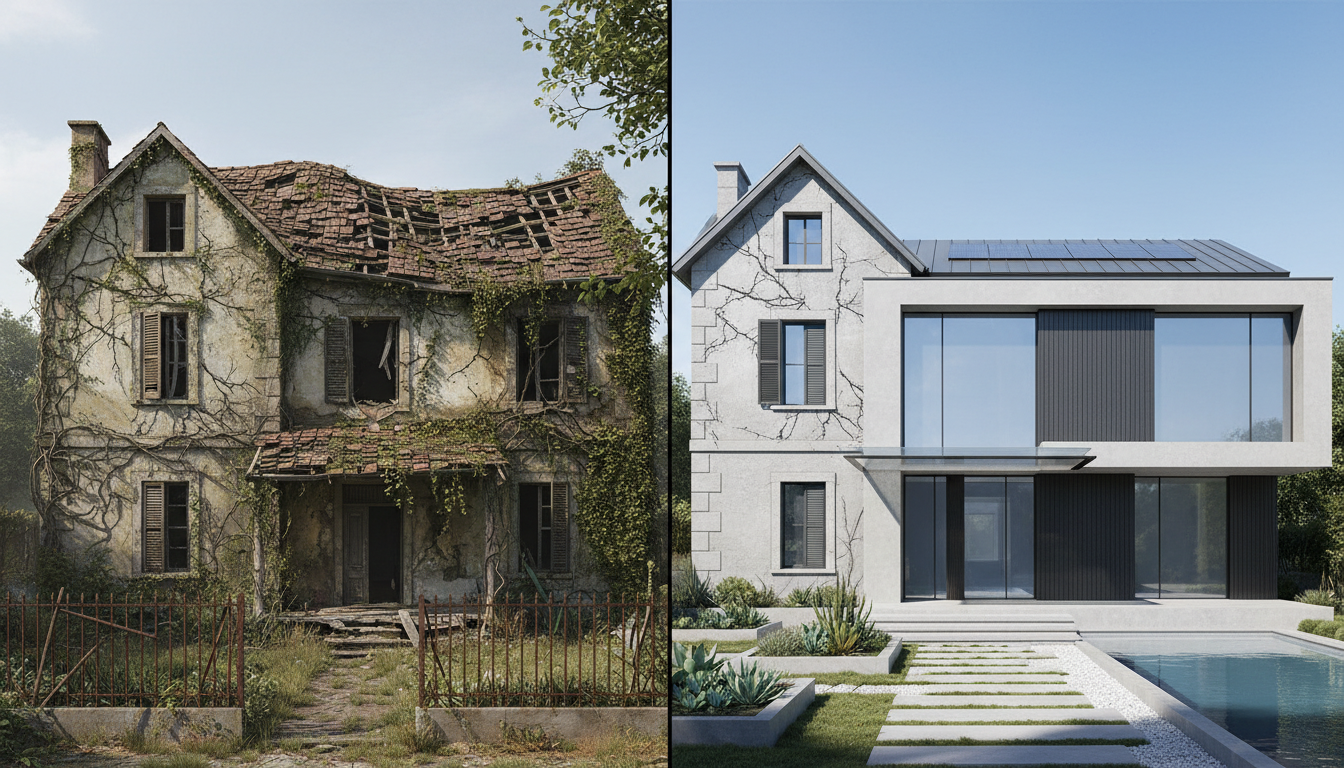
Feature | State A (Left) | State B (Right) |
|---|---|---|
Structural Condition | | |
Aesthetic Style | | |
Landscape/Environment | | |
- Conceptual Comparison: Compare the state of a building that is "well preserved" versus one that has "fallen into decay." How does the level of maintenance affect the way we perceive its historical value?
Part 5: Label the Diagram
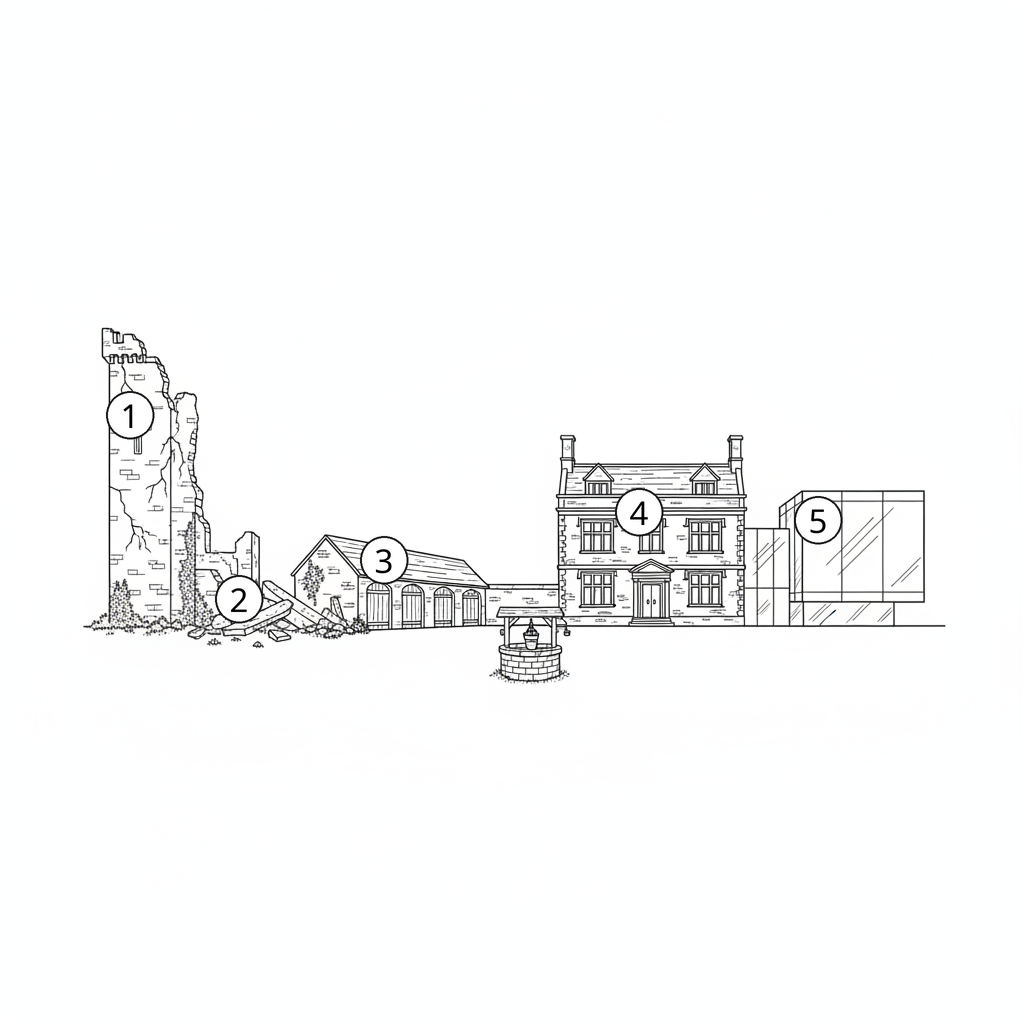
- Instructions: Look at the architectural diagram of the historical estate below. Label the different sections using the terms provided in the word bank based on their visual descriptions.
Labels to use:
- Medieval Tower
- Ruins
- Old Stables
- Well-preserved Manor
- Ultra-modern Extension
-
-
-
-
-