Generated with Monsha
Save this resource to edit, expand, or export it, or create more resources for free.
IGCSE Biology 0610 Topics 1-5 Scheme of Work — Grade 9 Biology (with Practicals & Assessment)
Anything
Grade 9
English
IGCSE Biology 0610 Topics 1-5 Scheme of Work — Grade 9 Biology (with Practicals & Assessment)
Cambridge IGCSE Biology (0610) Scheme of Work: Term 1
This scheme of work covers the first five topics of the Cambridge IGCSE Biology syllabus. It is designed for a 12-week term, integrating Core and Supplement objectives, required practicals, and regular assessment checkpoints.
Week 1: Characteristics and Classification (Part 1)
Syllabus References: 1.1, 1.2
Core Learning Objectives
- Describe the seven characteristics of living organisms (MRS GREN).
- State that organisms can be classified into groups by the features they share.
Supplement Learning Objectives
- Explain that classification systems aim to reflect evolutionary relationships.
- Explain that DNA sequences can be used as a more accurate means of classification.
Suggested Activities:
- MRS GREN Brainstorm: Students identify characteristics in various organisms (plants, animals, fungi).
- Binomial System Practice: Naming exercises using genus and species names.
Homework Suggestion: Research the binomial names of five local species and explain why scientists use this system instead of common names.
Checkpoint Question: Define 'excretion' and distinguish it from 'egestion'.
Week 2: Characteristics and Classification (Part 2)
Syllabus References: 1.3, 1.4
Core Learning Objectives
- State the main features used to place organisms into the five kingdoms.
- Use simple dichotomous keys based on easily identifiable features.
Supplement Learning Objectives
- List the features in the cells of all living organisms: DNA, ribosomes, and enzymes.
- Explain the classification of vertebrates and arthropods based on detailed anatomical features.
Suggested Activities:
- Dichotomous Key Workshop: Students create their own keys to identify a set of leaves or stationary items.
- Microscope Intro: Observe yeast or plant cells to identify basic kingdom features.
Homework Suggestion: Complete a classification table comparing the five classes of vertebrates (Mammals, Birds, Reptiles, Amphibians, Fish).
Checkpoint Question: What are the two main features of an arthropod?
Week 3: Cell Structure and Organisation
Syllabus References: 2.1, 2.3
Core Learning Objectives
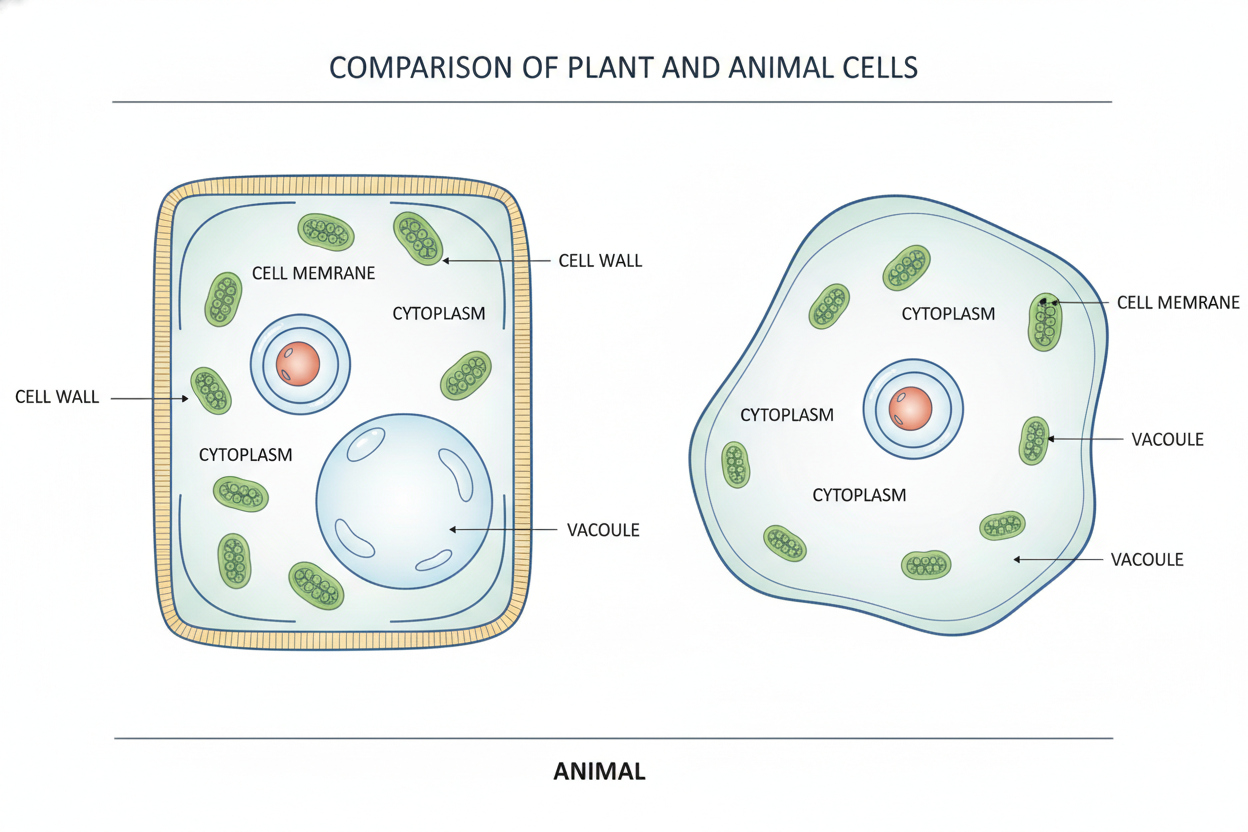
- Identify and describe the structures of a typical animal cell and plant cell (cytoplasm, nucleus, cell membrane, cell wall, chloroplasts, vacuole).
- Calculate magnification using the formula: .
Supplement Learning Objectives
- Identify mitochondria and ribosomes and state their functions.
- Relate the structure of specialized cells (e.g., ciliated cells, root hair cells) to their functions.
Suggested Activities:
- Microscopy Practical: Preparing slides of onion skin (plant) and cheek cells (animal).
- Magnification Calculations: Practice converting between mm and μm for exam-style questions.
Homework Suggestion: Past-paper practice: Solve three calculation questions from Paper 2 (Multiple Choice) regarding cell size.
Checkpoint Question: Which cell organelle is the site of aerobic respiration?
Week 4: Levels of Organisation
Syllabus References: 2.2
Core Learning Objectives
- Define and identify cells, tissues, organs, organ systems, and organisms.
- State that multicellular organisms are organized into these levels.
Supplement Learning Objectives
- Identify specific examples of these levels in the digestive system and transport system of plants.
Suggested Activities:
- Organ System Mapping: Create a flowchart showing the hierarchy from a heart cell to the circulatory system.
- Plant Dissection: Identify tissues (xylem/phloem) in a celery stalk cross-section.
Homework Suggestion: Create a labeled poster showing the levels of organization for a specific plant or animal.
Checkpoint Question: Define a 'tissue' and give one example found in plants.
Week 5: Cell Size and Specialization Review
Syllabus References: 2.1, 2.3
Suggested Activities:
- Specialized Cell Speed Dating: Students act as different specialized cells and explain their adaptations (e.g., sperm cell, red blood cell).
- Mixed Revision: Practice labeling unlabeled diagrams of bacterial cells and compare them to eukaryotic cells.
Homework Suggestion: Complete a Paper 4 (Extended Theory) style question on the adaptations of root hair cells and xylem vessels.
Checkpoint Question: Why do bacterial cells lack a nucleus?
Week 6: Movement In/Out of Cells - Diffusion
Syllabus References: 3.1
Core Learning Objectives
- Describe diffusion as the net movement of particles from high to low concentration.
- State that energy for diffusion comes from the kinetic energy of random movement.
Supplement Learning Objectives
- Explain the factors that influence the rate of diffusion: surface area, temperature, concentration gradient, and distance.
Suggested Activities:
- Diffusion in Agar Blocks: Use phenolphthalein agar blocks of different sizes in acid to demonstrate the effect of surface area-to-volume ratio.
- Potassium Permanganate Demo: Observe diffusion in a beaker of water.
Homework Suggestion: Write a lab report conclusion for the agar block experiment, relating results to the needs of larger organisms.
Checkpoint Question: List three factors that increase the rate of diffusion.
Week 7: Movement In/Out of Cells - Osmosis
Syllabus References: 3.2
Required Practical: Osmosis with Plant Tissue
Core Learning Objectives
- Describe osmosis as the diffusion of water through a partially permeable membrane.
- Understand the effects of osmosis on plant and animal tissues.
Supplement Learning Objectives
- Explain the importance of water potential and its effect on turgor pressure, plasmolysis, and lysis.
Suggested Activities:
- Potato Osmosis Lab: Measuring mass/length changes of potato cylinders in varying concentrations of sucrose solution.
- Dialysis Tubing Demo: Modeling a cell membrane.
Homework Suggestion: Graph the results from the potato experiment and determine the sucrose concentration equivalent to the cell sap (where change in mass = 0).
Checkpoint Question: What happens to a plant cell when placed in a concentrated salt solution? Use the term 'plasmolysis'.
Week 8: Active Transport
Syllabus References: 3.3
Core Learning Objectives
- Define active transport as movement of particles against a concentration gradient using energy from respiration.
Supplement Learning Objectives
- Explain how protein carriers move molecules across membranes.
- Discuss importance in ion uptake by root hairs and glucose uptake by the villi.
Suggested Activities:
- Active vs Passive Roleplay: Students act as molecules and carrier proteins (requiring 'ATP' tokens to move).
- Case Study: Investigate why mineral ions need active transport in plant roots.
Homework Suggestion: Compare and contrast Diffusion, Osmosis, and Active Transport in a Venn diagram.
Checkpoint Question: Why does active transport require mitochondria in the cell?
Week 9: Biological Molecules (Part 1)
Syllabus References: 4.1
Core Learning Objectives
- List the chemical elements that make up carbohydrates, fats, and proteins.
- State that large molecules are made from smaller basic units (e.g., glucose to starch/glycogen).
Supplement Learning Objectives
- Describe the structure of DNA: two strands coiled to form a double helix, linked by bases (A, T, C, G).
Suggested Activities:
- Molecule Building: Use molecular modeling kits to build glucose and simple amino acids.
- DNA Extraction: Extract DNA from strawberries or kiwi fruit.
Homework Suggestion: Memorize the pairings for DNA bases and the subunits for the three main biological molecules.
Checkpoint Question: What are the basic units that make up proteins?
Week 10: Biological Molecules (Part 2)
Syllabus References: 4.1
Required Practical: Food Tests
Suggested Activities:
- Food Test Circuit: Testing unknown food samples for starch (Iodine), reducing sugars (Benedict's), protein (Biuret), and fats (Ethanol emulsion).
- Vitamin C Titration: (Optional Supplement) Use DCPIP to test Vitamin C content in juices.
Homework Suggestion: Complete a results table for the food tests and identify which reagents require heat.
Checkpoint Question: Describe the positive result for the Benedict's test.
Week 11: Enzymes (Part 1)
Syllabus References: 5.1
Core Learning Objectives
- Define enzymes as biological catalysts.
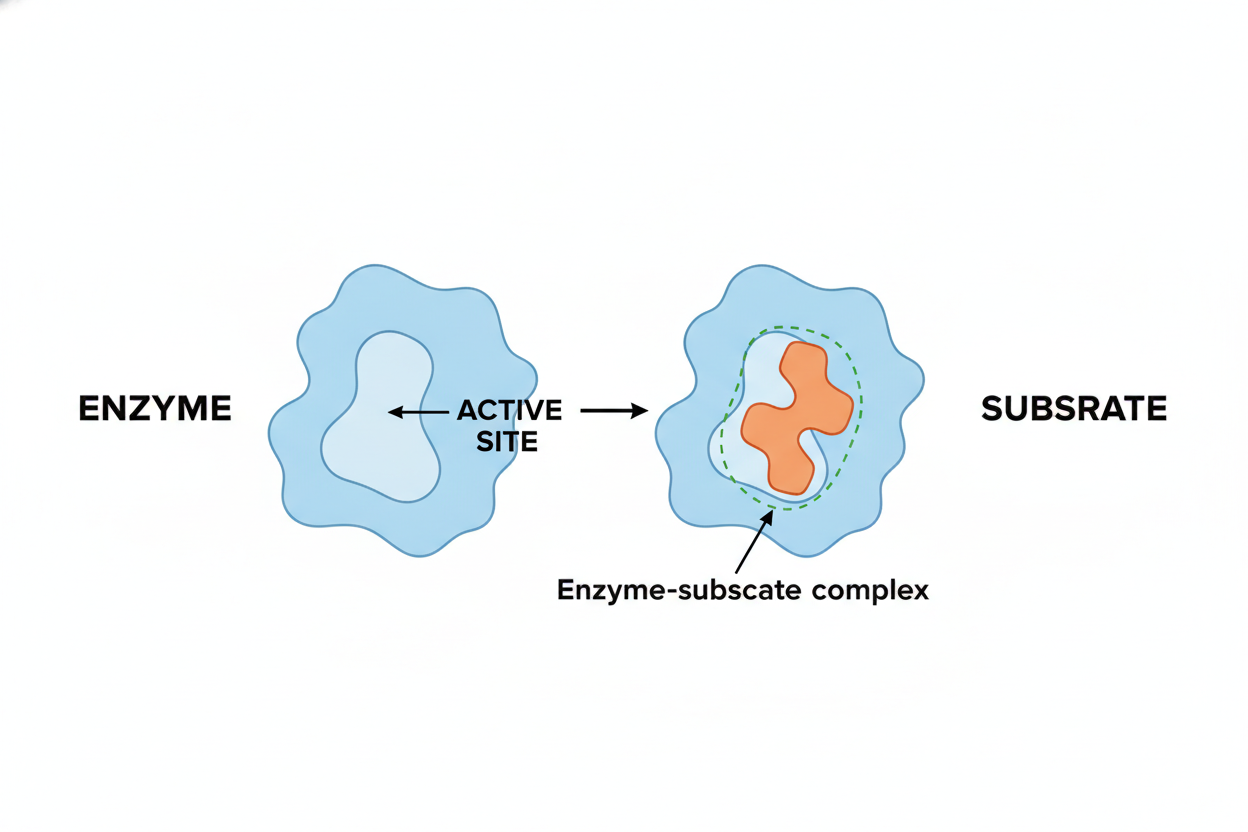
- Explain enzyme action in terms of the lock-and-key hypothesis.
Supplement Learning Objectives
- Explain how enzymes are proteins that are specific to substrates because of the shape of the active site.
Suggested Activities:
- Enzyme Modeling: Use cardboard cutouts to demonstrate substrate binding to the active site.
- Amylase Action: Simple iodine test to show the disappearance of starch in the presence of saliva/amylase.
Homework Suggestion: Explain why a denatured enzyme can no longer catalyze a reaction.
Checkpoint Question: Define the term 'catalyst'.
Week 12: Enzymes (Part 2)
Syllabus References: 5.1
Required Practical: Factors Affecting Enzymes
Suggested Activities:
- Temperature/pH Investigation: Investigate the effect of temperature or pH on the rate of oxygen production by catalase (using potato or yeast).
- Data Analysis: Interpreting enzyme rate-of-reaction graphs.
Homework Suggestion: Past-paper practice: Complete an 'Alternative to Practical' (Paper 6) question on an enzyme experiment.
Checkpoint Question: What is the 'optimum' temperature for an enzyme?
Term Assessment Week Plan
This week is dedicated to a formal summative assessment covering Topics 1–5. The assessment should follow IGCSE paper formats (Paper 2 Multiple Choice and Paper 4 Theory).
Question Mapping Table
Assessment Component | Syllabus Point | Topic Area | Question Type |
|---|---|---|---|
Section A | 1.1 - 1.4 | Characteristics & Classification | Multiple Choice (Recall) |
Section A | 2.1, 2.3 | Cell Structure & Magnification | Diagram Labeling / Calculation |
Section B | 3.2 | Osmosis (Potato Practical) | Data Analysis / Description |
Section B | 4.1 | Food Tests | Practical Procedures (Paper 6 style) |
Section C | 5.1 | Enzyme Action & Denaturation | Extended Prose (Supplement) |
Section C | 3.3 | Active Transport | Comparison with Diffusion |
Assessment Strategy:
- Revision (Lessons 1-2): Targeted past-paper practice focusing on common errors in magnification and osmosis definitions.
- The Exam (Lesson 3): 45-minute structured paper.
- Feedback (Lesson 4): Review mark scheme and identify 'Supplement' level requirements for high-tier grades.