Generated with Monsha
Save this resource to edit, expand, or export it, or create more resources for free.
Introduction to Economics: Key Vocabulary and Concepts
Worksheet
Grade 10
English
Introduction to Economics: Key Vocabulary and Concepts
Economics Fundamentals Worksheet
Name: ________________________________________
Date: ____________________
Class: Grade 10 Economics
Activity 1: Matching Concepts
Instructions: In the column on the left, you will find six key economic terms. In the column on the right, you will find their definitions. Write the correct letter of the definition in the space provided next to each term.
Term | Answer | Definition |
|---|---|---|
1. Scarcity | _______ | A. The quantity of a product that producers are willing and able to offer at various prices. |
2. Demand | _______ | B. A general increase in prices and a fall in the purchasing value of money. |
3. Supply | _______ | C. The condition where human wants are unlimited but resources are limited. |
4. Market Equilibrium | _______ | D. The cost of the next best alternative foregone when making a choice. |
5. Inflation | _______ | E. The point where the quantity demanded by consumers equals the quantity supplied by producers. |
6. Opportunity Cost | _______ | F. The quantity of a good or service that consumers are willing and able to buy at various prices. |
Activity 2: Multiple Choice Scenarios
Instructions: Read each scenario or question carefully and circle the letter of the most appropriate answer.
1. You have $20 to spend. You can either buy a new video game skin or a ticket to a movie. If you choose the video game skin, what is the movie ticket in economic terms?
A. A fixed cost
B. An opportunity cost
C. A scarcity tax
D. A market equilibrium
2. If the price of strawberries increases significantly, many consumers will likely buy fewer strawberries and switch to blueberries. This behavior is a direct illustration of which concept?
A. The Law of Supply
B. Inflation
C. The Law of Demand
D. Scarcity
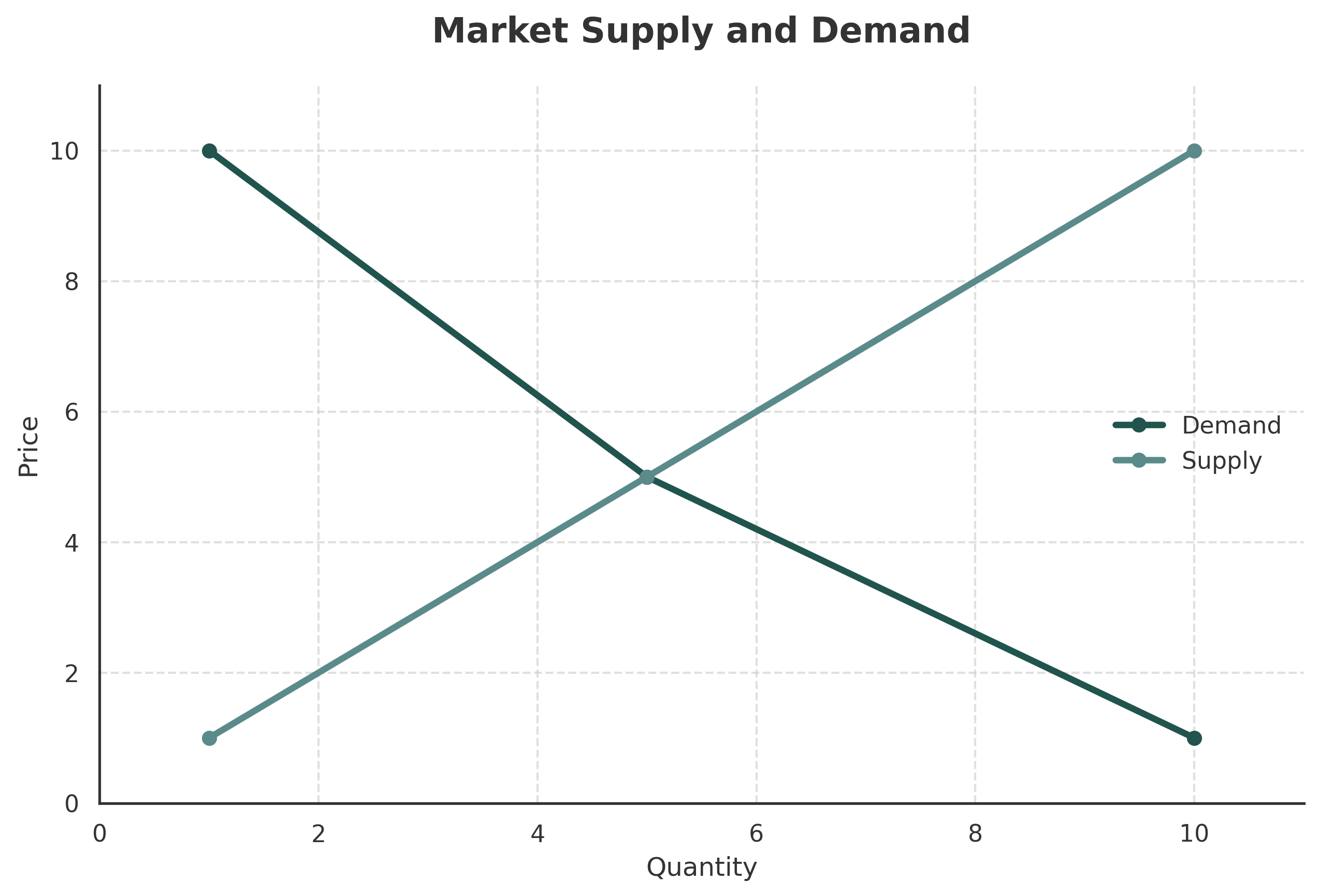
3. Look at the chart below representing a market for solar panels. What does the intersection point of the two lines represent?
A. The shortage point
B. The maximum supply
0. Market equilibrium
D. The inflation rate
4. Imagine you are a baker. If the cost of flour decreases, allowing you to produce more bread at the same price, which economic principle is shifting?
A. Demand
B. Supply
C. Scarcity
D. Opportunity Cost
5. Last year, a loaf of bread cost $2.00. This year, the same loaf of bread costs $2.50, and your $10 bill can buy less than it used to. This is an example of:
A. Equilibrium
B. Supply
C. Inflation
D. Demand
Activity 3: Fill-in-the-Gaps
Instructions: Use the words from the randomized word bank to complete the sentences below. Each word is used only once. Write your answers clearly in the blanks provided.
Word Bank: Market Equilibrium | Opportunity Cost | Supply | Inflation | Scarcity | Demand
1. Because of ________________________, people and societies must make choices about how to use their limited resources.
2. When the price of a popular sneaker drops, the ________________________ for that sneaker typically increases among teenagers.
3. A local farm produces 500 gallons of milk every week; this quantity represents the farm's ________________________.
4. When you decide to study for an hour instead of sleeping, the hour of sleep you missed is your ________________________.
5. Economists watch the ________________________ rate to see how quickly the cost of living is rising for the average family.
6. In a perfect market, the price will naturally move toward ________________________, where there is no surplus or shortage of goods.