Generated with Monsha
Save this resource to edit, expand, or export it, or create more resources for free.
The Quantum Mechanical Model: From Orbits to Probability
Lesson Plan
9
English
The Quantum Mechanical Model: From Orbits to Probability
Lesson Plan: The Quantum Mechanical Model of the Atom
Grade Level: 9
Subject: Science / Chemistry
Duration: 60 Minutes
1. Lesson Objectives
By the end of this lesson, students will be able to:
- Contrast the Bohr model (fixed orbits) with the Quantum Mechanical Model (probability clouds) of the atom.
- Describe the concept of an electron cloud and identify the basic shapes of atomic orbitals (and).
- Understand the concept of probability in locating electrons, explaining that we cannot know an electron's exact location and momentum simultaneously (Heisenberg Uncertainty Principle).
2. Materials & Setup
- Visual Aids: High-resolution diagram of the Quantum Mechanical Model (provided below).
- PhET Simulation: Models of the Hydrogen Atom .
- Hands-on Props: Target sheets (paper with a bullseye), felt-tip markers (one per group).
- Demonstration Tools: A ceiling fan or a portable desk fan.
- Technology: Projector and internet access for the video and simulation.
3. Hook / Anticipatory Set (7 Minutes)
The Spinning Fan Mystery
- Show students a portable fan that is turned off. Ask: "Where are the blades right now?" (Students can point to specific locations).
- Turn the fan on to its highest speed. Ask: "Where are the blades now? Can you point to the exact location of a single blade at this moment?"
- Discussion: Students will realize they see a "blur" or a "cloud" where the blades are likely to be, even though they can't see the exact position of one blade at any given time.
- Bridge: Explain that electrons are like the fan blades. In the Bohr model, we thought they moved in tracks like trains. In the Quantum Mechanical Model, they move so fast and so strangely that we only see a "cloud" of where they might be. This is the Quantum Mechanical Model.
4. Direct Instruction / Concept Explanation (20 Minutes)
Transition from Bohr to Quantum
- Erwin Schrödinger: Introduce Schrödinger as the scientist who used complex math to treat electrons as waves rather than just particles.
- Probability vs. Certainty: Explain that we don't know the exact path. Instead, we calculate the probability of finding an electron in a certain volume of space.
- Atomic Orbitals: Define an orbital as a region of space where there is a 90% probability of finding an electron.
- orbitals: Spherical shaped (like a ball).
- orbitals: Dumbbell shaped (like two balloons tied together).
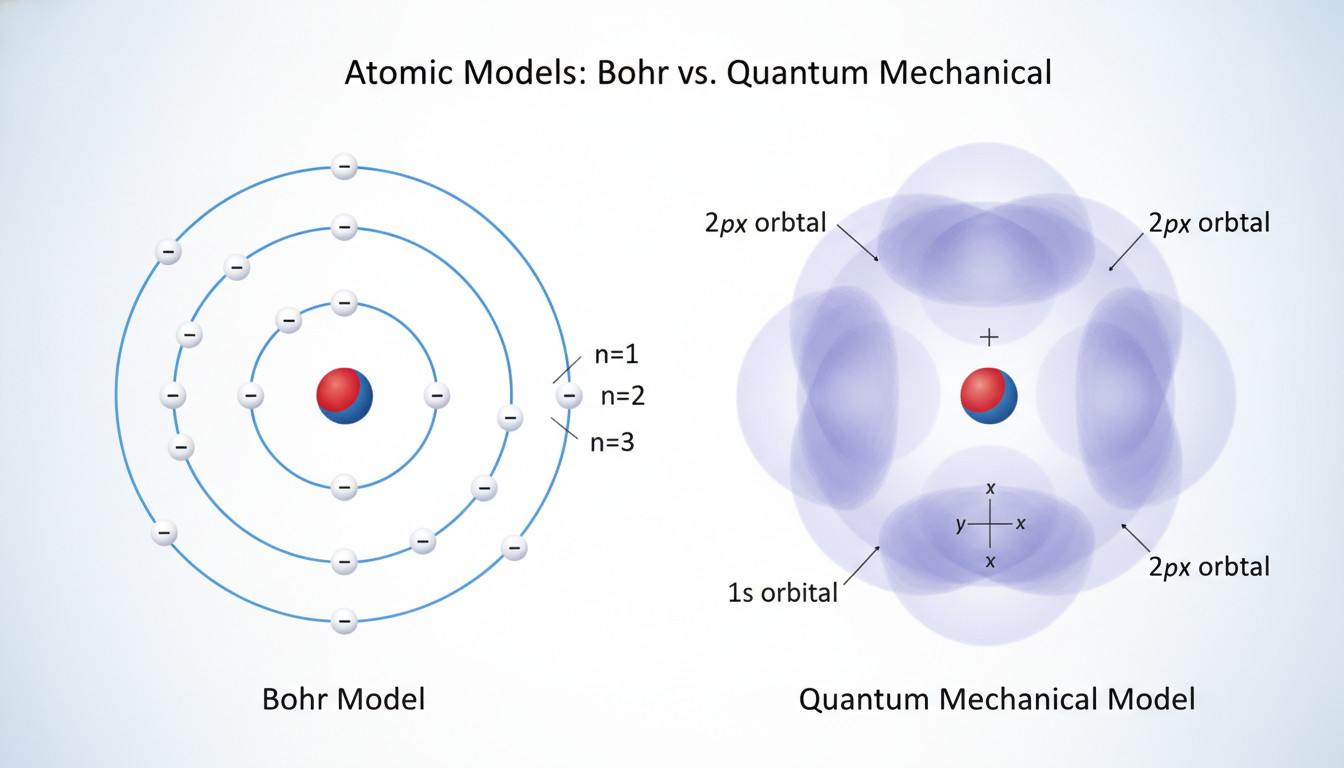
Comparison Table: Bohr vs. Quantum
Feature | Bohr Model (Planetary) | Quantum Mechanical Model |
|---|---|---|
Electron Path | Fixed, circular orbits | No fixed path (3D regions) |
Location | Exact position is known | Only the probability is known |
Representation | Rings around the nucleus | Electron "clouds" or orbitals |
Key Concept | Energy levels ( ) | Energy levels + Subshells ( ) |
Analogy: The Beehive
Explain that the nucleus is like a beehive, and the electrons are like bees buzzing around it. You can't predict the path of one bee, but you can see a "cloud" of bees where they spend most of their time near the hive.
5. Guided Practice / Interactive Activity (15 Minutes)
The "Target Probability" Activity
- Setup: Divide students into groups of 3. Give each group a paper with a bullseye (the "nucleus") in the center.
- Task: One student holds a marker 30cm above the target. Closing their eyes (or looking up), they try to tap the marker on the paper 50 times as quickly as possible, aiming for the center but not perfectly.
- Observation: Look at the resulting dots.
- Where are most dots located? (Usually near the center).
- Are there dots further away? (Yes).
- Analysis: Explain that the collection of dots represents an electron cloud. We can't say where one specific "tap" will land, but we can see a clear region of high electron density near the center.
6. Independent Practice (10 Minutes)
Checking for Understanding
- Which of the following best describes an "orbital" in the Quantum Mechanical Model?
- A) A circular track that electrons follow like planets.
- B) A 3D region of space where an electron is likely to be found.
- C) A solid shell that protects the nucleus.
- D) The path an electron takes when it moves between atoms.
- How does the Quantum Mechanical Model differ from the Bohr model regarding the location of an electron?
- A) It says electrons are inside the nucleus.
- B) It says electrons do not move at all.
- C) It replaces certain orbits with areas of probability.
- D) It claims electrons have no mass.
- Short Answer: Using the "fan blade" analogy from earlier, explain why we use the term "electron cloud" instead of "electron orbit."
- Drawing: Sketch a simple representation of an orbital and aorbital. Label the nucleus in your drawing.
7. Closure & Exit Ticket (5 Minutes)
Wrap-up: Summarize that the atom is much more "fuzzy" and mathematical than earlier models suggested.
Exit Ticket Prompt:
"In your own words, why can't scientists predict the exact location of an electron? Mention one thing you learned today about the shape of an electron's home (the orbital)."
8. Accommodations / Differentiation
- For ELL Students: Use the "Beehive" and "Fan" visual analogies extensively. Provide a vocabulary scaffold with images for terms like "Spherical" and "Dumbbell."
- For Visual Learners: Use the PhET simulation to let them see the "cloud" form in real-time as they switch between models. Highlight the color-coding in diagrams to distinguish between different orbitals.
- For Struggling Learners: Focus on the "90% probability" concept by comparing it to their own habits (e.g., "There is a 90% probability you are in this classroom right now, but you could be in the hallway").