Generated with Monsha
Grade 12 Biology: The Eukaryotic Cell Cycle and Mitosis
Anything · Grade 12 · English
Grade 12 Biology: The Eukaryotic Cell Cycle and Mitosis
Mitosis is a fundamental biological process that ensures genetic continuity within an organism. In multicellular eukaryotes, mitosis is the mechanism by which a single-celled zygote grows into a complex organism and how damaged tissues are repaired throughout life. At the Grade 12 level, understanding mitosis requires a deep dive into the regulatory mechanisms that control the timing and accuracy of cell division.
1. The Eukaryotic Cell Cycle
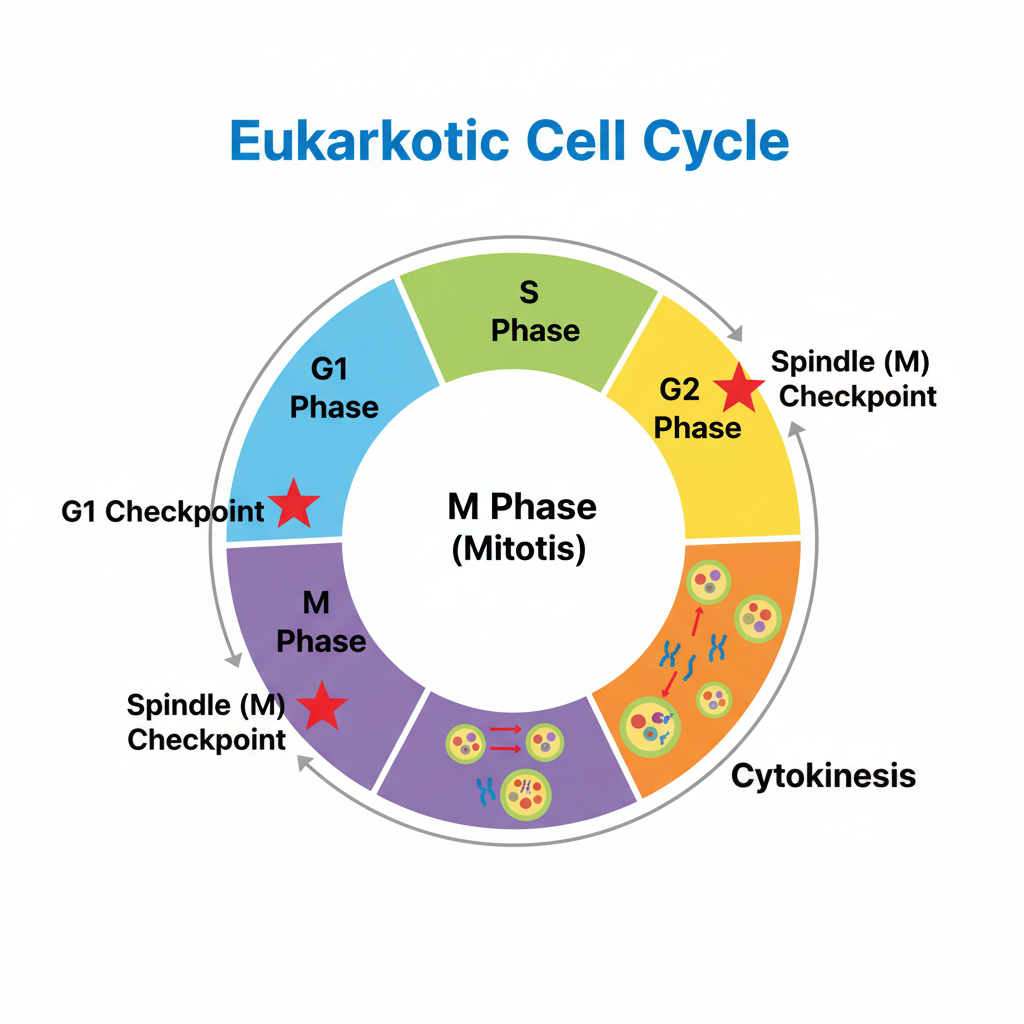
The cell cycle is an ordered series of events involving cell growth and division that produces two new daughter cells. It is broadly divided into two main periods: Interphase and the Mitotic (M) Phase.
Interphase: Preparation for Division
Interphase accounts for approximately 90% of the cell's life cycle. During this time, the cell grows, performs its specialized functions, and replicates its DNA. It is divided into three sub-phases:
- Phase (First Gap): The cell is metabolically active, synthesizing proteins and growing in size. It monitors its environment to ensure conditions are favorable for DNA replication.
- Phase (Synthesis): The cell replicates its entire genome. Each chromosome is duplicated to form two identical sister chromatids joined at a centromere. The centrosome is also duplicated.
- Phase (Second Gap): Further growth occurs as the cell prepares for division. Enzymes and proteins necessary for mitosis are synthesized, and the cell checks for DNA replication errors.
2. The Stages of Mitosis (M Phase)
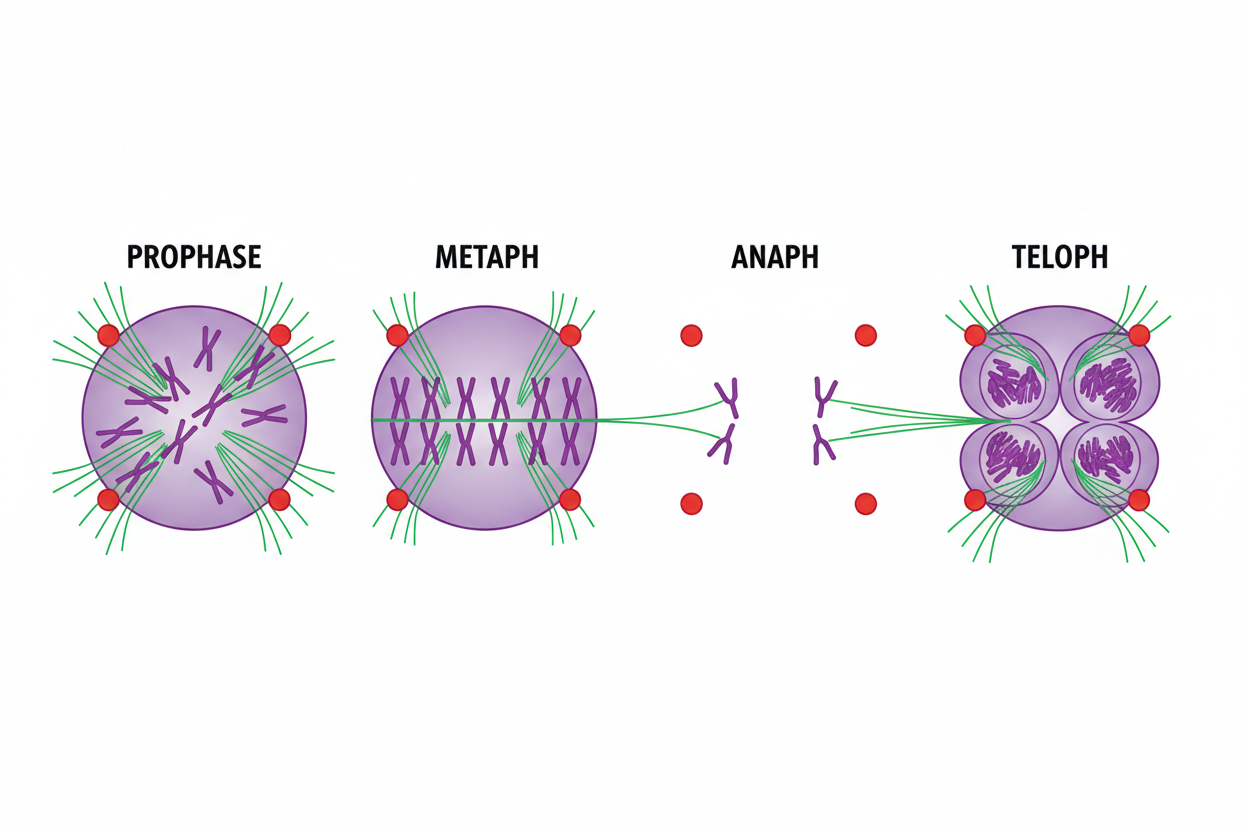
Mitosis is the division of the cell nucleus. It is a continuous process but is typically described in four distinct stages to highlight key chromosomal movements.
Prophase
During prophase, the loosely packed chromatin fibers condense into visible chromosomes. Each chromosome consists of two sister chromatids. The nucleolus disappears, and the mitotic spindle (composed of microtubules) begins to form between the two centrosomes as they move toward opposite poles of the cell.
Metaphase
The centrosomes reach opposite poles, and the chromosomes align along the metaphase plate, an imaginary line equidistant from the two poles. Spindle fibers attach to the kinetochores—protein structures located at the centromeres of each sister chromatid.
Anaphase
The shortest stage of mitosis. The cohesin proteins holding the sister chromatids together are cleaved. Once separated, each chromatid becomes an independent chromosome. These daughter chromosomes are pulled toward opposite poles by the shortening of the kinetochore microtubules.
Telophase
Two daughter nuclei form at the opposite poles of the cell. Nuclear envelopes reform around the sets of chromosomes, which begin to de-condense back into chromatin. The nucleoli reappear, and the spindle apparatus is dismantled.
3. Cytokinesis: Dividing the Cytoplasm
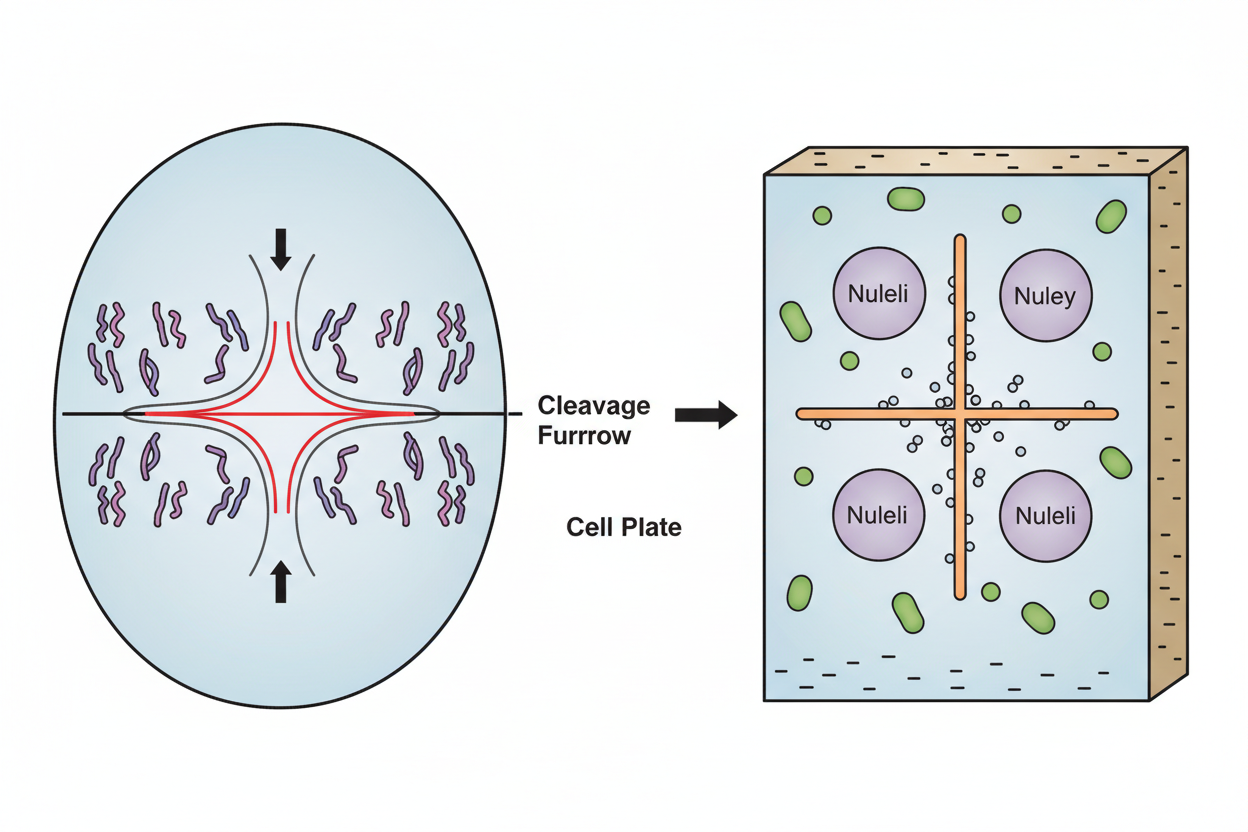
Cytokinesis usually overlaps with the final stages of mitosis and involves the physical division of the cytoplasm and organelles into two daughter cells.
- In Animal Cells: A contractile ring of actin microfilaments forms just inside the plasma membrane. It contracts to create a cleavage furrow, which pinches the cell in two like a drawstring.
- In Plant Cells: Because plants have rigid cell walls, they cannot form a cleavage furrow. Instead, vesicles from the Golgi apparatus align in the center of the cell and fuse to form a cell plate. This plate grows outward until it fuses with the existing cell wall, creating two separate cells.
4. Regulation of the Cell Cycle
To prevent uncontrolled cell growth (cancer), the cell cycle is governed by a complex molecular control system. This system relies on checkpoints that act as stop-and-go signals.
- Checkpoint: Often called the "restriction point." If the cell receives a go-ahead signal, it proceeds to thephase. If not, it may enter a non-dividing state called(common in mature nerve and muscle cells).
- Checkpoint: Ensures that DNA replication in thephase was completed correctly and the DNA is undamaged before entering mitosis.
- M Checkpoint (Spindle Checkpoint): Occurs during metaphase to ensure all chromosomes are properly attached to spindle fibers. This prevents unequal distribution of chromosomes (aneuploidy) in daughter cells.
The Molecular Basis of Control
The timing of the cell cycle is controlled by two types of proteins:
- Cyclins: Proteins whose concentrations rise and fall at specific times during the cycle.
- Cyclin-Dependent Kinases (CDKs): Enzymes that are always present but only become active when bound to a specific cyclin.
A key example is the MPF (Maturation-Promoting Factor), a cyclin-CDK complex that triggers the transition from
to the M phase.5. Summary of Significance
Significance | Description |
|---|---|
Growth | Allows multicellular organisms to increase in size by adding more cells. |
Tissue Repair | Replaces damaged or dead cells in skin, blood, and the digestive lining. |
Genetic Stability | Ensures every somatic cell contains the identical diploid number of chromosomes (e.g., 46 in humans). |
Asexual Reproduction | Enables some organisms to produce offspring that are genetically identical to the parent. |