Generated with Monsha
Save this resource to edit, expand, or export it, or create more resources for free.
Trigonometry: Angles of Elevation and Depression
Lesson Plan
Year 10
English
Trigonometry: Angles of Elevation and Depression
Objectives & Learning Outcomes
By the end of this lesson, students will be able to:
- Define the concepts of the angle of elevation and the angle of depression.
- Identify these angles in various real-world scenarios.
- Calculate unknown heights and distances using trigonometric ratios (Sine, Cosine, and Tangent) in contexts involving angles of elevation and depression.
- Interpret and solve multi-step word problems by drawing accurate right-angled triangle diagrams.
Standards Addressed
GCSE Mathematics (UK Year 10):
- G20: Know the formulae for: Pythagoras’ theorem , and the trigonometric ratios; apply them to find angles and lengths in right-angled triangles in two-dimensional figures.
- G21: Know the exact values of andfor; know the exact value offor.
Material & Resources Needed
- Scientific calculators (Casio or similar).
- Rulers and protractors.
- Multi-link cubes or "clinometers" (optional for practical activity).
- Handout with practice problems.
- Visual aids (diagrams and real-world images).
Key Concepts
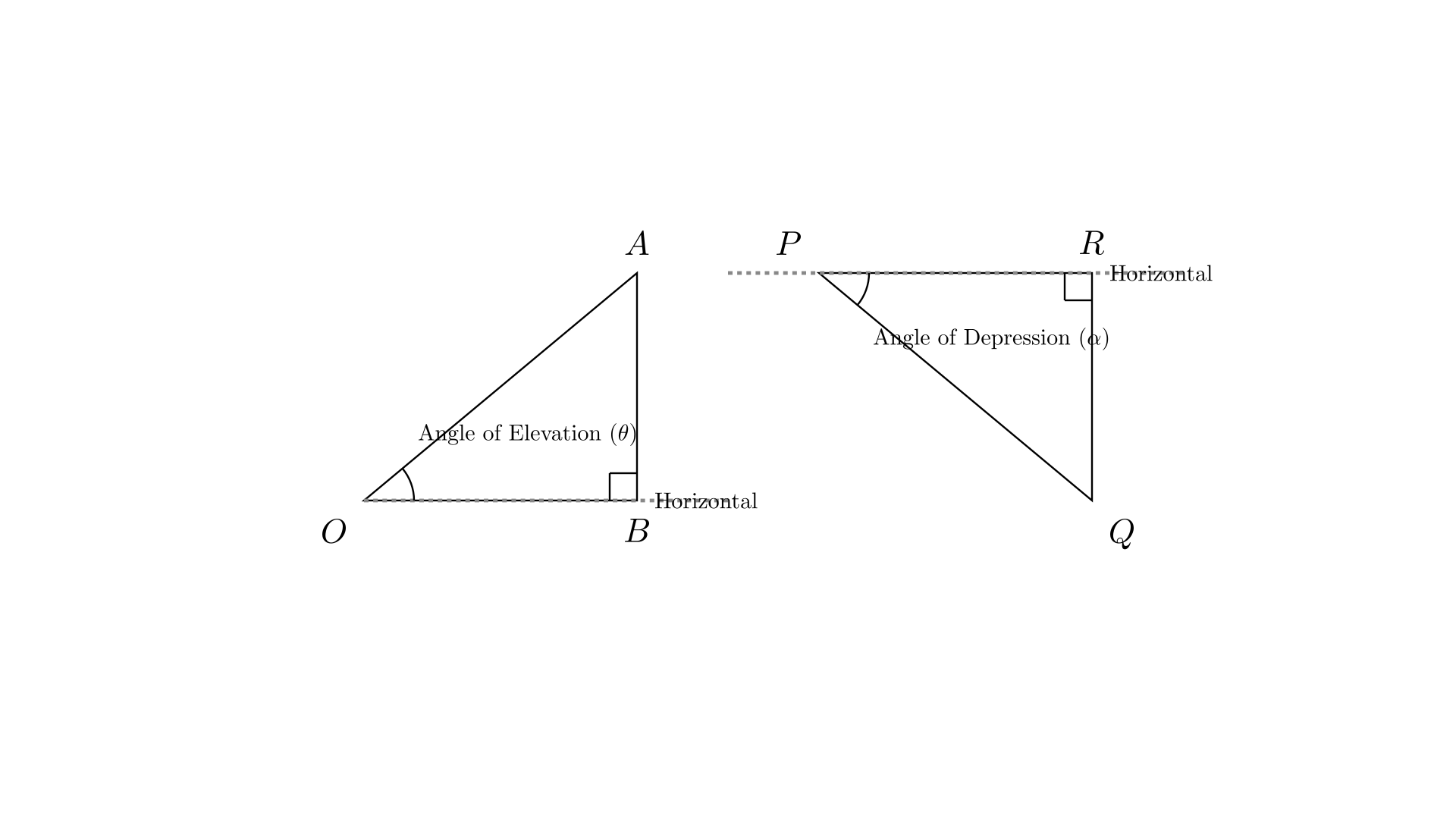
- Line of Sight: The imaginary line from an observer's eye to the object being viewed.
- Horizontal Line: A line parallel to the horizon or ground level starting from the observer's eye.
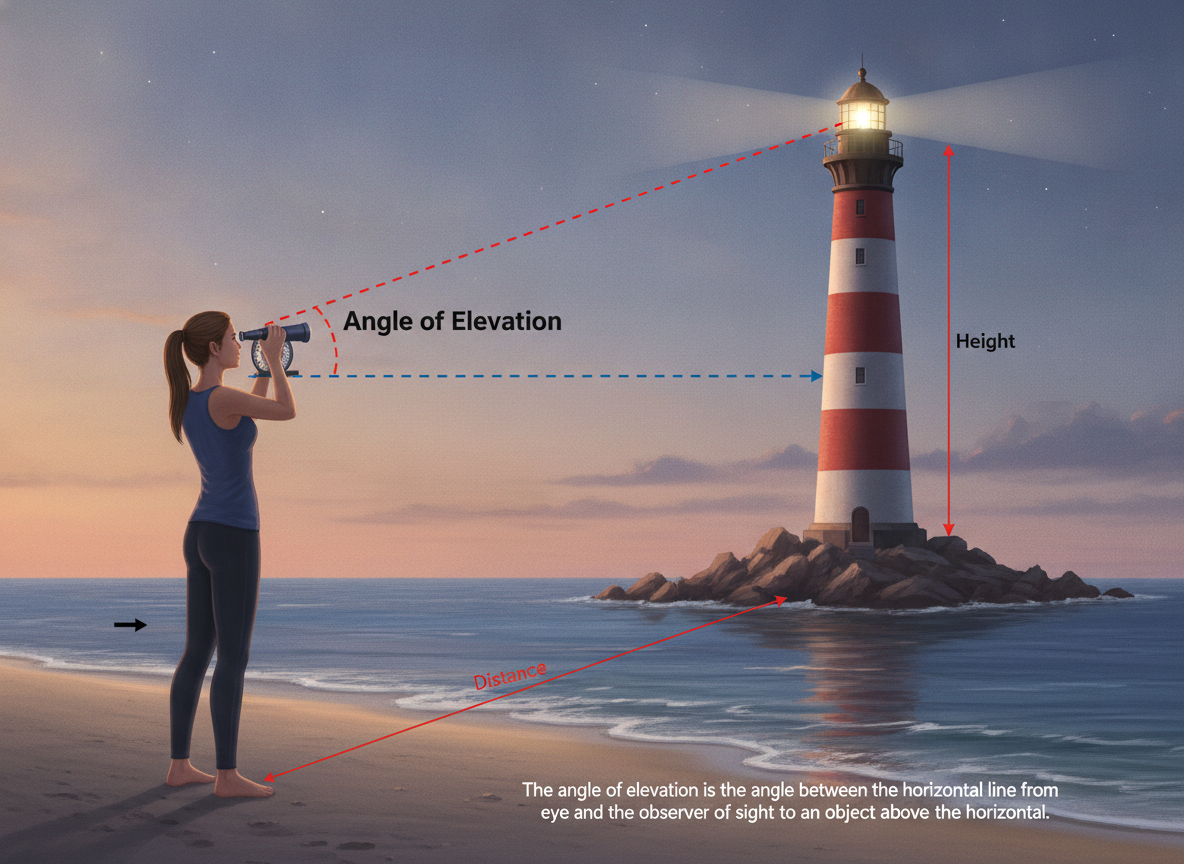
- Angle of Elevation: The angle formed between the horizontal line and the line of sight when looking up at an object.
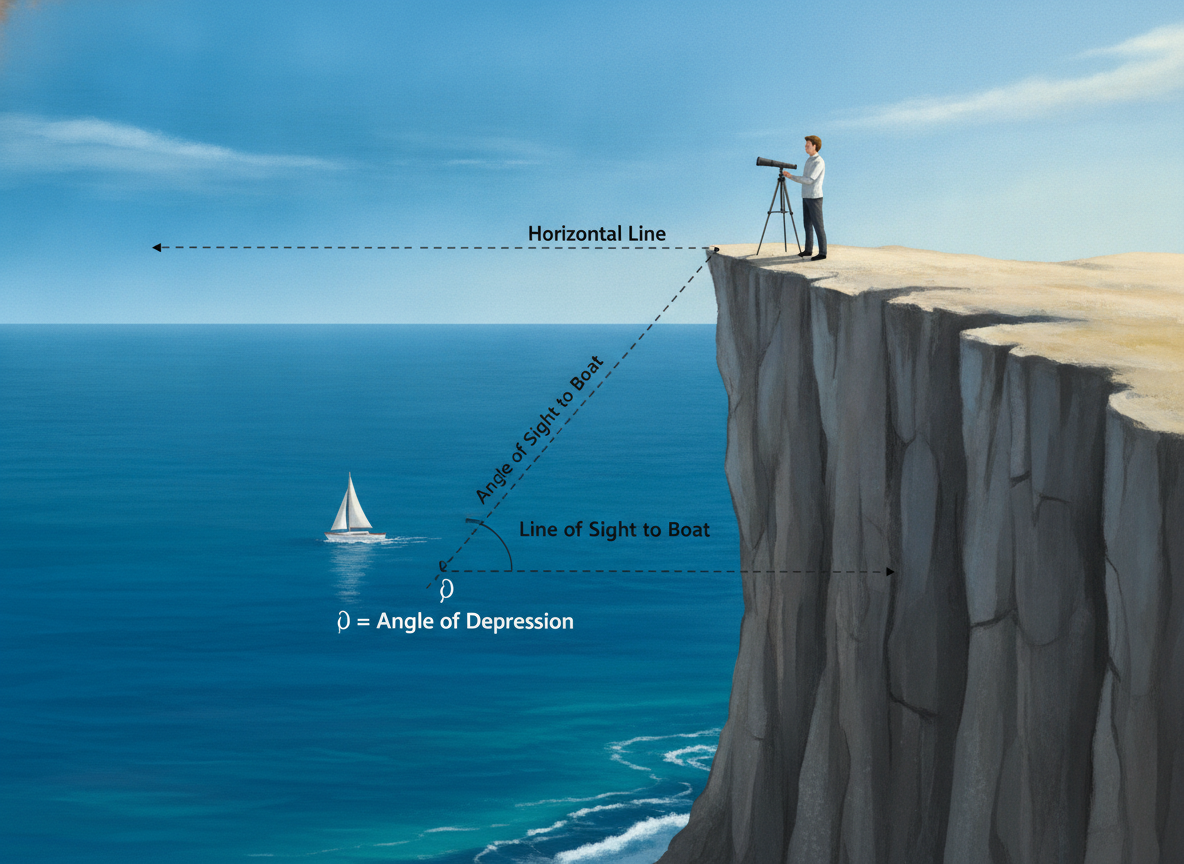
- Angle of Depression: The angle formed between the horizontal line and the line of sight when looking down at an object.
Instructional Sequence (60 Minutes)
1. Introduction (5 Minutes)
Begin with a real-world scenario to hook interest. Use the following illustrations to explain that trigonometry isn't just about triangles on paper—it's how we measure the height of buildings, the distance of ships at sea, or the altitude of a plane.
Looking Up (Elevation) | Looking Down (Depression) |
|---|---|
 |  |
2. Direct Instruction: Definitions & Formulas (15 Minutes)
- The Rule of Alternating Angles: Explain that the angle of depression from point A to point B is equal to the angle of elevation from point B to point A (Z-angles/alternate angles), as the horizontal lines are parallel.
- Trigonometric Ratios (SOH CAH TOA):
3. Guided Practice: Solving Real-Life Examples (15 Minutes)
Work through these problems on the board:
Example 1 (Elevation):
A student is standing 8m away from a flagpole. The angle of elevation to the top of the pole is
. Calculate the height of the flagpole.- Solution: We know the adjacent side (8m) and need the opposite side (height).
- Use Tangent:
- Since , then.
Example 2 (Depression):
A lifeguard on a 10m high tower spots a swimmer. The angle of depression to the swimmer is
. How far is the swimmer from the base of the tower?- Solution: The angle of depression is , which is the same as the angle of elevation from the swimmer to the lifeguard.
- Use Tangent:
- Rearrange: .
4. Independent Practice: Problem Set (20 Minutes)
Students work on the following problems individually:
- The Kite Problem: Ryan is flying a kite with 100m of string let out. The string makes an angle of elevation of with the ground. How high is the kite? (Ignore Ryan's height).
- The Lighthouse: From the top of a 50m lighthouse, the angle of depression to a boat is . How far is the boat from the base of the lighthouse?
- The Shadow: A tree casts a shadow 15m long when the angle of elevation of the sun is . Find the height of the tree.
5. Conclusion & Exit Ticket (5 Minutes)
Ask students to draw a quick sketch for the following scenario on a sticky note as they leave:
"An observer in a helicopter at 500m altitude sees a landing pad. Label the angle of depression and the horizontal line."
Assessment and Evaluation Plan
- Formative Assessment: Monitoring student sketches during the guided practice to ensure they correctly place the angle of depression (not between the vertical and the line of sight).
- Mini-Whiteboards: Use for quick-fire checks on which trig ratio to use for a given diagram.
- Independent Practice: Collection of the problem set to check for calculation accuracy and correct use of units.
21st Century Skills/College & Career Readiness Skills
- Critical Thinking: Students must translate verbal descriptions into mathematical models (diagrams).
- Problem Solving: Applying abstract trigonometric concepts to solve tangible, real-world distance and height challenges.
- Precision: Utilizing scientific tools (calculators) and rounding to appropriate degrees of accuracy (significant figures or decimal places).