Generated with Monsha
Save this resource to edit, expand, or export it, or create more resources for free.
Dynamics of Peer Influence in Professional and Academic Environments
Lesson Plan
25
English
Dynamics of Peer Influence in Professional and Academic Environments
At a Glance
Lesson Title: Dynamics of Peer Influence: Mechanisms, Impacts, and Applications
Grade Level: Advanced Academic / Professional (Level 25)
Duration: 40 Minutes
Overview
This session explores the multifaceted nature of peer influence, transcending adolescent-centric views to examine how social proximity and identity drive behavioral and cognitive shifts in professional and adult environments. Participants will analyze the psychological drivers of conformity and modeling, distinguishing between constructive and destructive social dynamics.
Learning Objectives
By the end of this lesson, learners will be able to:
- Define peer influence through the lens of Normative and Informational Social Influence.
- Distinguish between positive (prosocial) and negative (maladaptive) influence within professional networks.
- Analyze the causal mechanisms (e.g., Social Identity Theory) and evaluate their longitudinal effects on individual and organizational outcomes.
Key Concepts
1. Defining Peer Influence
Peer influence is the process through which individuals modify their beliefs, attitudes, or behaviors to align with those of a proximal social group. In advanced contexts, this is often characterized by the Dual-Process Model:
- Informational Influence: Accepting information from peers as evidence of reality, driven by a desire to be correct.
- Normative Influence: Conforming to peer expectations to gain social approval or avoid sanction, driven by a desire to be liked or accepted.
2. Positive vs. Negative Peer Influence
Positive Peer Influence (Prosocial)
- Modeling Excellence: Peers setting high benchmarks for performance or ethical standards.
- Health-Promoting Behaviors: Social support networks that encourage resilience and work-life balance.
- Collaborative Innovation: Diverse peer groups fostering "intellectual friction" that leads to creative breakthroughs.
Negative Peer Influence (Maladaptive)
- Groupthink: The suppression of dissenting views to maintain harmony, leading to poor decision-making.
- Normalization of Deviance: Gradual acceptance of unethical or risky shortcuts because "everyone else does it."
- Risk-Taking Escalation: Peer-driven pressure to engage in high-stakes behaviors without adequate mitigation.
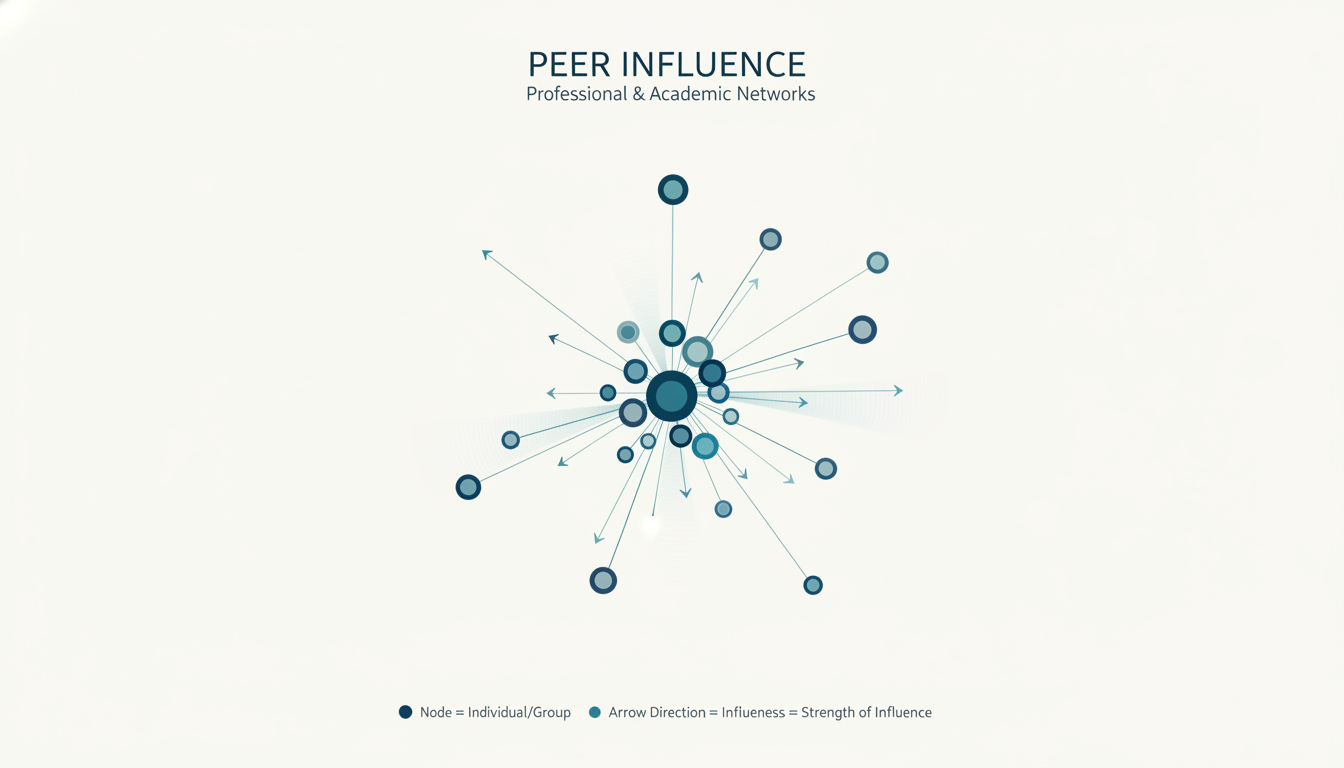
3. Visualizing Social Influence Networks
4. Causes and Effects of Peer Influence
Core Causes
- Social Learning Theory (Bandura): Individuals learn new behaviors through the observation and imitation of peers who serve as "prestige models."
- Social Identity Theory (Tajfel & Turner): The drive to maintain "positive distinctiveness" leads individuals to align their behaviors with their "in-group" to strengthen their social identity.
- The Proximity Principle: Frequent interaction leads to shared mental models and behavioral synchrony.
Key Effects
- Cognitive Alignment: Adoption of group-specific heuristics and biases, which can either streamline efficiency or blind the group to external data.
- Behavioral Standardization: The creation of informal norms that dictate everything from communication styles to risk tolerance.
- Psychological Well-being: High-quality peer influence fosters a sense of belonging and self-efficacy, while negative influence (peer pressure) correlates with increased stress and decreased autonomy.
Assessment and Evaluation Plan
Formative Assessment (10 Minutes)
- Scenario Mapping: Participants are presented with a brief case study of an organizational failure (e.g., the Space Shuttle Challenger or a corporate scandal). In small groups, they must identify whether the primary driver was Informational or Normative influence and pinpoint the specific "prestige models" involved.
Summative Assessment (End of Session)
- Reflection Audit: Learners will complete a 250-word "Influence Audit." They must identify one positive and one negative peer influence they have navigated in their current professional environment and propose a strategy for leveraging or mitigating such influences in the future.
- Peer Feedback: During the final 5 minutes, participants will share one "takeaway" with a colleague, evaluated by the instructor for conceptual accuracy.
Differentiation Strategy
- For Research-Oriented Learners: Provide an additional reading list featuring meta-analyses on social contagion and behavioral economics to satisfy those seeking deeper theoretical foundations.
- For Practitioner/Management Learners: Focus the Case Analysis on "Managerial Interventions"—how leaders can intentionally curate peer groups to foster positive influence and disrupt negative cycles.
- Multimodal Engagement: Utilize the Network Map (Figure 1) to support visual learners and structured debate formats for those who process information through verbal argumentation.
- Flexible Output: Allow the summative "Reflection Audit" to be submitted as a written note, a recorded audio clip, or a visual mind map.