Generated with Monsha
Learning Days and Time: Today, Tomorrow, and Yesterday
Lesson Plan · UKG · English
Learning Days and Time: Today, Tomorrow, and Yesterday
Objectives & Learning Outcomes
By the end of this 40-minute lesson, UKG students will be able to:
- Identify and recite the seven days of the week in their correct sequence.
- Understand and apply the concepts of "Yesterday" (the day before), "Today" (the present day), and "Tomorrow" (the day after).
- Recognize the daily date on a calendar and understand that it changes every morning.
- Participate in group songs and interactive activities that reinforce time-based vocabulary.
Key Concepts
This lesson focuses on building a foundational understanding of time and the cyclical nature of a week.
- The Seven Days of the Week: Children learn that there are seven special names for days that repeat in a circle: Monday, Tuesday, Wednesday, Thursday, Friday, Saturday, and Sunday.
- Relative Time (The Time Chain):
- Today: The day we are in right now. It is "now."
- Yesterday: The day that has already finished. It is "behind us."
- Tomorrow: The day that will come after we sleep tonight. It is "ahead of us."

- The Date: Every day has a number (e.g., the 12th) and belongs to a month. This helps us keep track of special events like birthdays or holidays.
Material & Resources Needed
To make this lesson engaging and hands-on, the following materials are recommended:
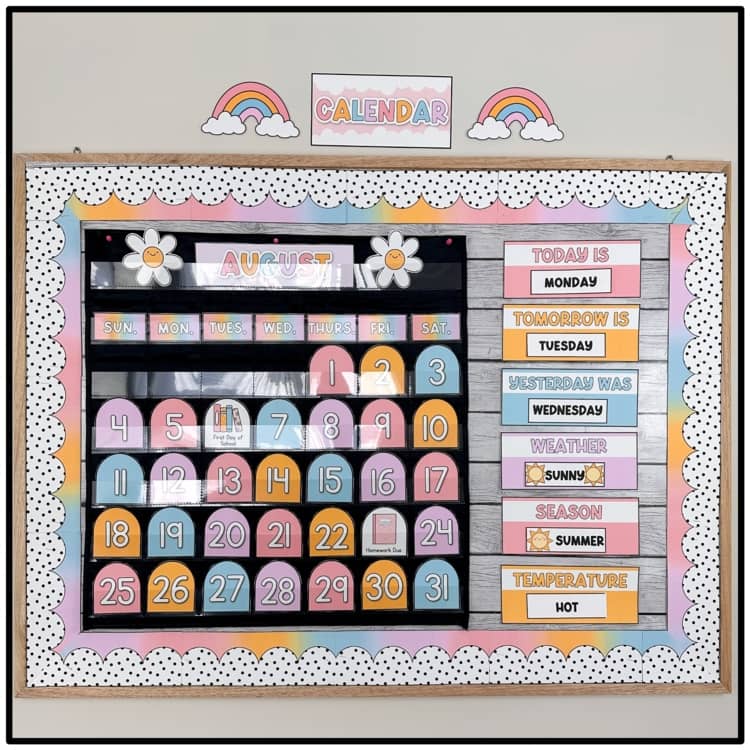
- Classroom Calendar: A large, interactive wall calendar with moveable numbers and month names.
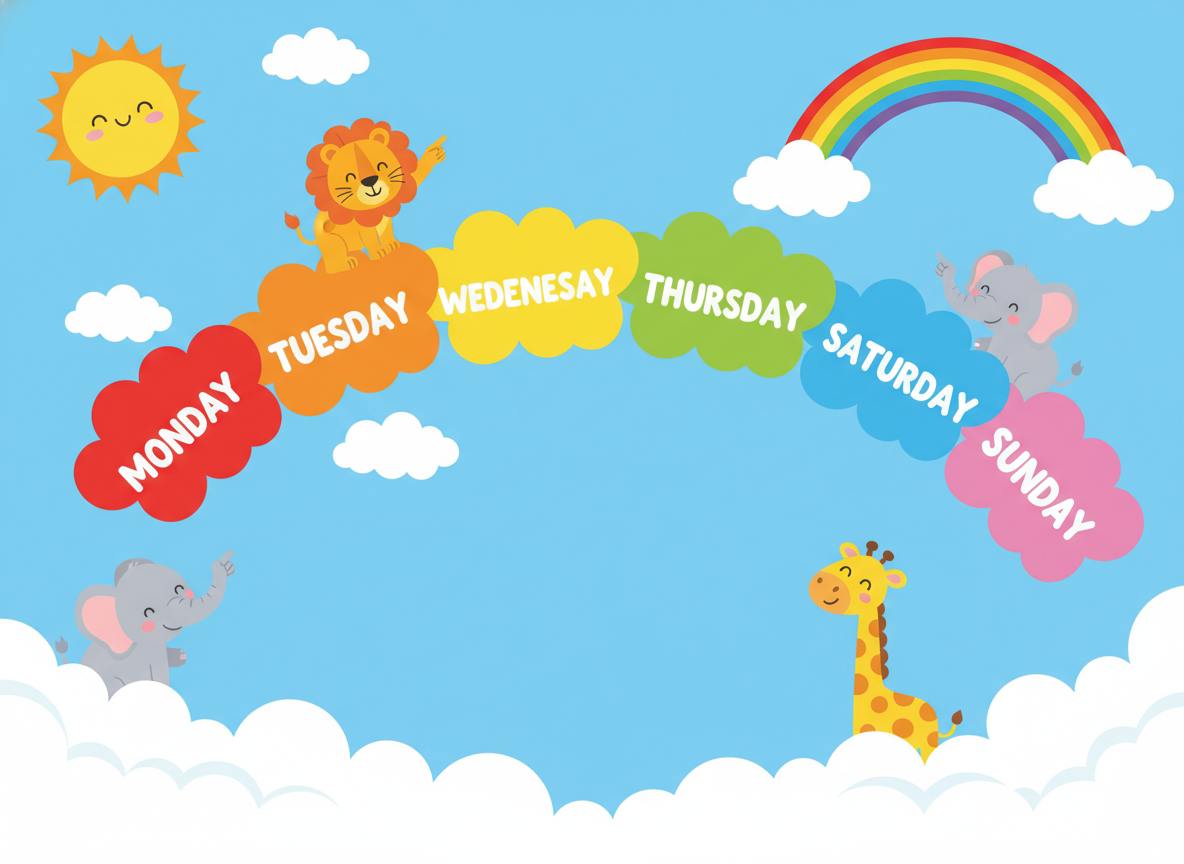
- Days of the Week Chart: A bright, colorful visual aid showing all seven days.
- Day Labels: Three large cards labeled YESTERDAY, TODAY, and TOMORROW with Velcro or magnets on the back.
- Audio Resource: A catchy "Days of the Week" song (e.g., the "7 Days" song to the tune of The Addams Family or Oh My Darling Clementine).
- Pointer Stick: A fun "magic wand" or pointer for students to use when identifying days on the board.
Assessment and Evaluation Plan
Evaluation for UKG students should be informal, continuous, and integrated into the lesson activities.
Assessment Type | Activity Details |
|---|---|
Oral Recognition | During the "Circle Time," ask the group: "If today is Monday, what day comes next?" Observation of choral responses. |
Interactive Matching | Invite individual students to come to the board and place the "Today" label next to the correct day of the week. |
Concept Check | Ask students to share one thing they did yesterday (e.g., "Yesterday I played in the park") to check understanding of the past tense concept. |
Exit Ticket | Before transitioning to the next activity, ask each child: "What day is it today?" or "What is the next day after Friday?" |
Expanded Lesson Plan: Mastering the Calendar (Days and Dates)
Objectives & Learning Outcomes
By the end of this session, students will be able to:
- Recite the seven days of the week in chronological order starting from Monday.
- Identify the current day, the day that just passed (Yesterday), and the day coming next (Tomorrow).
- Locate the current date on a monthly calendar and understand that the number increases by one each day.
- Express past and future events using "Yesterday" and "Tomorrow" in simple sentences (e.g., "Yesterday we had art class").
Material & Resources Needed
To create a rich sensory learning environment, use the following resources:
Visual Aids:
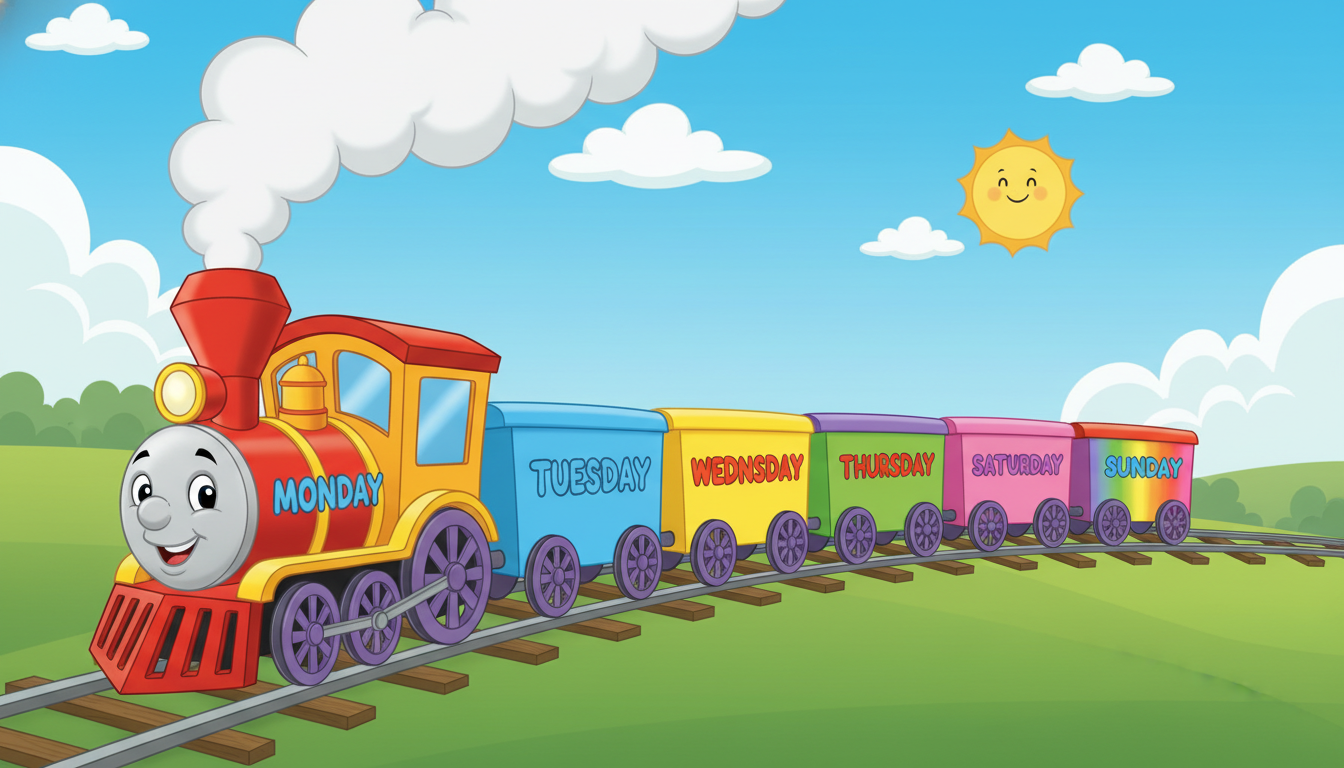
- Days of the Week Train: A colorful wall display where each day is a carriage.
- Interactive Weather & Date Board: A board including a thermometer, weather icons, and the "Today is..." section.
- The "Day Slider": A physical tool where students slide a window over the correct day.
Hands-on Materials:
- Pointer Magic: A sparkling stick for the "Calendar Captain" of the day.
- Flashcards: Large-print cards for Monday through Sunday.
- Clothespins: Labeled with student names to "clip" onto the current day on a hanging line.
Key Concepts & Classroom Activities
1. The Concept of "The Loop"
Explain that days move in a circle. When we reach Sunday, we start back at Monday.
- Activity: The Human Train Assign seven students a day of the week. Have them stand in a line. The student labeled "Monday" starts a chugging motion, followed by Tuesday, etc. When Sunday finishes, Monday starts again to show the cycle.
2. Relative Time: Yesterday, Today, Tomorrow
Use the "Time Chain" to explain that these names change every time we wake up.
- Activity: Yesterday’s News & Tomorrow’s Dreams During circle time, use a "microphone" prop.
- Yesterday: Ask, "What is one fun thing you did yesterday?"
- Today: Ask, "What are we excited to do in school today?"
- Tomorrow: Ask, "What is one thing you hope to do tomorrow?"
3. Number Sequence (The Date)
Explain that every day gets a number. If today is the 12th, tomorrow must be the 13th.
- Activity: Calendar Hide-and-Seek Cover several numbers on the classroom calendar with sticky notes. Ask students to guess which number is hiding behind "Tomorrow" or "Yesterday" based on the sequence.
Assessment and Evaluation Plan
Assessment for this age group is based on observation and participation:
- The "Daily Captain" Check: Assign a different student each day to update the calendar. Observe if they can correctly identify "Today" and move the markers for "Yesterday" and "Tomorrow" with minimal prompting.
- Sorting Challenge: Provide a mixed-up stack of Day Flashcards. Ask a small group of students to lay them out on the floor in the correct order from Monday to Sunday.
- Vocabulary Check: Use situational questions during transition times.
- "If we had a holiday yesterday (Sunday), what day is it today?"
- "If we have swimming class tomorrow (Wednesday), what day is it today?"
- Drawing Journal: Ask students to draw a picture of something they did Yesterday and something they want to do Tomorrow. Review their drawings to ensure they distinguish between the past and future.