Generated with Monsha
The Original Voice: Ethical AI Integration in Writing
Lesson Plan · Grade 10 · English
The Original Voice: Ethical AI Integration in Writing
At a Glance
- Topic: Ethical Use of AI in Written Responses
- Grade Level: Grade 10
- Duration: 60 Minutes
- Lesson Goal: To transition students from using AI as a ghostwriter to using it as a collaborative brainstorming and editing tool while maintaining academic integrity.
Objectives & Learning Outcomes
By the end of this lesson, students will be able to:
- Define AI Plagiarism: Articulate the difference between "AI-generated" (dishonest) and "AI-assisted" (ethical) writing.
- Apply Ethical Frameworks: Use an AI transparency checklist to disclose how technology was used in their writing process.
- Synthesize AI Feedback: Demonstrate how to use AI for brainstorming and structural feedback without copying verbatim text.
- Evaluate Output: Critically assess AI-generated content for accuracy, tone, and personal voice.
Standards Addressed
- CCSS.ELA-LITERACY.W.10.4: Produce clear and coherent writing in which the development, organization, and style are appropriate to task, purpose, and audience.
- CCSS.ELA-LITERACY.W.10.6: Use technology, including the Internet, to produce, publish, and update individual or shared writing products, taking advantage of technology's capacity to link to other information and to display information flexibly and dynamically.
Material & Resources Needed
- Devices: Laptops or tablets with internet access.
- AI Tools: Access to a school-approved LLM (e.g., ChatGPT, Claude, or Gemini).
- Visual Aids:

-
- Handouts: "The AI Transparency Disclosure" form.
- Sample Text: A 100% AI-generated paragraph vs. a student-written paragraph on the same topic.
Key Concepts
- The Ghostwriting Trap: When AI produces the final words, the student loses the cognitive benefit of writing and commits a form of plagiarism.
- AI as a 'Rubber Duck': Using AI to talk through ideas, clarify complex concepts, or find synonyms.
- Academic Integrity 2.0: Shifting focus from "not using tools" to "disclosing tool use" and ensuring the final product reflects original thought.
- Prompt Engineering for Learning: Writing prompts that ask for feedback (e.g., "Check my logic") rather than output (e.g., "Write this for me").
21st Century Skills / College & Career Readiness
- Information Literacy: Determining the reliability and ethical boundaries of digital information sources.
- Critical Thinking: Analyzing the difference between a machine-generated argument and a human-centered one.
- Self-Direction: Taking ownership of the writing process even when shortcuts are available.
- Technology Literacy: Mastering emerging tools in a way that enhances rather than replaces human capability.
Instructional Sequence
1. The Hook: Human vs. Machine (5 Minutes)
- Display two paragraphs on the board. One is AI-generated (highly formal, repetitive structure), and one is student-written (varied syntax, specific personal examples).
- Ask students to vote on which is which. Discuss: Why does the student-written one feel more "real"?
2. Direct Instruction: The Ethical Workflow (10 Minutes)
- Introduce the concept of the "Ethical AI Writing Process."
- Explain that plagiarism occurs when the "Core Thinking" is outsourced.
- Visual Aid: Refer to Figure 2 to show where AI fits into a healthy writing cycle.
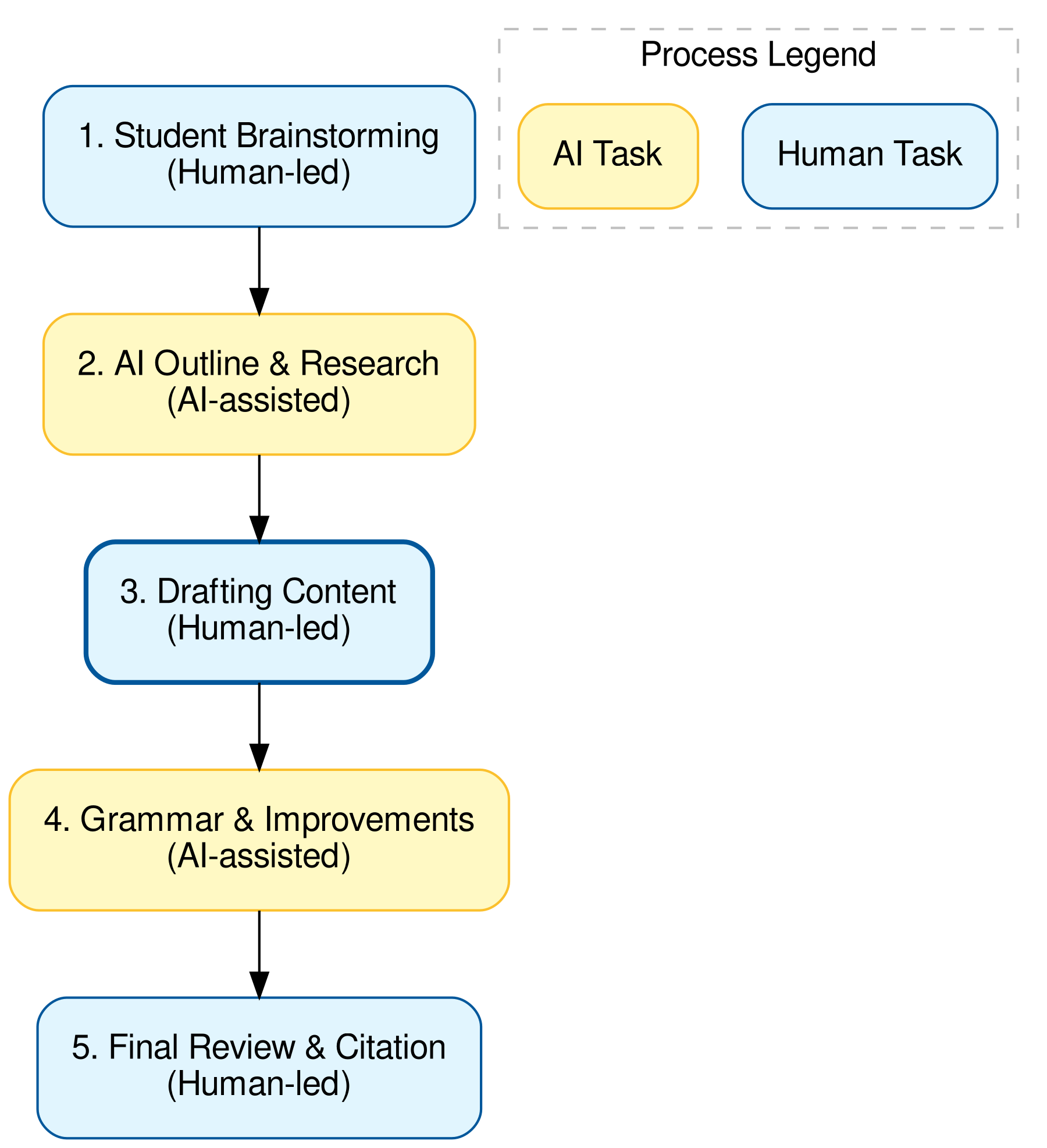
3. Guided Practice: Prompt Engineering for Feedback (15 Minutes)
- Task: Students are given a draft paragraph with weak transitions.
- Activity: Instead of asking AI to "fix it," students must write a prompt asking for suggestions.
- Example Prompt: "I am a 10th grader writing about Julius Caesar. Can you suggest three ways to improve the transition between my second and third sentences without writing them for me?"
- Students share the suggestions they received and explain which one they chose and why.
4. Independent Practice: Drafting with Disclosure (20 Minutes)
- Students respond to a short prompt (e.g., "Should high school start later in the morning?").
- They are encouraged to use AI for one specific part of the process (brainstorming, outlining, or grammar check).
- Requirement: They must fill out a "Transparency Statement" at the bottom of their work:
- "I used [AI Tool] to [Specific Task]. I chose to [keep/discard] its suggestion because..."
5. Closure & Reflection (10 Minutes)
- Exit Ticket: "What is one thing a human writer can do that an AI cannot?"
- Collect the Transparency Statements to evaluate the depth of student reflection on the tool's utility.
Assessment and Evaluation Plan
- Formative Assessment: Observation during the Prompt Engineering activity. Can students distinguish between asking for a "suggestion" vs. asking for an "answer"?
- Summative Assessment: The final written response with the Transparency Statement. Grading will focus on:
- Originality: Does the voice sound consistent and personal?
- Disclosure: Is the use of AI clearly and honestly documented?
- Critical Analysis: Does the student explain why they accepted or rejected the AI's help?
Differentiation Strategy
- For Students Needing Support (ELL/IEP): Provide a "Prompt Bank"—pre-written ethical prompts they can copy/paste to get started (e.g., "Explain this concept in simpler terms so I can write about it").
- For Advanced Learners: Challenge students to use the AI to generate a counter-argument to their thesis, then write a rebuttal in their own voice to strengthen their essay.
- Visual Learners: Use the provided flowchart (Fig 2) as a desk reference throughout the writing process.