Generated with Monsha
Surat al-Mutaffifeen: The Record of the Wicked (Verses 7-17)
Lesson Plan · Grade 8 · English
Surat al-Mutaffifeen: The Record of the Wicked (Verses 7-17)
1. Key Concepts
- Sijjeen (سِجِّين): Derived from the word for 'prison' (Sijn), it refers to the record or place where the deeds of the wicked are permanently inscribed. It signifies confinement, lowliness, and a fixed destiny for those who persist in evil.
- Ar-Ran (الرَّان): The spiritual 'rust' or 'stain' that covers the heart when a person repeatedly commits sins without repentance. This layer prevents the heart from perceiving divine truth.
- The Day of Reckoning (Yaum ad-Deen): The ultimate accountability where every soul is judged for its intentions and actions.
- Spiritual Veiling: The punishment of being prevented from seeing the presence of Allah on the Day of Judgment—considered the greatest loss for a soul.
- 'Fables of the Ancients' (Asatir al-awwalin): The dismissive excuse used by deniers to claim that divine revelation is merely outdated folklore.
2. At a Glance
This lesson explores the consequences of denying divine truth as outlined in verses 7–17 of Surat al-Mutaffifeen. Students will analyze the spiritual progression from committing sins to the hardening of the heart, resulting in the denial of the Day of Judgment. The lesson emphasizes the transition from 'Sijjeen' (the fixed record of deeds) to the ultimate spiritual consequence: being veiled from the Lord's mercy and presence.
3. Objectives & Learning Outcomes
By the end of this lesson, students will be able to:
- Define and explain the linguistic and theological meaning of Sijjeen and Ar-Ran.
- Analyze the cause-and-effect relationship between repeated sin and the inability to recognize truth.
- Interpret the spiritual significance of being 'veiled' from Allah and contrast it with the reward of the righteous.
- Identify the specific behaviors (denial, mockery, and transgression) that lead to the fate described in the verses.
- Develop a personal strategy for 'polishing the heart' through repentance (Istighfar) and reflection.
4. Standards Addressed
- Thematic Analysis: Students should be able to identify the primary theme of the Surah (integrity and accountability) and how these verses support it.
- Textual Evidence: Linking specific outcomes (e.g., entering the fire) to textual behaviors (e.g., claiming the Quran is 'fables').
- Ethical reasoning: Discussing the importance of honesty in deeds and thoughts to maintain a 'clean' spiritual heart.
- Character Development: Implementing the concept of Tazkiyah (purification) in response to the concept of Ar-Ran.
5. Material & Resources Needed
- Textbook: Surat al-Mutaffifeen (Verses 7–17).
- Visual Aids:

-
-
- Digital Tools: Shared document for group reflections, access to Quranic tafsir online (e.g., Quran.com).
- Guided Notes: Handouts for tracking key vocabulary and their definitions.
6. Assessment and Evaluation Plan
- Formative Assessment: 'Check for Understanding' questions during the instructional sequence regarding the meaning of Sijjeen.
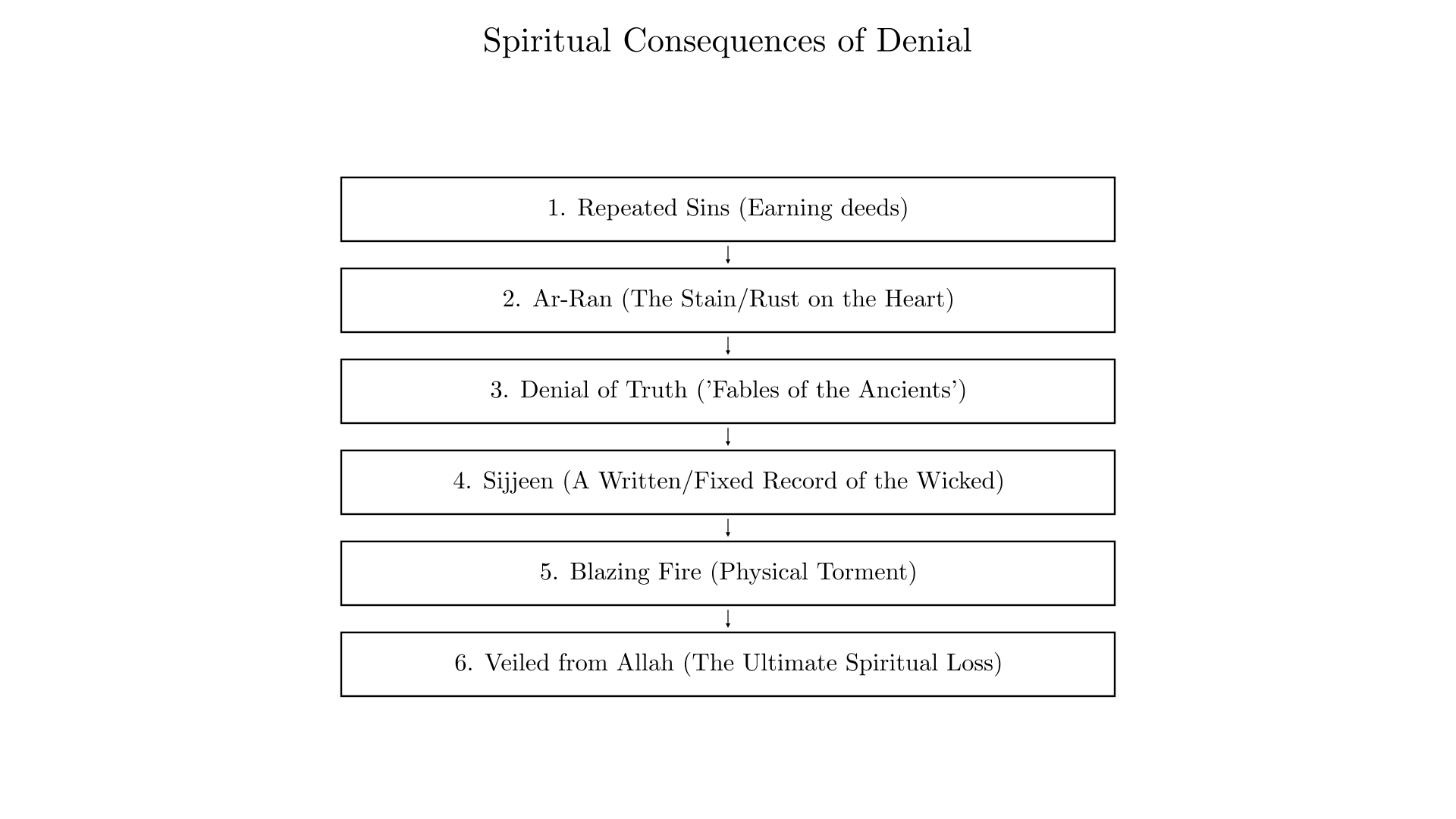
- Group Activity: Mapping the 'Spiritual Consequences' diagram based on their interpretation of the text.
- Exit Ticket: Students must write 1-2 sentences explaining why being 'veiled from Allah' is considered a greater punishment than 'blazing fire' for a believer.
- Self-Reflection: A short journal entry on how to prevent 'Ar-Ran' from developing on the heart in daily life.
7. Differentiation Strategy
- For Advanced Learners: Research and compare the descriptions of Sijjeen (for the wicked) and Illiyyun (for the righteous, verses 18–21) to analyze the contrast in Allah's treatment of the two groups.
- For Struggling Learners: Provide a vocabulary matching worksheet (Sijjeen, Ar-Ran, Reckoning) with simplified definitions and pictorial cues.
- Visual Learners: Utilize the flow diagram (Figure 2) to walk through the logic of the verses sequentially rather than just through text.
8. 21st Century Skills/College & Career Readiness Skills
- Critical Thinking: Analyzing the psychological impact of repeated behaviors on a person's worldview (the 'rust' on the heart).
- Ethical Reasoning: Evaluating how denial of accountability affects one's honesty and integrity in life and business.
- Communication: Expressing complex theological concepts in clear, modern language suitable for peer discussion.
9. Instructional Sequence (120 Minutes)
Phase 1: Hook and Introduction (15 mins)
- Activity: Show an image of a rusted or tarnished object. Ask: "Can you see the original beauty of this object? Why not?"
- Connection: Relate the physical rust to the spiritual 'rust' (Ar-Ran) mentioned in Verse 14.
- Introduction: Set the context—Surat al-Mutaffifeen begins with cheaters in trade; today we look at the internal spiritual state of those who deny truth.
Phase 2: Verse Exploration and Vocabulary (30 mins)
- Read Aloud: Recite Verses 7–17 in Arabic and English.
- Deep Dive: Focus on Verses 7–9. Introduce the concept of Sijjeen (Figure 1). Discuss how deeds are 'written clearly' and what that means for accountability.
- Vocabulary: Students fill in guided notes for key terms: Sijjeen, Ar-Ran, and Fables.
Phase 3: Visual Analysis (20 mins)
- Diagram Study: Display Figure 2 (Spiritual Consequences of Denial).
- Discussion: Ask students to identify the 'turning point' in the diagram. When does sin move from an action to a state of being (the heart stain)?
- Logical Flow: Explain that physical punishment (Blazing Fire) follows the spiritual condition (Denial/Stain).
Phase 4: Group Discussion – The Greatest Loss (25 mins)
- Think-Pair-Share: Discuss Verse 15: "No! Indeed, they will be veiled from seeing their Lord on that day."
- Central Question: Why is seeing Allah the ultimate reward, and why is being veiled from Him the ultimate punishment?
- Synthesis: Connect this to Verse 17: "This is the very thing which you used to deny!" How does mocking a truth lead to being excluded from it?
Phase 5: Assessment and Wrap-Up (30 mins)
- Reflection Writing: Students draft their strategy for 'Heart Maintenance' (how to avoid the stain through honesty and Istighfar).
- Quiz/Exit Ticket: A quick 5-question check on the meaning of Sijjeen and the sequence of consequences.
- Closing: Reiterate the theme—our hearts are like mirrors; we must keep them clean to see the truth clearly.