Generated with Monsha
Lesson Plan: Number Classification and Mathematical Language
Lesson Plan · IGCSE Year 1 · English
Lesson Plan: Number Classification and Mathematical Language
Lesson Plan: Number Classification and Mathematical Language
Subject: Cambridge IGCSE Mathematics (0580)
Grade Level: IGCSE Year 1 (Grade 9)
Chapter: 1 - Number and Language
Lesson Duration: 60 Minutes
This lesson serves as the foundation for Chapter 1, introducing students to the formal classification of number sets and the specific mathematical vocabulary required by the Cambridge IGCSE syllabus.
1. Objectives & Learning Outcomes
By the end of this lesson, students will be able to:
- Identify and Classify Numbers: Distinguish between natural numbers, integers, prime numbers, square numbers, cube numbers, rational numbers, irrational numbers, and real numbers.
- Understand Set Notation: Use and interpret formal mathematical symbols such as (is an element of),(is not an element of), and the symbols for number sets ().
- Apply Mathematical Language: Use correct terminology to describe properties of numbers, including factors, multiples, and the distinction between terminating and recurring decimals.
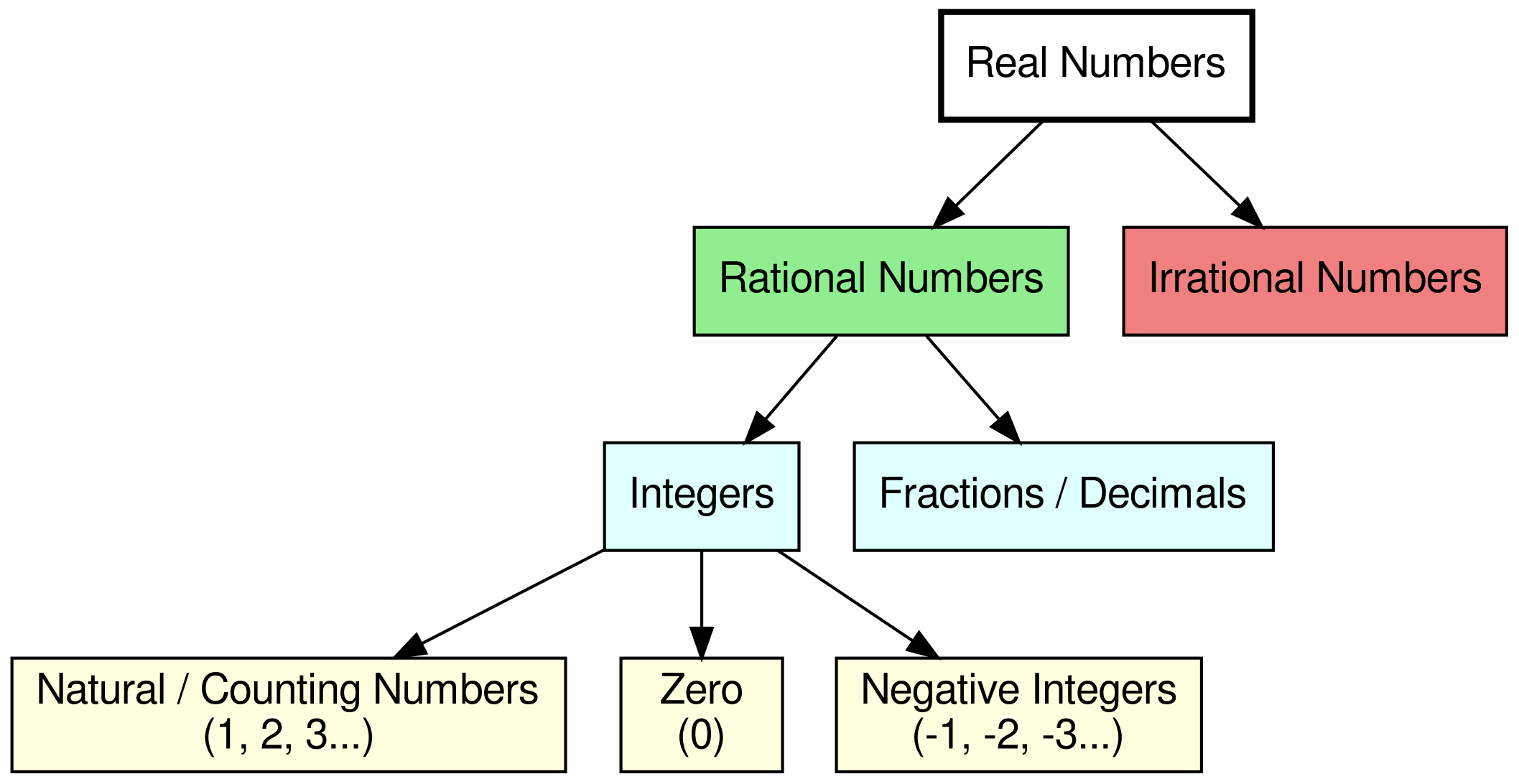
- Relate Concepts: Understand the hierarchical relationship between different number sets using visual models.
2. Key Concepts
The Hierarchy of Numbers
Mathematics organizes numbers into specific sets based on their properties. Understanding this hierarchy is essential for algebraic manipulation and problem-solving.
Definitions and Vocabulary
- Natural Numbers (): Counting numbers starting from 1 (some definitions include 0, but IGCSE typically uses).
- Integers (): Whole numbers, including positive, negative, and zero (e.g.,).
- Rational Numbers (): Numbers that can be written as a fractionwhereandare integers and. These include terminating and recurring decimals.
- Irrational Numbers: Numbers that cannot be expressed as simple fractions (e.g., ). Their decimal expansions are non-terminating and non-recurring.
- Real Numbers (): The set of all rational and irrational numbers combined.
Common Mathematical Symbols
Symbol | Meaning | Example |
|---|---|---|
| Is an element of | |
| Is not an element of | |
| Set of rational numbers | |
| Set of positive integers | |
3. Assessment and Evaluation Plan
To ensure students have mastered the classification of numbers and the relevant language, the following assessments will be conducted:
Formative Assessment (During Lesson)
- Think-Pair-Share: Students are given a list of numbers (e.g., ) and must categorize them into the smallest possible number set they belong to.
- Whiteboard Drills: The teacher displays a symbol or a definition, and students write the corresponding term or number set on their individual mini-whiteboards.
Summative Assessment (End of Lesson/Homework)
- Classification Matrix: A worksheet requiring students to tick boxes for all sets a specific number belongs to (e.g., for the number '-5', students would tick 'Integer', 'Rational', and 'Real').
- Exit Ticket: Students must write down one example of an irrational number that is not and explain why it is irrational using the term "non-recurring decimal."
Evaluation Criteria
- Accuracy: Ability to correctly place numbers into sets without confusing rational and irrational types.
- Notation Literacy: Correct usage of set notation symbols in written responses.
- Conceptual Clarity: Explaining the difference between a square number and a prime number using appropriate mathematical terminology.