Generated with Monsha
Systemic Confidence: The A-Z Execution Blueprint
Smart Worksheet · Grade 12 · English
Systemic Confidence: The A-Z Execution Blueprint
Introduction: Building Trust Through Systems
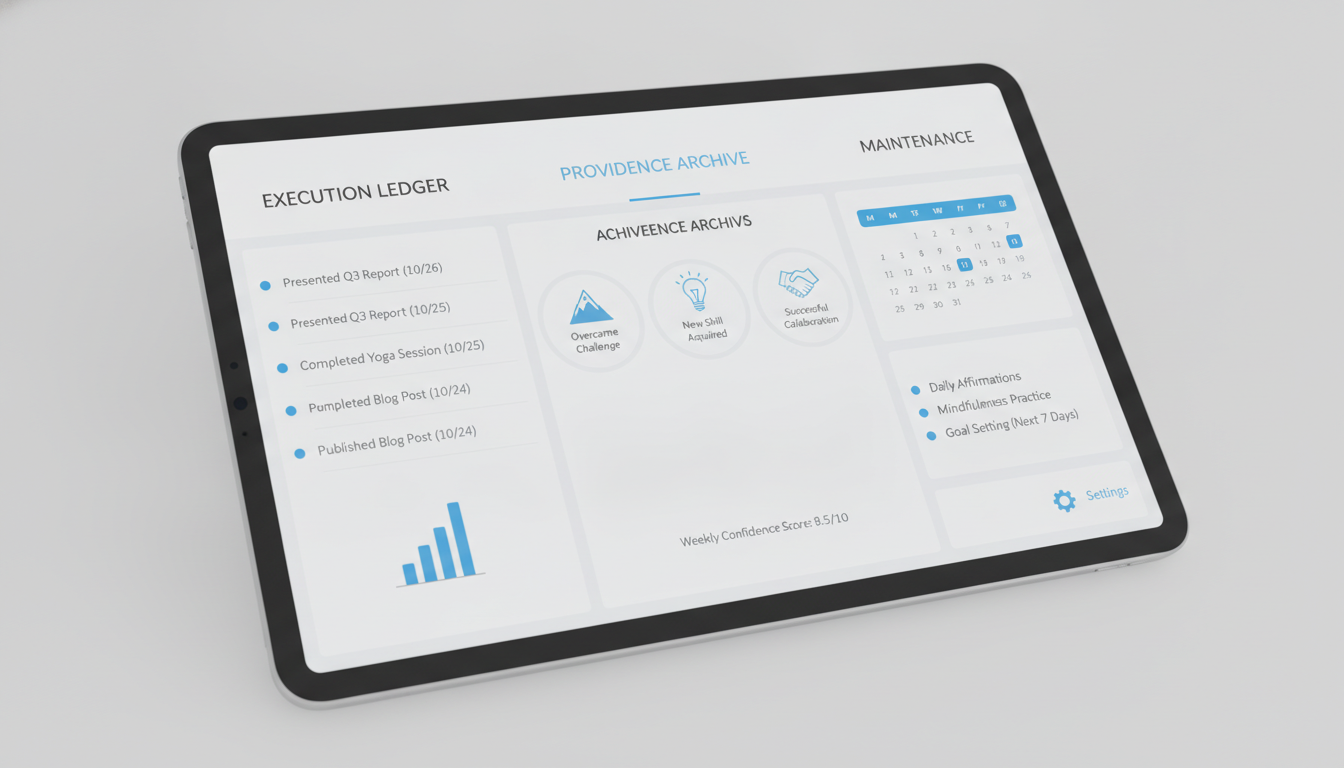
Confidence is not a feeling; it is a byproduct of Factual Agency. This worksheet utilizes a rigorous systemic approach to transform poor self-esteem into self-trust by separating internal static from external output. You will build a blueprint, track your execution, and archive your evidence.
Section 1: The Blueprint Separation Log
Goal: To separate objective plans from emotional interference and self-limiting beliefs.
Activity 1: The Cognitive Divide
Identify a complex goal you currently feel hesitant to start. In the table below, separate the Logical Blueprint (the steps required) from the Emotional Static (the self-doubt or "noise" surrounding the goal).
Logical Blueprint (Steps) | Emotional Static (Noisy Thoughts) |
|---|---|
1. __________________________ | 1. __________________________ |
2. __________________________ | 2. __________________________ |
3. __________________________ | 3. __________________________ |
Activity 2: Boundary Protocol
Internal self-trust is often compromised by external noise. Identify three external influences (people, social media, or past failures) that interfere with your "Blueprint." Describe how you will "Log" their removal from your decision-making process.
-
-
-
Activity 3: Strategic Deconstruction
Choose one "Confidence-Breaking" thought you frequently have (e.g., "I'm not talented enough"). Deconstruct it into its structural flaws. Why is this thought statistically or logically invalid within a Systemic Blueprint?
Activity 4: Multiple Choice - Blueprinting Logic
Which of the following best describes the primary purpose of the Blueprint Separation Log?
A) To visualize a perfect outcome where nothing goes wrong.
B) To separate actionable project data from the emotional state of the user.
C) To list every possible reason why a project might fail.
D) To replace negative thoughts with positive affirmations.
Your Answer: [ ]
Section 2: The Build Execution Ledger
Goal: To track tangible actions and prioritize execution metrics over the trap of perfection.
Activity 5: The First Five (Inertia-Breakers)
Define a specific project. List the first five non-negotiable physical actions in your Ledger. These must be discrete, measurable, and independent of "quality."
-
-
-
-
-
Activity 6: Metric Selection: Metrics vs. Perfection
For the actions listed in Activity 5, assign an Execution Metric. A metric is a number (e.g., "Time spent: 20 mins" or "Words written: 200"). It ignores how "good" the work is.
Action 1 Metric: ____________________
Action 2 Metric: ____________________
Action 3 Metric: ____________________
Activity 7: The Resistance Audit
When execution stops, it is usually due to a "Resistance Spike." In the box below, describe a hypothetical moment of resistance for your project. What is the Ledger Entry (the immediate next tiny move) to break that resistance?
Resistance Description:
Next Ledger Move:
Activity 8: True or False - Agency Concepts
Determine if the following statements align with the Build Execution Ledger philosophy.
- [T / F] The goal of the Ledger is to produce high-quality work on the first try.
- [T / F] Execution metrics are successful even if the user feels anxious during the task.
- [T / F] A Ledger entry is only complete if it receives external validation.
Section 3: The Providence Archive
Goal: To create a systematic folder of evidence that validates your factual agency.
Activity 9: Artifact Identification
An "Artifact" is a receipt, a link, or a physical output. If you completed a 10-day research project, list four distinct artifacts you would store in your Archive as "Receipts of Growth."
- __________________________ 3. __________________________
- __________________________ 4. __________________________
Activity 10: The Folder Hierarchy
Design the directory structure for your digital Providence Archive. Use the lines below to create a map of your folders (e.g., /Archive/Project_Alpha/Receipts).
Activity 11: Systematized Documentation (The Post-Mortem)
Select a small success from your past. Write a "Step-by-Step" technical manual for how you achieved it. This documents the process as a permanent asset in your Archive.
Step 1: ________________________________________________________________________
Step 2: ________________________________________________________________________
Step 3: ________________________________________________________________________
Step 4: ________________________________________________________________________
Activity 12: Multiple Choice - Archival Purpose
How does the Providence Archive directly improve self-esteem?
A) It reminds you of how many people like your work.
B) It provides a catalog of factual proof that your agency exists, regardless of how you feel.
C) It creates a backup in case your computer crashes.
D) It allows you to brag about your accomplishments to others.
Your Answer: [ ]
Section 4: The Maintenance Protocol (REST)
Goal: To schedule system updates, pauses, and tuning to prevent burnout and ensure system integrity.
Activity 13: Defining the REST Framework
Define what each category of REST means for your personal development system:
- Rest (Physical/Mental Recovery): __________________________________________
- Evaluation (Data Review): ________________________________________________
- Strategy (Adjusting the Blueprint): ______________________________________
- Tuning (Minor System Tweaks): __________________________________________
Activity 14: System Update Scheduling
In a 4-week cycle, when will you perform your "System Update"? Create a brief schedule for a "Strategic Pause."
Week 1: [ ] Execution Week 2: [ ] Execution Week 3: [ ] Execution Week 4: [ ] UPDATE
Describe the "Update" activities for Week 4: ________________________________________________
Activity 15: The Audit Loop
Draft three critical questions you must answer during every System Update to ensure your Ledger and Blueprint are still aligned.
- __________________________________________________________________________?
- __________________________________________________________________________?
- __________________________________________________________________________?
Activity 16: True or False - Protocol Maintenance
- [T / F] A "Pause" in the system is a sign of failure or lack of discipline.
- [T / F] The Maintenance Protocol should be scheduled strictly, not just used when tired.
Section 5: Hypothesis Execution & Factual Agency
Goal: To test reality and validate your power to affect the physical world.
Activity 17: The Capability Hypothesis
Draft a hypothesis for a new skill you want to test. Focus on execution, not talent.
"I hypothesize that if I execute [Task] for [Time/Quantity], then I will produce [Tangible Artifact]."
Your Hypothesis: ________________________________________________________________
Activity 18: Metrics Over Perfection Analysis
A perfectionist says: "I will write a beautiful, life-changing poem today."
Convert this into a Capability Hypothesis based strictly on execution metrics.
Activity 19: Reality Validation Task
Look at your immediate surroundings. Identify one Tangible Output of your agency (something you created, moved, or organized) that exists in reality right now. How does this prove your agency is a fact?
Activity 20: The A-Z Synthesis
Describe the journey of a single idea from the Blueprint Separation Log to the Providence Archive. How does the Maintenance Protocol ensure this journey continues?
Intake Assessment: Systemic Confidence A-Z
Part 1: The Intake Needs Assessment Checklist
Instructions: Evaluate your current operational state. Read each statement and check the box that most accurately describes your behavior over the last 30 days. Be ruthlessly objective; this is data collection, not a moral judgment.
Assessment Item | Never | Rarely | Often | Always |
|---|---|---|---|---|
1. I wait for "inspiration" or a specific mood before starting a difficult task. | [ ] | [ ] | [ ] | [ ] |
2. I research a topic indefinitely to avoid the discomfort of taking the first physical step. | [ ] | [ ] | [ ] | [ ] |
3. I check my phone or social media the moment a task becomes intellectually taxing. | [ ] | [ ] | [ ] | [ ] |
4. I struggle to begin a project if I cannot visualize the exact final result. | [ ] | [ ] | [ ] | [ ] |
5. My internal dialogue labels me as a "failure" before I have even gathered execution data. | [ ] | [ ] | [ ] | [ ] |
6. I abandon work-in-progress because it doesn't look "professional" or "perfect" immediately. | [ ] | [ ] | [ ] | [ ] |
7. I believe my past failures are a permanent blueprint for my future performance. | [ ] | [ ] | [ ] | [ ] |
8. I complete tasks but fail to document or "archive" them, leading to a sense of zero progress. | [ ] | [ ] | [ ] | [ ] |
9. I avoid setting measurable goals (metrics) because failing to meet a number feels painful. | [ ] | [ ] | [ ] | [ ] |
10. I believe I must feel confident before I am allowed to act with agency. | [ ] | [ ] | [ ] | [ ] |
Part 2: Diagnostic Analysis & Active Tasks
Goal: Transform your checklist data into actionable system requirements. Performance metrics over perfection.
Activity 11: Static vs. Logic Isolation
Review your answers for Questions 5 and 7. These represent "Emotional Static." List one specific thought you marked as "Often" or "Always" and identify the Data Gap—the factual evidence you are currently ignoring.
Activity 12: The "Inertia-Breaker" Protocol
Look at Question 2. Identify one task you are currently over-researching. Write down the first physical move that takes less than 60 seconds (e.g., "Create a blank folder named 'Project X'").
Activity 13: Uncertainty Tolerance Rating
In Question 4, you identified a struggle with visualizing results. On a scale of 1–10 (10 being paralyzed), rate your discomfort with "Operating in the Dark." What is one metric you can track to prove you are moving despite the darkness?
Rating: [ ] Metric: ________________________________________________________
Activity 14: The Avoidance Audit
Refer to Question 3. What is your primary "Exit Route" when a task gets hard? Describe a physical barrier you can implement to protect your Build Execution Ledger (e.g., "Phone in the other room").
Activity 15: Artifact Identification
Regarding Question 8, identify one "Artifact" (a file, a receipt, a physical object) from a success you had this week. Why does this count as factual evidence of your agency?
Activity 16: Perfectionism Pivot
Look at Question 6. If you were forced to prioritize Quantity over Quality for the next 48 hours, what would be your target metric? (e.g., "3 messy pages" or "500 words of any quality").
Target Metric: ________________________________________________________________
Activity 17: Static Deconstruction
Choose the most frequent "Confidence-Breaking Thought" from Question 10. If you treat this thought as a "bug" in a software system rather than a truth about your identity, what is the specific "Code Fix"?
Activity 18: The Boundary Protocol
If your response to Question 1 was "Often" or "Always," identify the "Mood Lie" you tell yourself (e.g., "I need to be calm to work"). Write a non-negotiable rule that ignores your mood.
Rule: _________________________________________________________________________
Activity 19: Resistance Mapping
Draw a simple line graph below showing your "Resistance Levels" over a typical school day. Mark the hours where your Build Execution Ledger is most likely to fail.
(Draw your graph here: Time on X-axis, Resistance on Y-axis)
Activity 20: System Prioritization
Based on this entire assessment, which part of the A-Z System do you need most urgently? Circle one and explain why using the data from your checklist.
A) Blueprint Separation Log (To stop the static)
B) Build Execution Ledger (To start moving)
C) Providence Archive (To prove I've moved)
D) Maintenance Protocol (To keep it sustainable)
Reason: ________________________________________________________________________
Systematized Documentation: The Post-Mortem Archive
Introduction: The Science of Factual Agency
Confidence is built on the Archive of Evidence. This Post-Mortem template converts a completed task into a permanent systemic asset. By documenting the how and what with technical precision, you prove to yourself that your success was not an accident of "feeling good," but a result of Systemic Execution.
Fill out the following 20 data points to archive your most recent project.
Section 1: The Factual Outcome
Goal: Define the tangible result independent of your emotional state.
Activity 1: Project Identifier
Assign a unique name or code to this specific effort (e.g., Project_Alpha_01).
Activity 2: Date & Timestamp Range
Record the exact start and end dates/times of the execution phase.
Start: ___________________________ End: ___________________________
Activity 3: The Physical Result
What exists in the physical or digital world now that did not exist before? (e.g., "A 5-page PDF document," "A clean room," "10 lines of functional code").
Activity 4: The Primary Metric
What is the quantitative measure of this success? (Words written, minutes active, items completed).
Metric Type: _____________________ Value: _____________________
Activity 5: Verification Method
How can an outside observer verify this exists without asking you how you "feel"? (e.g., "Check the 'Sent' folder," "Inspect the shared directory").
Section 2: The Toolstack & Resource Sequence
Goal: Document the technical infrastructure used to bypass inertia.
Activity 6: Hardware/Platform
Identify the primary tool used (e.g., Laptop, Notepad, Kitchen equipment).
Activity 7: Digital/Instructional Resources
List any software, URLs, or manuals used in chronological order.
-
-
Activity 8: The Sequencing Logic
Why did you use the tools in this specific order? (e.g., "I opened the timer before the document to force a start").
Section 3: The Execution Ledger (Chronological Actions)
Goal: Record the physical movements required to achieve the outcome.
Activity 9: Action 1 (The Trigger Move)
What was the very first physical action you took? (e.g., "Sat in the blue chair").
Activity 10: Action 2 (The Setup)
Activity 11: Action 3 (The Deep Work phase)
Activity 12: Action 4 (The Review phase)
Activity 13: Action 5 (The Closing Move)
What was the final action to finalize the artifact? (e.g., "Hit Save and Upload").
Section 4: The Troubleshooting Archive
Goal: Document the friction points and the logical overrides used to solve them.
Activity 14: The Friction Event
Identify a specific moment where you wanted to stop or felt "confused."
Activity 15: The Emotional Static
What was the specific "noisy thought" or feeling you had during that friction? (e.g., "This is boring," "I'm not doing this right").
Activity 16: The Logical Override
What factual statement did you use to push past the static? (e.g., "Boredom is not a metric of capability," "The blueprint only requires a draft, not a masterpiece").
Activity 17: The Resolution Action
What was the immediate physical move you took to break the friction? (e.g., "Typed one nonsense sentence," "Drank 8oz of water and returned").
Section 5: Systemic Review & Archiving
Goal: Integrate this data back into the A-Z system for future efficiency.
Activity 18: Systemic Efficiency Rating
On a scale of 1–10, how well did your Blueprint match reality?
Rating: [ ] (1 = Total chaos, 10 = Perfect alignment)
Activity 19: The "Code Fix" (Future Improvement)
Based on the Troubleshooting Archive, what is one change you will make to your next Maintenance Protocol?
Activity 20: Providence Archive Metadata
Where is the digital or physical "receipt" of this project being stored? Provide the exact path.
Path: /Archive//
Systemic Confidence: The Capability Hypothesis Lab
Introduction: Breaking the Perfectionist Loop
In the Systemic Confidence A-Z framework, we replace vague, high-pressure goals with Capability Hypotheses. A hypothesis is a testable statement: "If I execute X (metric), then I will produce Y (artifact)." This shifts focus from how you feel or how "good" the work is to the raw data of execution.
Section 1: The Matching Matrix (Perfectionism vs. Metrics)
Activities 1–10: Below are ten common perfectionistic or anxiety-inducing statements. Match each statement to its scientifically sound Capability Hypothesis found in the randomized Word Bank. Write the corresponding letter in the brackets.
Perfectionist / Anxiety-Inducing Statement | Hypothesis Match [Letter] |
|---|---|
1. "I need to write a perfect intro that hooks the reader instantly." | [ ] |
2. "I must understand every single concept before taking the practice exam." | [ ] |
3. "I have to give a speech that makes me look like the smartest person there." | [ ] |
4. "I need to organize my entire room so it's a professional workspace." | [ ] |
5. "I can't start this math project because I don't know the final answer." | [ ] |
6. "I need to research every scholarship so I don't miss anything." | [ ] |
7. "I must study until I feel completely calm and prepared for the test." | [ ] |
8. "I have to find the perfect topic for my essay before I write a word." | [ ] |
9. "I need my group members to think my contribution is flawless." | [ ] |
10. "I must be in the right 'headspace' to start my exercise routine." | [ ] |
Word Bank (Randomized Hypotheses)
- A. If I answer 15 practice questions and score them, I will generate 15 data points for review.
- B. If I record myself speaking for 3 minutes without stopping, regardless of stumbles, I have met my execution metric.
- C. If I put on my shoes and walk for 5 minutes, the execution hypothesis is validated.
- D. If I brainstorm 10 random ideas on paper in 5 minutes, the 'Topic Selection' phase is verified.
- E. If I click on 10 links from the database and copy them to a doc, I have fulfilled the research hypothesis.
- F. If I spend 10 minutes moving physical objects into the bin, my organization metric is 100% complete.
- G. If I sit at my desk for 15 minutes and type 200 words of any quality, I will have an artifact.
- H. If I send 2 bullet points of progress to the group chat, the collaboration metric is verified.
- I. If I write out the 'Given' variables for 5 math problems, I have broken the inertia barrier.
- J. If I read 5 pages of Chapter 4 and write 3 summary bullets, I have executed my Ledger.
Section 2: Hypothesis Design Studio
Activities 11–15: Convert the following anxiety-inducing scenarios into a strict Capability Hypothesis. Remember: The "If" must be a quantitative metric (time or count), and the "Then" must be a tangible artifact.
11. Scenario: You are terrified of an upcoming 10-minute presentation.
Hypothesis: If I __________________________, then I will produce __________________________.
12. Scenario: Your digital desktop is cluttered with over 50 unorganized files.
Hypothesis: If I __________________________, then I will produce __________________________.
13. Scenario: You have to read a complex 50-page scientific journal article.
Hypothesis: If I __________________________, then I will produce __________________________.
14. Scenario: You need to email a teacher to ask for a letter of recommendation.
Hypothesis: If I __________________________, then I will produce __________________________.
15. Scenario: You want to learn a new language but feel "untalented."
Hypothesis: If I __________________________, then I will produce __________________________.
Section 3: The Static Filter
Activities 16–18: For each statement, circle whether it is Emotional Static (internal noise) or Logical Data (factual input). Then, provide the "Systemic Correction."
16. Statement: "I’ve failed the last two quizzes, so I will definitely fail this one."
Type: [ Emotional Static / Logical Data ]
Systemic Correction: _________________________________________________________________
17. Statement: "The rubric requires three primary sources and a 1,000-word count."
Type: [ Emotional Static / Logical Data ]
Systemic Correction (Metric): __________________________________________________________
18. Statement: "My heart is racing, which means I'm not ready to perform."
Type: [ Emotional Static / Logical Data ]
Systemic Correction: _________________________________________________________________
Section 4: System Integration
Activity 19: The Resistance Protocol
Identify your most frequent "pause" in execution (e.g., the 3:00 PM slump). Design a 3-step Maintenance Protocol to reset your system using only physical actions.
Step 1: __________________________ Step 2: __________________________ Step 3: __________________________
Activity 20: Folder Hierarchy Design
In the space below, sketch the folder structure for your Providence Archive for this semester. Ensure every subject has a "Receipts" sub-folder to store your artifacts.
[ Draw/Write your Hierarchy here ]
System Update Audit Guide: Week 4 Maintenance
Introduction: The Strategic Pause
Welcome to Week 4: The System Update. In the Systemic Confidence A-Z framework, this is not a "break" from work, but a high-level maintenance procedure. The goal is to audit your data, tune your protocols, and ensure your Execution Ledger is successfully feeding your Providence Archive.
Part 1: Core System Audit Questions
Instructions: Answer these three critical questions by reviewing your logs from Weeks 1–3. Use data, not feelings.
Activity 1: The Artifact Link
Looking at your Build Ledger entries, did your recorded actions consistently result in tangible artifacts in your Providence Archive? Identify the percentage of "Action-to-Artifact" conversion.
Activity 2: Static Variance
Compare your "Emotional Static" logs from Week 1 to Week 3. Is the frequency or intensity of confidence-breaking thoughts decreasing as your archive grows? Provide one data point (e.g., "Static occurred 5 times in Wk 1, 2 times in Wk 3").
Activity 3: Friction Identification
Where is the specific systemic friction occurring? (e.g., "I stop logging at 4 PM," "I forget to move files to the Archive," "The Blueprint is too complex").
Part 2: Ledger-to-Archive Behavioral Checklist
Instructions: For the previous 21 days of execution, check the box that represents the factual reality of your system.
Behavioral Metric | Always | Mostly | Rarely | Never |
|---|---|---|---|---|
4. I opened the Build Ledger before starting any physical work. | [ ] | [ ] | [ ] | [ ] |
5. Every "Completed" entry in my Ledger has a matching artifact in the Archive. | [ ] | [ ] | [ ] | [ ] |
6. I utilized a quantitative metric (time/count) rather than a quality goal. | [ ] | [ ] | [ ] | [ ] |
7. I named my Archive files according to my Project Identifier system. | [ ] | [ ] | [ ] | [ ] |
8. I recorded "Friction Events" in the Troubleshooting Archive immediately. | [ ] | [ ] | [ ] | [ ] |
9. I ignored "Mood Lies" (e.g., needing to feel calm) to meet my daily metric. | [ ] | [ ] | [ ] | [ ] |
10. I successfully performed a 10-minute "Maintenance Reset" when resistance spiked. | [ ] | [ ] | [ ] | [ ] |
Part 3: System Tuning & Reset
Instructions: Use the audit data above to modify your protocol for the next 4-week cycle.
Activity 11: The Protocol Update
Based on your answer to Activity 3, what is the one specific "Code Fix" you will implement starting Monday?
Activity 12: Metric Calibration
Were your previous metrics (e.g., "2 hours of study") too high or too low? Reset your primary execution metric to a number that ensures a 90% success rate.
New Metric: ____________________________________________________________________
Activity 13: Folder Hierarchy Verification
Does your current Providence Archive folder structure need a new category based on the work you actually produced this month? List any new sub-folders required.
Activity 14: The "Static" Counter-Script
Identify the most common piece of "Static" from this month. Write the logical, evidence-based counter-statement you will use when it reappears.
Activity 15: Verification Stamp
Confirm that all Week 4 Update tasks are complete and stored in the Archive.
[ ] Audit Complete [ ] Protocol Updated [ ] Archive Backed Up
IEP Implementation & Teacher Support: Systemic Confidence A-Z
Introduction: Specialized Intervention Design
Supporting students with Emotional Disturbance (ED) or General Anxiety Disorder (GAD) requires shifting the focus from high-stakes "performance" to Systemic Agency. This worksheet is designed for teachers and specialists to translate the "Systemic Confidence A-Z" framework into formal IEP accommodations and daily classroom modifications.
Part 1: Formal IEP Accommodation Mapping
Activities 1–5: Match the following A-Z System Components to the appropriate Formal IEP Accommodation language. Write the letter of the correct accommodation in the brackets.
A-Z Component | IEP Accommodation [Letter] |
|---|---|
1. Execution Ledger (Pre-work logging) | [ ] |
2. 5-Minute Initial Traction Rule (Inertia breaking) | [ ] |
3. Providence Archive (Artifact storage) | [ ] |
4. Boundary Protocol (Environment protection) | [ ] |
5. Capability Hypothesis (Metric over quality) | [ ] |
Accommodation Bank (Formal Language)
- A. Provide an alternative workspace or preferential seating to minimize external sensory/emotional triggers.
- B. Modify task complexity by allowing the student to submit raw drafts or quantitative outputs for credit.
- C. Allow for "Chunking of Assignments" with a mandatory teacher-check at the 5-minute mark of a new task.
- D. Use of a graphic organizer or structured log for daily self-monitoring of task initiation and completion.
- E. Use of a visual portfolio or digital folder to collect non-graded evidence of work progress.
Part 2: Teacher-Led Modifications (Active Tasks)
Instructions: As the implementing educator, complete the following design tasks for your target student.
Activity 6: The "Co-Sign" Protocol
Draft a 1-sentence "Verification Statement" you will write on the student's Ledger each day to validate their raw effort, regardless of the work's quality.
Activity 7: Environmental Boundary Mapping
Identify three specific physical markers in your classroom that define the student's "Execution Zone" (e.g., "Facing the north wall," "Using the green headphones").
-
-
-
Activity 8: The "Mood-Independent" Check-In
Write a script for a 30-second check-in that focuses only on the Ledger and never on the student's anxiety level.
Teacher: "I see you've logged ____________________. What is the next ____________________?"
Activity 9: Metric Calibration Modification
For a student with GAD, quality requirements often trigger a shutdown. Propose a "Metric Swap" for a standard essay assignment (e.g., Swap "A persuasive intro" for "50 words of brainstormed ideas").
Standard Requirement: ____________________ Metric Swap: ____________________
Activity 10: The Artifact Audit Task
Determine the frequency with which you will move student artifacts from the "Working" folder to the "Providence Archive" to prevent the sense of "zero progress."
Frequency: _____________________ Time of Day: _____________________
Part 3: Behavioral Interaction Ledger
Activity 11: Defining the "Escape Route"
In an IEP context, students often need breaks. Define a physical "Logical Escape" (A-Z aligned) vs. an "Avoidance Escape" for this student.
Logical (Systemic): ___________________________________________________________
Avoidance (Static): ___________________________________________________________
Activity 12: Co-Signing the "Traction Rule"
If a student cannot start a task within 5 minutes, what specific "Traction Move" will you co-sign to lower the barrier? (e.g., "Write the date and name only").
Activity 13: Resistance Mapping (Class Period)
Draw a line graph below showing the typical resistance spikes for your student during your 60-minute class block. Mark where you will interject with a "Maintenance Reset."
(X-axis: 0-60 mins | Y-axis: Resistance Level)
Activity 14: Artifact Metadata Requirement
What specific piece of data will you require the student to include on every artifact to make it "factual evidence"? (e.g., "Word count," "Time spent," "Date stamp").
Activity 15: Modification of Grading
Draft a "Systemic Grading Rule" for the student's IEP (e.g., "Student receives 50% of assignment credit for Ledger completion alone").
Part 4: Scenario-Based Resolution
Activity 16: The "Panic Pivot"
Scenario: The student experiences high emotional static during a timed quiz. Identify the "Code Fix" you will facilitate (e.g., "Turn the paper over and write 5 facts you know for 2 minutes").
Activity 17: The Archive Review
Design a 2-minute "End of Week" ritual where the student must look at their Providence Archive. What is the one question they must answer?
Question: ____________________________________________________________________
Activity 18: Metric Transparency
On the student's desk, what visual aid will you place to remind them of their "Capability Hypothesis" for today?
Activity 19: The Boundary Protection Task
How will you inform other students/staff about the student's "Boundary Protocol" without revealing the disability? (e.g., "Student is using a focused-work trial").
Activity 20: The Maintenance Calibration
If the student successfully logs 5 entries this week, how will you modify the metric for next week to ensure the "Confidence Loop" continues?
Next Week Metric: _____________________________________________________________
Systemic Confidence: 8-Week Coordinator Progress Ledger
Introduction: The Coordinator’s Role
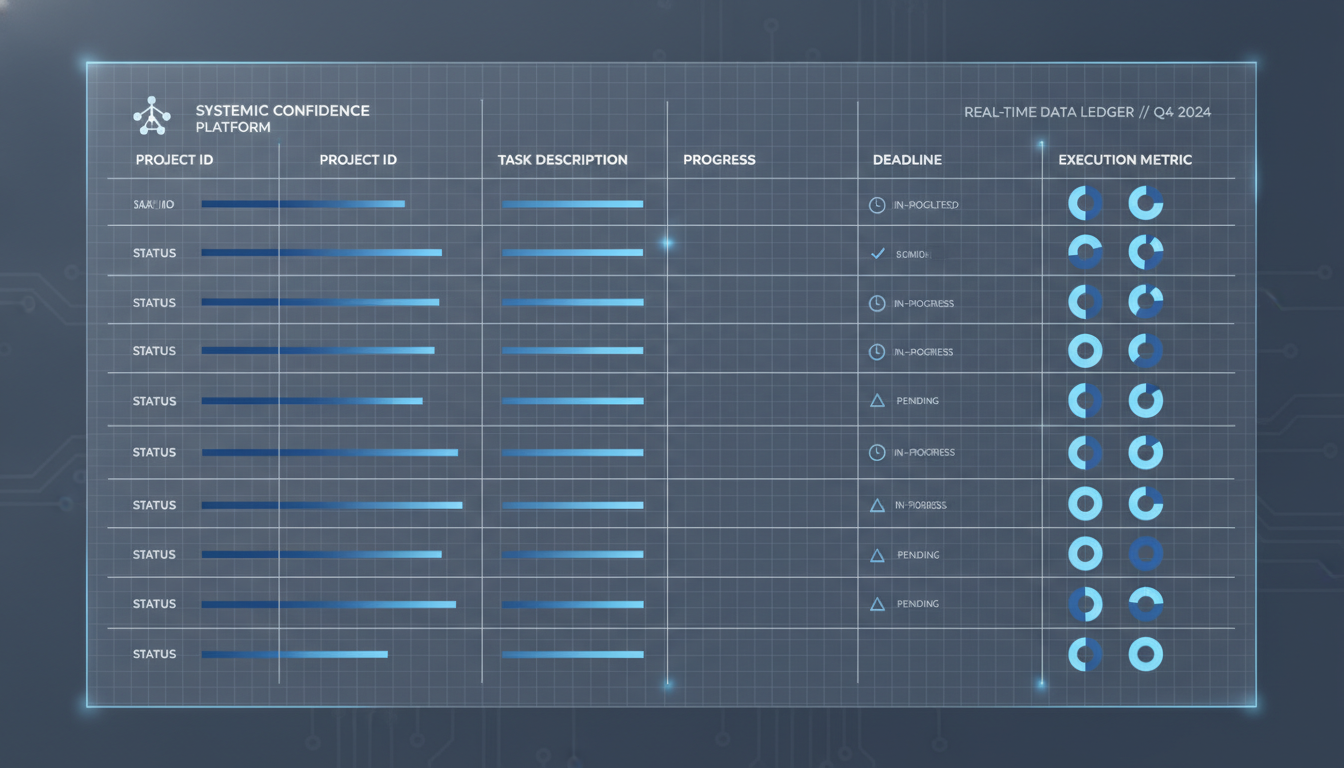
As a facilitator of the Systemic Confidence A-Z curriculum, your primary objective is to move the student from "Mood-Based Execution" to "Systemic Agency." This 8-week ledger is your diagnostic tool to measure the health of the student's Capability Hypotheses and the integrity of their Providence Archive.
Section 1: Weekly Planning (Hypothesis Design)
Activities 1–8: Before each week begins, collaborate with the student to define one primary Capability Hypothesis. Focus on a quantitative "If" (Time/Count) and a tangible "Then" (Artifact).
- Week 1 Hypothesis: ____________________________________________________________________
- Week 2 Hypothesis: ____________________________________________________________________
- Week 3 Hypothesis: ____________________________________________________________________
- Week 4 Hypothesis: ____________________________________________________________________
- Week 5 Hypothesis: ____________________________________________________________________
- Week 6 Hypothesis: ____________________________________________________________________
- Week 7 Hypothesis: ____________________________________________________________________
- Week 8 Hypothesis: ____________________________________________________________________
Section 2: The 8-Week Progress Monitoring Table
Activity 9: Fill in the following data points at the end of each week based on the student's Build Ledger and Providence Archive.
Week | Target Capability Hypothesis | Metric Target vs. Actual | Artifacts Secured | Resistance Spike? (Yes/No) |
|---|---|---|---|---|
1 | | | | |
2 | | | | |
3 | | | | |
4 | | | | |
5 | | | | |
6 | | | | |
7 | | | | |
8 | | | | |
Section 3: Systemic Health Diagnostics
Activities 10–15: Use the data from Activity 9 to perform a mid-cycle and final audit of the student's progress.
10. Artifact Yield Rate: Total Artifacts Secured / Total Metric Targets. Calculate the percentage.
Calculation: _____________________________________ Yield: [ _______ % ]
11. Peak Resistance Identification: In which week did the most intense Resistance Spike occur? What was the primary "Emotional Static" recorded by the student?
Week: ________ Static: ___________________________________________________________
12. The Metric Accuracy Audit: Identify a week where "Actual" execution was significantly higher or lower than "Target." Was the hypothesis poorly calibrated?
13. Resistance Spike Post-Mortem: Choose one "Yes" from the Resistance Spike column. What was the Logical Override used to bypass it?
14. Archive Growth Projection: Based on current yield, how many artifacts will be in the Providence Archive by the end of the semester?
15. Future Calibration: Based on the 8-week trend, should the student's next cycle of metrics be increased (Growth) or decreased (Stability)?
Decision: [ Increase / Decrease ] Reason: ___________________________________________
Section 4: Coordinator Review & Archiving
Activities 16–20: Finalize the 8-week monitoring period by verifying system integrity.
16. Are all 8 weeks of Build Ledgers signed and verified? [ Yes / No ]
17. Is the student's folder hierarchy (Providence Archive) current? [ Yes / No ]
18. Percentage of goals met without "Mood-Lies" influencing the outcome: _______%
19. Coordinator’s "Code Fix": One change you will make to the facilitation protocol for the next cycle:
20. Verification Signature: _____________________________ Date: ________________
Systemic Confidence: Tool Guide & Practice
Introduction: The Tools of Agency
In the Systemic Confidence A-Z framework, we use two primary physical tools to bypass anxiety and build factual proof of your capability:
- The Daily Log (Accommodation D): A tracker to record when you start and what you actually do, ignoring how you feel.
- The Evidence Folder (Accommodation E): A "Providence Archive" where you store physical proof (artifacts) of your completed work.
Part 1: The Daily Task Initiation & Completion Log
This tracker is your "black box" flight recorder. It doesn't care if the work was "good"—it only cares that the work happened.
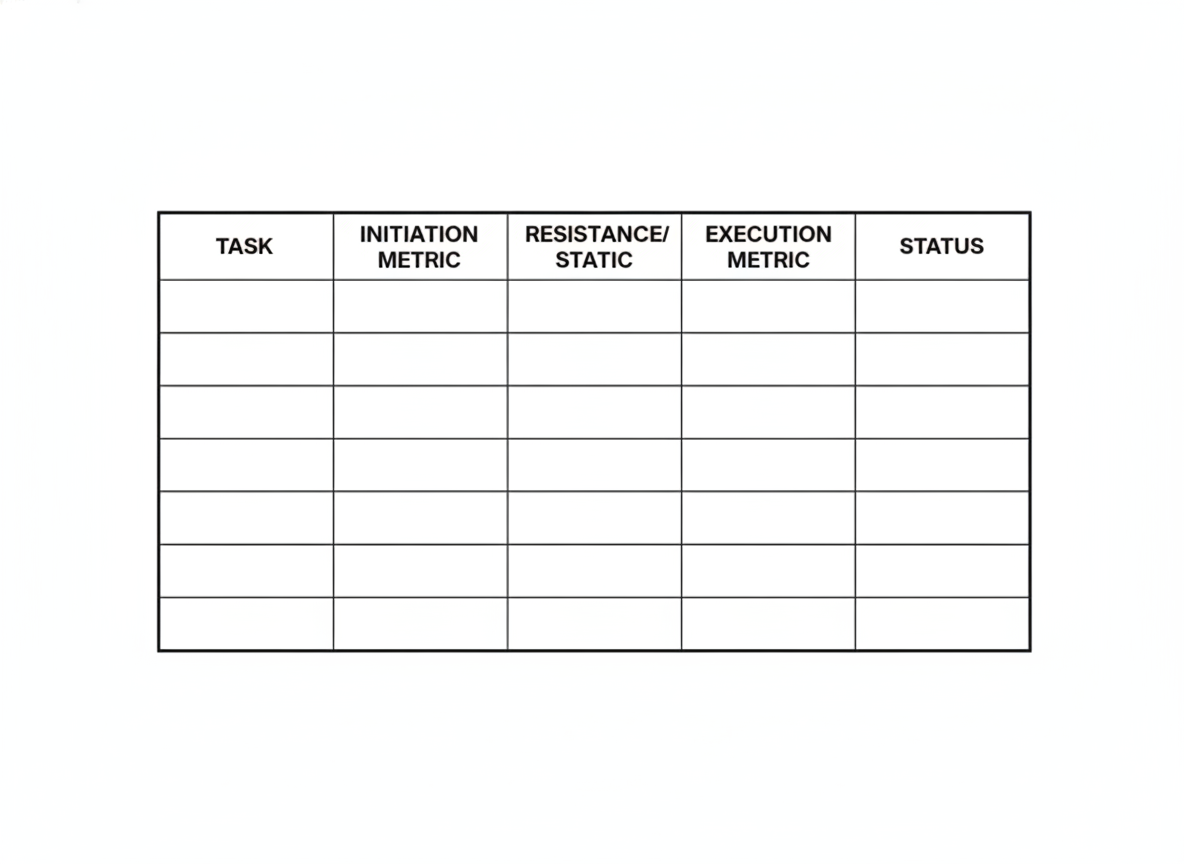
Activity 1: Diagram Labeling (Log Components)
Look at Figure 1 above. Match the correct component to its lettered location in the log. Write the correct letter in the blanks below.
- [ ___ ] Task Name: The specific assignment or project.
- [ ___ ] Initiation Metric: A small 5-minute task to break inertia (e.g., "Open doc").
- [ ___ ] Resistance/Static: The anxious thoughts or "Mood Lies" you felt (e.g., "I'm tired").
- [ ___ ] Execution Metric: The quantitative work done (e.g., "Wrote 200 words").
- [ ___ ] Status/Check-in: A final verification checkmark once the artifact is archived.
Activity 2: Defining the "Traction Move"
An Initiation Metric (or Traction Move) must be so small it is impossible to fail. Fill in the blanks to create an Initiation Metric for these tasks:
- Task: Math Homework | Initiation Metric: Write ________________ on the top of the page.
- Task: English Essay | Initiation Metric: Open the ________________ and name the file.
Activity 3: Identifying "Emotional Static"
Which of the following belongs in the Resistance/Static column? Circle the correct answer.
A. "I typed three sentences of the introduction."
B. "I feel like I'm going to fail because I don't understand the prompt."
C. "I spent 15 minutes researching the French Revolution."
D. "I moved 5 files into the Archive folder."
Activity 4: Static vs. Data
Rewrite this "Static" thought into a "Systemic Correction" (Logical Data).
- Static: "I can't start because I'm not in the right headspace and my work will be terrible."
- Correction: If I work for ______ minutes, I will have ______ words produced, regardless of my mood.
Activity 5: Mock Ledger Entry
Imagine you have to study for a Biology test. Fill out the mock ledger row below using the A-Z principles.
Task | Initiation Metric | Resistance/Static | Execution Metric |
|---|---|---|---|
Biology | __________________ | __________________ | __________________ |
Part 2: The Evidence Folder (Providence Archive)
This folder is where you store your "Receipts." When your brain says "I haven't done anything," you open this folder to see the physical proof.
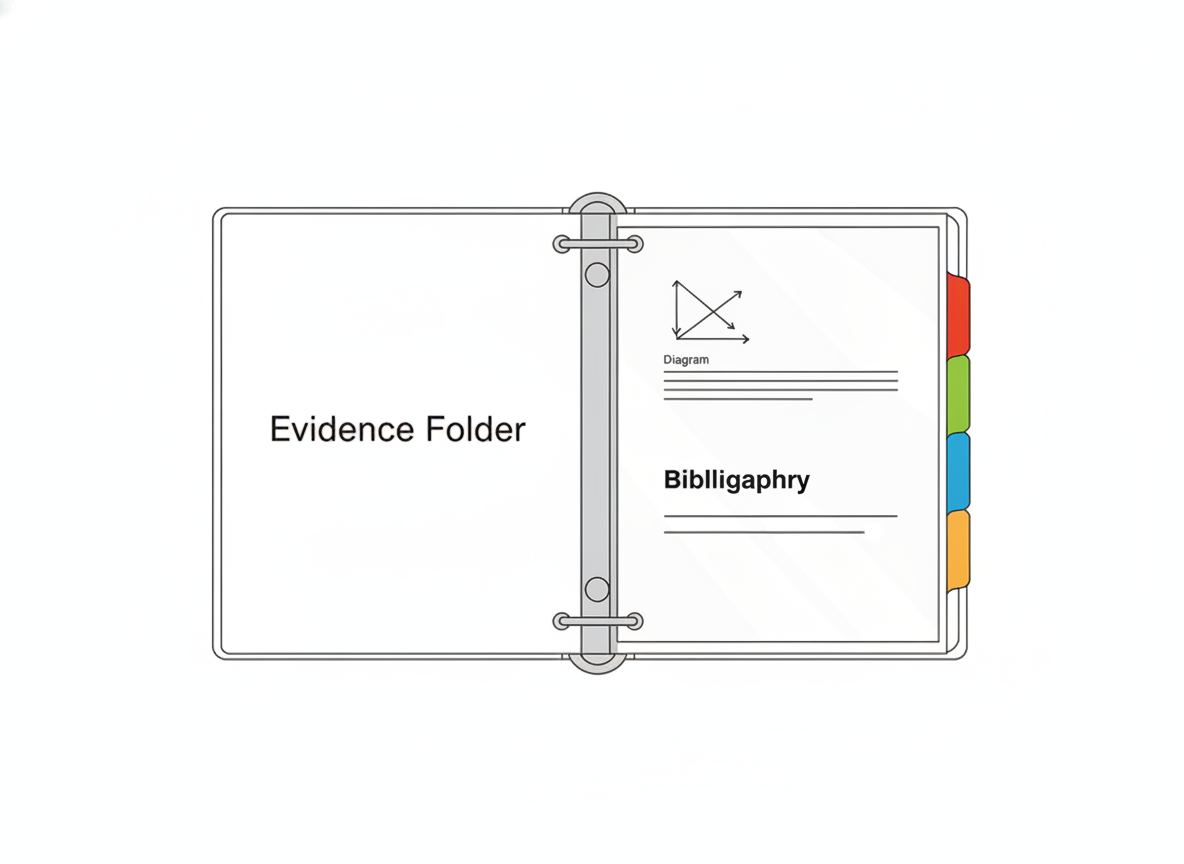
Activity 6: Diagram Labeling (Archive Components)
Identify the parts of the Evidence Folder in Figure 2. Write the correct term next to the description.
- ____________________: Used to separate different subjects (Math, English, History).
- ____________________: A visual brainstorm or "Mind Map" showing how ideas connect.
- ____________________: The physical printout of a draft, a quiz, or a list of sources.
Activity 7: Artifact Categorization
Which of the following items are considered "Artifacts" for your Evidence Folder? Put a checkmark [ ✓ ] next to the correct items.
- A list of 5 vocabulary words you defined.
- A feeling of being stressed about a test.
- A printed bibliography with 3 sources.
- A screenshot of a submitted Google Form.
- A thought about how hard the project is.
- A 2-minute voice memo of you practicing a speech.
Activity 8: Tab Hierarchy Design
Design the tab structure for your folder. List the four main subjects you are tracking this semester.
Tab 1: ____________________
Tab 2: ____________________
Tab 3: ____________________
Tab 4: ____________________
Activity 9: The "Receipt" Name
When you save a file to your digital archive, it needs a specific name. Create a file name for a History essay draft written on October 12th using the format: [Subject][Date][ArtifactType].
File Name: _________________________________________________________________
Activity 10: The Capability Map
Match the Capability Hypothesis to the Artifact it would produce in the folder. Draw a line to connect them.
Hypothesis | Artifact |
|---|---|
"If I read 5 pages..." | A. A recorded audio file |
"If I practice for 10 mins..." | B. A handwritten math scratch-sheet |
"If I solve 3 problems..." | C. A list of 3 summary bullet points |
Personal Operating Console: Systemic Confidence A-Z
System Overview: The Operator’s Framework
This Personal Operating Console is designed for high-performance self-regulation. By isolating emotional noise and focusing strictly on empirical execution data, the System Operator (you) can bypass resistance and build an objective record of agency.
This manual is organized into three tiers based on real-time psychological friction. Select the level that matches your current state.
LEVEL 1: THE RED-ALERT PROTOCOL
State: High Friction / Low Energy. Paralyzed by overthinking, perfectionism, or a severe Resistance Spike.
Objective: Break inertia via the 5-Minute Traction Rule. Starting the timer is a 100% success.
Activity 1: Dual-Column Cognitive Split Log
Instructions: Use this table to separate physical requirements from emotional static. Park your noise on the right so you can execute the data on the left.
Actionable Steps (Technical) | Emotional Static Parking Lot (Noise) |
|---|---|
1. _________________________________ | Example: "I'm going to fail at this." |
2. _________________________________ | _________________________________ |
3. _________________________________ | _________________________________ |
Activity 2: Structural Thought Deconstruction
Instructions: Run this deconstruction on your most persistent self-limiting loop. Translate the noise back into data.
- Identify the Loop (The Noise): ___________________________________________________
- Isolate the Factual Variable: Does this thought contain a quantitative prediction (Yes/No)? ______
- Apply the Systemic Correction: If I execute for 5 minutes, what is the guaranteed artifact produced?
- Guaranteed Artifact: ________________________________________________________
LEVEL 2: THE STEADY-STATE LEDGER
State: Medium Friction / Routine Output. Functional but prone to drift or loss of momentum.
Objective: Maintain systemic integrity through structured tracking.
Activity 3: Daily Task Initiation and Completion Log
Instructions: Record the factual reality of your system. Ignore quality; track only the execution metrics.
Task Name | Initiation Metric (5m) | Resistance/Static Check-In | Factual Output Count | Archive Status |
|---|---|---|---|---|
________________ | ________________ | ________________ | ________________ | [ ] |
________________ | ________________ | ________________ | ________________ | [ ] |
________________ | ________________ | ________________ | ________________ | [ ] |
________________ | ________________ | ________________ | ________________ | [ ] |
LEVEL 3: THE ARCHIVAL VAULT & RESTRUCTURING LOG
State: High Energy. Clear-headed and ready to solidify proof of agency or tune the long-term system.
Objective: Audit data and update the protocol for the next cycle.
Activity 4: Providence Archive Mapping Index
Instructions: Index your artifacts here to create a permanent record of capability.
- Category 1: _____________________ | Artifact Count: _______ | Key Proof: _________________
- Category 2: _____________________ | Artifact Count: _______ | Key Proof: _________________
- Category 3: _____________________ | Artifact Count: _______ | Key Proof: _________________
Activity 5: Post-Mortem Technical Manual (The "Code Fix")
Instructions: Analyze a recent system failure (friction event) and design a technical solution.
- Friction Point: At what specific timestamp did execution stop? ________________________
- Root Cause (Data, not feelings): ____________________________________________________
- The Code Fix: What physical change will be implemented starting Monday? (e.g., "Phone in timed locker," "Metric lowered by 50%").
- Fix: ___________________________________________________________________________
Activity 6: System Update (REST Review Checklist)
Instructions: Audit your alignment for the previous cycle. Use the 3 core questions.
- Artifact Check: Did every "Completed" entry result in a tangible artifact in the Archive?
- Static Variance: Is the frequency of "Red-Alert" states decreasing as the Archive grows?
- Metric Calibration: Are the current metrics resulting in a >90% success rate? (If no, lower the metric).
The Maintenance Reset Task: Based on the audit above, write the one execution metric that will define your success for the next 4 weeks.
Primary Metric: ____________________________________________________________________