Generated with Monsha
Main Idea & Supporting Details: Comprehensive Grade 3 Reading Unit
Smart Worksheet · Grade 3 · English
Main Idea & Supporting Details: Comprehensive Grade 3 Reading Unit
Main Idea & Supporting Details Unit
This unit is designed to help students in Grades 2–3 master the concept of identifying the main idea and supporting details in nonfiction texts.
Part 1: Anchor Charts & Visual Aids
Use these posters to introduce the concepts and keep them visible for student reference throughout the unit.
Poster 1: Topic vs. Main Idea vs. Detail
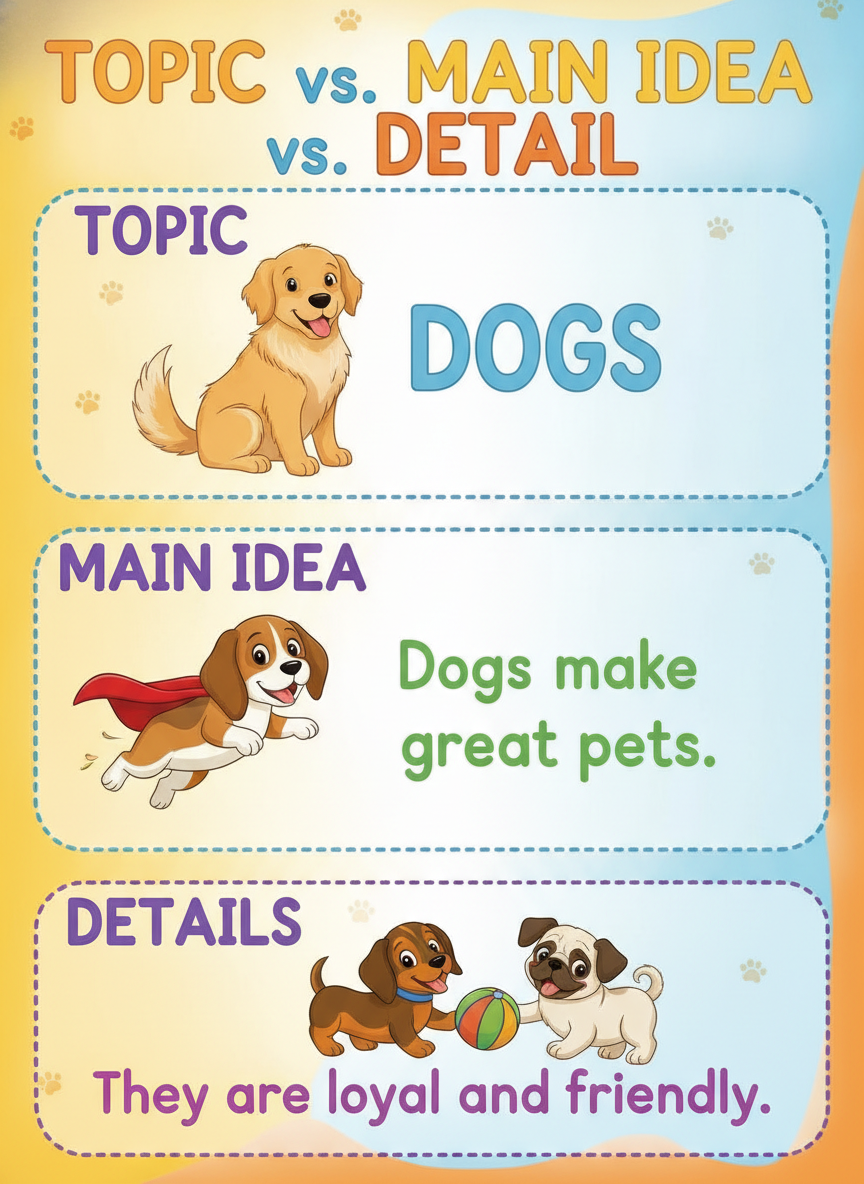
Poster 2: How to Find the Main Idea
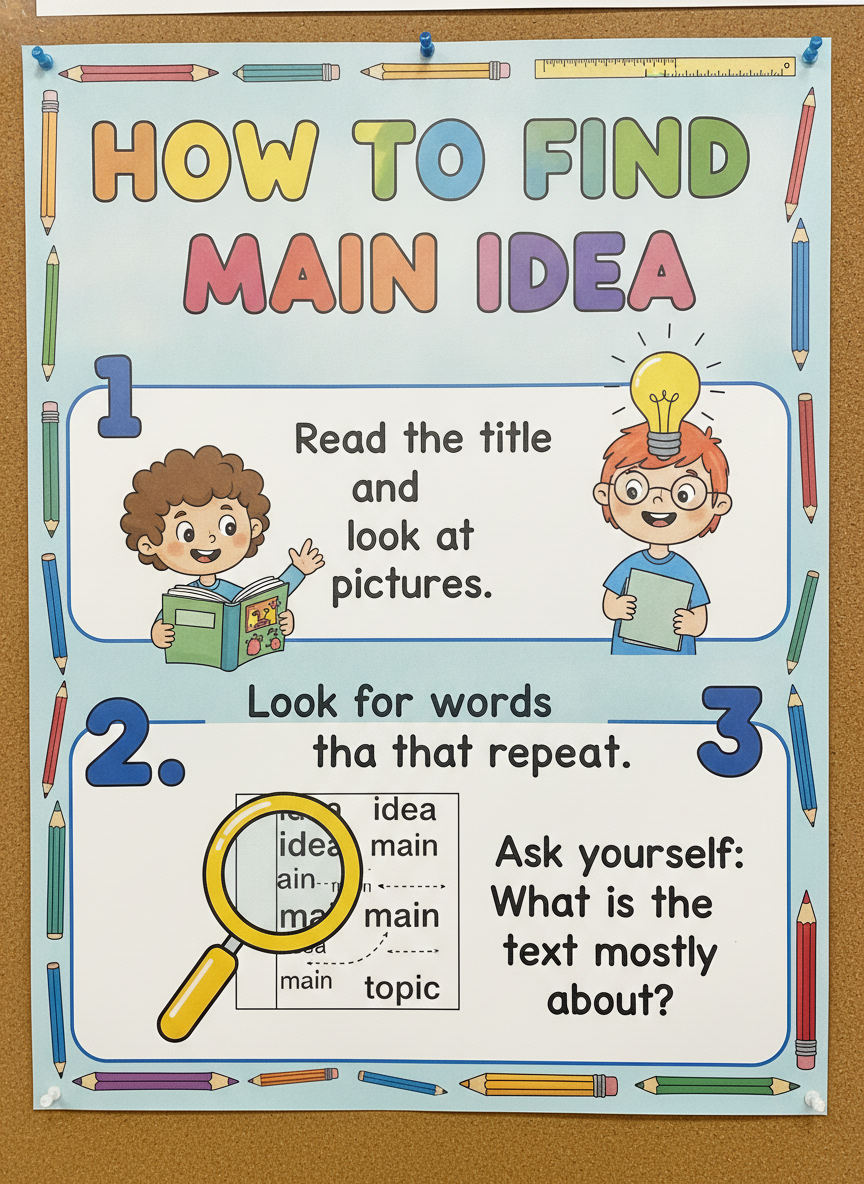
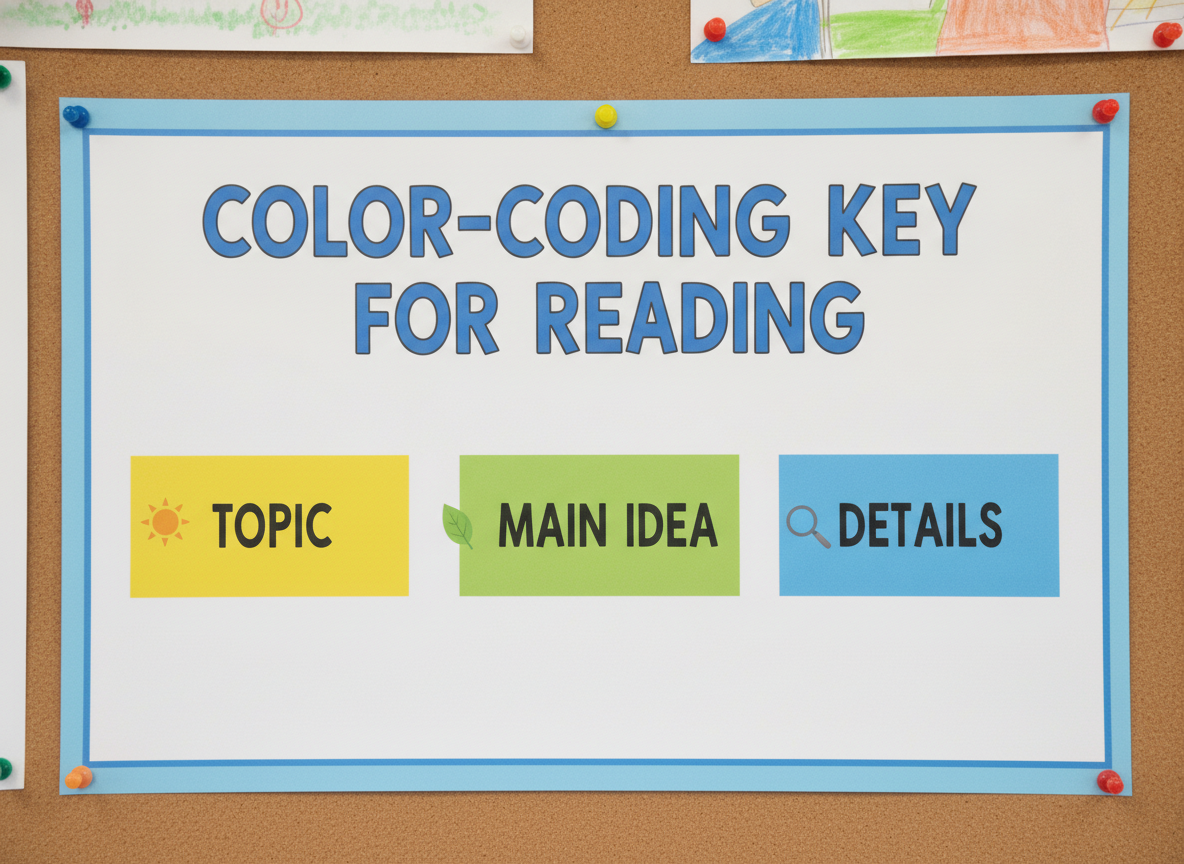
Poster 3: Color-Coding Key
Poster 4: Details Support the Main Idea
In this model, think of the Main Idea as the top of a table. It is the most important part that holds everything up. The Supporting Details are the legs. Without the legs, the table (the main idea) cannot stand!
Activity: Label the Table
Look at the diagram below. Match the labels to the correct parts of the table visual.
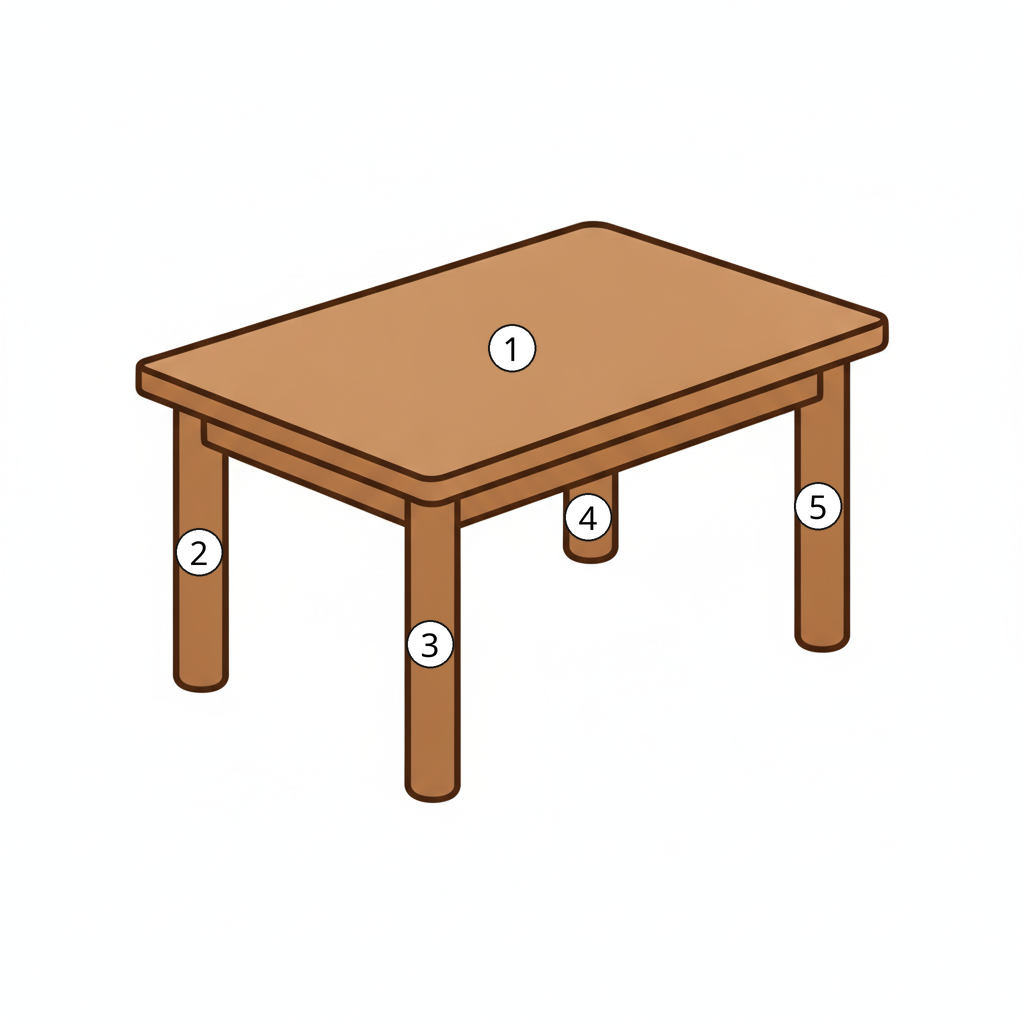
Labels to use:
- Table Top (Main Idea)
- Leg 1 (Supporting Detail)
- Leg 2 (Supporting Detail)
- Leg 3 (Supporting Detail)
- Leg 4 (Supporting Detail)
- ________________
- ________________
- ________________
- ________________
- ________________
Part 2: Graphic Organizers
These organizers can be used with any of the passages in this unit or any other nonfiction text.
Graphic Organizer 1: Main Idea Web
Name:
Date:
Main Idea Web
Grade 3: Main Idea & Details
Instructions:
Write the main idea in the center circle. Then, write four supporting details in the circles around it.
MAIN IDEA
Graphic Organizer 2: Detail & Example Table
Name:
Date:
Evidence Tracking Table
| Concept | Your Response |
|---|---|
| Topic | |
| Main Idea | |
| Detail 1 | |
| Detail 2 | |
| Detail 3 | |
| Example of a Detail |
Graphic Organizer 3: Color-Coding Checklist
Reading Checklist
Did I color the Topic YELLOW?
Did I color the Main Idea GREEN?
Did I color the Details BLUE?
Check each box after you finish coloring your passage!
Part 3: Practice Passages
Passage 1: Life at a Fire Station (Difficulty: ~470L)
Firefighters have a very busy life at the fire station. They do not just wait for fires. When they are at the station, they clean the big red trucks. They check the long hoses to make sure they work. Firefighters also practice how to stay safe. They exercise to keep their bodies strong. They even cook meals together in a big kitchen. Life at the station is full of hard work and team spirit.
Task 1: Color-Code
- Highlight the Topic in yellow.
- Highlight the Main Idea in green.
- Highlight one Detail in blue.
Task 2: Restate
- Topic: ________________
- Main Idea: ________________
- One Detail: ________________
- Which sentence states the main idea of the passage? A. Firefighters wait for fires to start. B. Firefighters cook meals in a big kitchen. C. The fire trucks are painted red. D. Firefighters have a very busy life at the station.
- Which detail supports the idea that firefighters stay busy? A. They only work when there is a fire. B. They sleep all day. C. They clean the trucks and check the hoses. D. The station has a big kitchen.
Short Answer: In your own words, what is this passage mostly about?
________________
Passage 2: The Planet Mercury (Difficulty: ~500L)
Mercury is a very interesting planet because it is so close to the Sun. It is the smallest planet in our solar system. Because it is so close to the Sun, Mercury gets very hot during the day. However, it gets very cold at night. This is because Mercury does not have a thick layer of air to hold in the heat. It is also covered in deep holes called craters. Mercury is a dry and rocky world.
Task 1: Color-Code
- Highlight the Topic in yellow.
- Highlight the Main Idea in green.
- Highlight one Detail in blue.
Task 2: Restate
- Topic: ________________
- Main Idea: ________________
- One Detail: ________________
- Which sentence tells the main idea of this text? A. Mercury is very cold at night. B. Mercury is interesting because it is close to the Sun. C. Mercury is the smallest planet. D. Mercury has deep holes called craters.
- What is one detail that explains why Mercury gets cold at night? A. It is made of rock. B. It is very dry. C. It is the smallest planet. D. It does not have a thick layer of air.
Short Answer: Why does the author think Mercury is interesting?
________________
Passage 3: Harriet Tubman (Difficulty: ~550L)
Harriet Tubman was a brave woman who helped many people find freedom. She escaped from slavery herself, but she went back to help others. Harriet used a secret path called the Underground Railroad. She led people through the woods and across rivers at night. She looked at the stars to find the way. Harriet Tubman never lost a single person on her trips. She is remembered as a hero for her courage.
Task 1: Color-Code
- Highlight the Topic in yellow.
- Highlight the Main Idea in green.
- Highlight one Detail in blue.
Task 2: Restate
- Topic: ________________
- Main Idea: ________________
- One Detail: ________________
- What is the main idea of this passage? A. Harriet Tubman used the stars to travel. B. Harriet Tubman lived in the woods. C. The Underground Railroad was a secret path. D. Harriet Tubman was a hero who helped people escape to freedom.
- Which detail shows that Harriet was a safe leader? A. She went back to help her family. B. She never lost a person on her trips. C. She walked at night. D. She was very brave.
Short Answer: How did Harriet Tubman show courage?
________________
Passage 4: Black Bears (Difficulty: ~600L)
Black bears have special ways to survive the changing seasons. During the summer, they eat as much food as they can. They love berries, nuts, and fish. This helps them get fat for the winter. When the weather gets cold, black bears find a cozy den. They go into a deep sleep for many months. Their heart rate slows down, and they do not eat or drink. When spring comes, the bears wake up and look for food again.
Task 1: Color-Code
- Highlight the Topic in yellow.
- Highlight the Main Idea in green.
- Highlight one Detail in blue.
Task 2: Restate
- Topic: ________________
- Main Idea: ________________
- One Detail: ________________
- Which sentence states the main idea? A. Bears sleep in a den in the winter. B. Bears get fat in the summer. C. Black bears eat berries and nuts. D. Black bears have special ways to survive the seasons.
- Which detail supports the idea that bears prepare for winter? A. They have black fur. B. They like to catch fish. C. They wake up in the spring. D. They eat as much food as they can in the summer.
Short Answer: What happens to a black bear's body in the winter?
________________
Passage 5: How to Make Pancakes (Difficulty: ~650L)
Making delicious pancakes is easy if you follow a few simple steps. First, gather your ingredients like flour, milk, and eggs. Mix them together in a large bowl until the batter is smooth. Next, heat a flat pan on the stove and add a little butter. Pour a small amount of batter onto the hot pan. Wait for tiny bubbles to appear on the surface of the pancake. Then, carefully flip it over with a spatula. Once both sides are golden brown, your pancake is ready to eat with syrup!
Task 1: Color-Code
- Highlight the Topic in yellow.
- Highlight the Main Idea in green.
- Highlight one Detail in blue.
Task 2: Restate
- Topic: ________________
- Main Idea: ________________
- One Detail: ________________
- What is the main idea of this text? A. Gathering ingredients is the first step. B. Pancakes need syrup to taste good. C. You can make pancakes by following simple steps. D. Bubbles appear on the surface of pancakes.
- When should you flip a pancake? A. When you heat the pan. B. As soon as you pour the batter. C. After you put syrup on it. D. When tiny bubbles appear on the surface.
Short Answer: Why is it important to heat the pan before pouring the batter?
________________
Passage 6: Anaconda Snakes (Difficulty: ~700L)
The green anaconda is one of the most powerful predators in the Amazon rainforest. This massive snake can grow to be over 20 feet long. Anacondas spend most of their time in the water, such as slow-moving rivers and swamps. This helps them hide from their prey. They are excellent swimmers and can stay underwater for a long time. Anacondas use their strong bodies to squeeze their prey. They do not have venom like some other snakes. Instead, they rely on their incredible strength to survive in the wild.
Task 1: Identify
- Main Idea: ________________
- Supporting Detail: ________________
- Example of that detail: ________________
- Which sentence best describes the main idea? A. Anacondas do not have venom. B. Anacondas can swim very well. C. The green anaconda is a powerful and strong predator. D. Anacondas live in the Amazon rainforest.
- Which detail supports the idea that anacondas are suited for water? A. They live in slow-moving rivers and swamps. B. They squeeze their prey. C. They grow to 20 feet long. D. They live in the rainforest.
Short Answer: How does the anaconda's size help it be a predator?
________________
Passage 7: The Wampanoag People (Difficulty: ~720L)
The Wampanoag people have a long history of living in harmony with the land in New England. They were skilled farmers and hunters who used natural resources wisely. For example, they planted corn, beans, and squash together in a way called the 'Three Sisters.' This method helped the soil stay healthy. They also moved their homes based on the seasons. In the winter, they lived in protected valleys. In the summer, they moved closer to the ocean to fish. Today, the Wampanoag continue to share their traditions and care for their ancestral lands.
Task 1: Identify
- Main Idea: ________________
- Supporting Detail: ________________
- Example of that detail: ________________
- What is the main idea of the passage? A. The Three Sisters are corn, beans, and squash. B. The Wampanoag people lived in harmony with the land. C. They liked to fish in the ocean during summer. D. The Wampanoag moved their homes in the winter.
- Which is an example of the Wampanoag using resources wisely? A. They move their homes. B. They used the 'Three Sisters' planting method. C. They have a long history. D. They lived in New England.
Short Answer: Why did the Wampanoag move their homes during different seasons?
________________
Passage 8: Thunder and Lightning (Difficulty: ~750L)
Thunder and lightning are powerful natural events that happen during a storm. Lightning is actually a giant spark of electricity that jumps between clouds or to the ground. It is extremely hot—five times hotter than the Sun! This heat causes the air around the lightning to expand very quickly. When the air expands, it creates a loud shockwave that we hear as thunder. Even though they happen at the same time, we see lightning before we hear thunder because light travels much faster than sound. Understanding these events helps us stay safe during storms.
Task 1: Identify
- Main Idea: ________________
- Supporting Detail: ________________
- Example of that detail: ________________
- What causes thunder? A. Electricity jumping to the ground. B. Light traveling fast. C. Air expanding quickly due to heat from lightning. D. Clouds bumping into each other.
- Which detail explains why we see lightning first? A. Lightning is hotter than the Sun. B. Thunder is a shockwave. C. Lightning is a spark of electricity. D. Light travels faster than sound.
Short Answer: In your own words, explain the relationship between lightning and thunder.
________________
Passage 9: A Kid Who Built Wells (Difficulty: ~780L)
Ryan Hreljac was only six years old when he learned that many people in Africa did not have clean water. He wanted to help, so he started doing chores to earn money. Eventually, Ryan’s passion inspired others to donate. His hard work led to the creation of the Ryan’s Well Foundation. This organization has helped build over 1,000 wells in 16 different countries. These wells provide safe, clean water for nearly a million people. Ryan’s story proves that even a young child can make a global impact by following their heart and taking action to solve a problem.
Task 1: Identify
- Main Idea: ________________
- Supporting Detail: ________________
- Example of that detail: ________________
- Which sentence states the main idea? A. One child can make a global impact by taking action. B. Many people in Africa need clean water. C. Ryan's Well Foundation built 1,000 wells. D. Ryan Hreljac was six years old.
- Which detail shows the scale of Ryan's impact? A. His foundation built over 1,000 wells in 16 countries. B. He did chores to earn money. C. He was inspired by his teacher. D. He learned about Africa in school.
Short Answer: How did Ryan start his mission to help people?
________________
Passage 10: The Super Bowl (Difficulty: ~800L)
The Super Bowl is more than just a championship football game; it is a major cultural event in the United States. Every year, millions of people gather to watch the two best teams in the NFL compete for the Vince Lombardi Trophy. However, the game is only part of the excitement. Companies spend millions of dollars to create special commercials that are often funny or touching. During halftime, famous musicians perform incredible shows that attract viewers who might not even like football. The Super Bowl has become a day for families and friends to gather, eat snacks, and celebrate a unique American tradition.
Task 1: Identify
- Main Idea: ________________
- Supporting Detail: ________________
- Example of that detail: ________________
- What is the main idea of this passage? A. Halftime shows feature famous musicians. B. The Super Bowl is a major cultural event that involves more than just football. C. Companies spend a lot of money on commercials. D. The Super Bowl is the NFL championship game.
- Which detail supports the idea that the Super Bowl is about more than football? A. Two teams compete for a trophy. B. The winning team gets a trophy. C. It is played every year. D. People gather to watch commercials and halftime shows.
Short Answer: Why do people who don't like football still watch the Super Bowl?
________________
Part 4: Unit Test
Passage A: The Tower of London
The Tower of London is a historic castle located on the north bank of the River Thames in London. It was founded toward the end of 1066. Over the centuries, it has served many different purposes. At first, it was built as a royal palace and a fortress to protect the city. Later, it became a famous prison for important people. Today, the Tower is a popular tourist site and holds the Crown Jewels. The castle is guarded by the Yeoman Warders, also known as 'Beefeaters.' Visitors from all over the world come to see its thick walls and learn about its long history.
- What is the main idea of Passage A? A. The Tower was built in 1066. B. The Tower of London is a historic castle with many past uses. C. The Crown Jewels are kept in the Tower. D. The Tower of London is guarded by Beefeaters.
- Which was NOT a use for the Tower of London mentioned in the text? A. Fortress B. Royal palace C. Prison D. Library
- Who are the Yeoman Warders? A. Tourists B. Prisoners C. Guards of the Tower D. Kings and Queens
- Why do visitors come to the Tower today? A. To cross the River Thames B. To work as guards C. To see the Crown Jewels and learn history D. To stay in the palace
Short Constructed Response: Identify one supporting detail from the text that explains the Tower's role as a fortress.
________________
Passage B: Labor Day
Labor Day is a federal holiday in the United States celebrated on the first Monday in September. It was created to honor the hard work and achievements of American workers. The holiday began in the late 1800s during a time when many people worked very long hours in difficult conditions. Today, Labor Day often represents the unofficial end of summer. Many families celebrate with parades, picnics, and backyard barbecues. It is also a time for many students to get ready for the start of a new school year. Most importantly, it remains a day to appreciate everyone who contributes to the country’s strength.
- What is the main purpose of Labor Day? A. To celebrate the end of summer. B. To honor American workers and their achievements. C. To start the school year. D. To have a picnic with family.
- When is Labor Day celebrated? A. The last day of August B. The late 1800s C. The end of the school year D. The first Monday in September
- How do people celebrate Labor Day today? A. By working long hours B. By moving to a new city C. By staying at school D. With parades and barbecues
- Which detail explains why the holiday was started? A. Workers had difficult conditions and long hours. B. People like picnics. C. It is the end of summer. D. Students are going back to school.
Short Constructed Response: Based on the text, why is Labor Day considered the 'unofficial end of summer'?
________________