Generated with Monsha
Mastering the Synthesis Essay: AP Seminar EOC Part B Strategy
Lesson Plan · Grade 10 · English
Master the Synthesis Essay: AP Seminar EOC Part B Lesson Plan
Grade Level: 10th Grade
Duration: 45 Minutes
This lesson plan is designed to equip students with the structural and analytical skills required to excel in the AP Seminar End-of-Course (EOC) Exam: Part B. By focusing on the "Line of Reasoning" and the synthesis of multiple sources, students will learn to move beyond mere summary to construct original, well-supported arguments.
1. Objectives & Learning Outcomes
By the end of this lesson, students will be able to:
- Synthesize Information: Identify a central theme or common issue that connects four diverse stimulus sources.
- Develop a Perspective: Formulate a thesis statement that takes a clear position and incorporates an "unrepresented perspective" or an insightful approach not explicitly detailed in the sources.
- Establish a Line of Reasoning: Organize a multi-paragraph outline that logically connects claims, evidence, and commentary.
- Evaluate Academic Standards: Utilize the AP Seminar Row 1–4 Scoring Guidelines to self-assess and refine their argument planning.
2. 21st Century Skills/College & Career Readiness Skills
- Critical Thinking: Analyzing divergent viewpoints to create a unique, reasoned conclusion.
- Information Literacy: Effectively selecting and attributing evidence from multiple sources to validate a personal claim.
- Academic Integrity: Practicing proper attribution techniques (using source letters or author names) to acknowledge external information.
- Strategic Communication: Building a persuasive argument that anticipates and rebuts counter-arguments, a vital skill for college-level writing and professional advocacy.
3. Material & Resources Needed
- Stimulus Packet: Four diverse sources (Articles, Images, or Data Sets) typical of the AP Seminar EOC Part B.
- AP Seminar Scoring Guidelines: The 2023 Rubric (focusing on Row 1: Establish Argument, Row 2: Line of Reasoning, Row 3: Select and Use Evidence, and Row 4: Conventions).
- EOC B Planning Template: A structured worksheet with sections for: Hook, Context, Thesis, Claims, Evidence, and Rebuttal.
- Exemplar Material: Sample Student Response A (the "High-Score" 24-point sample) to use for modeling.
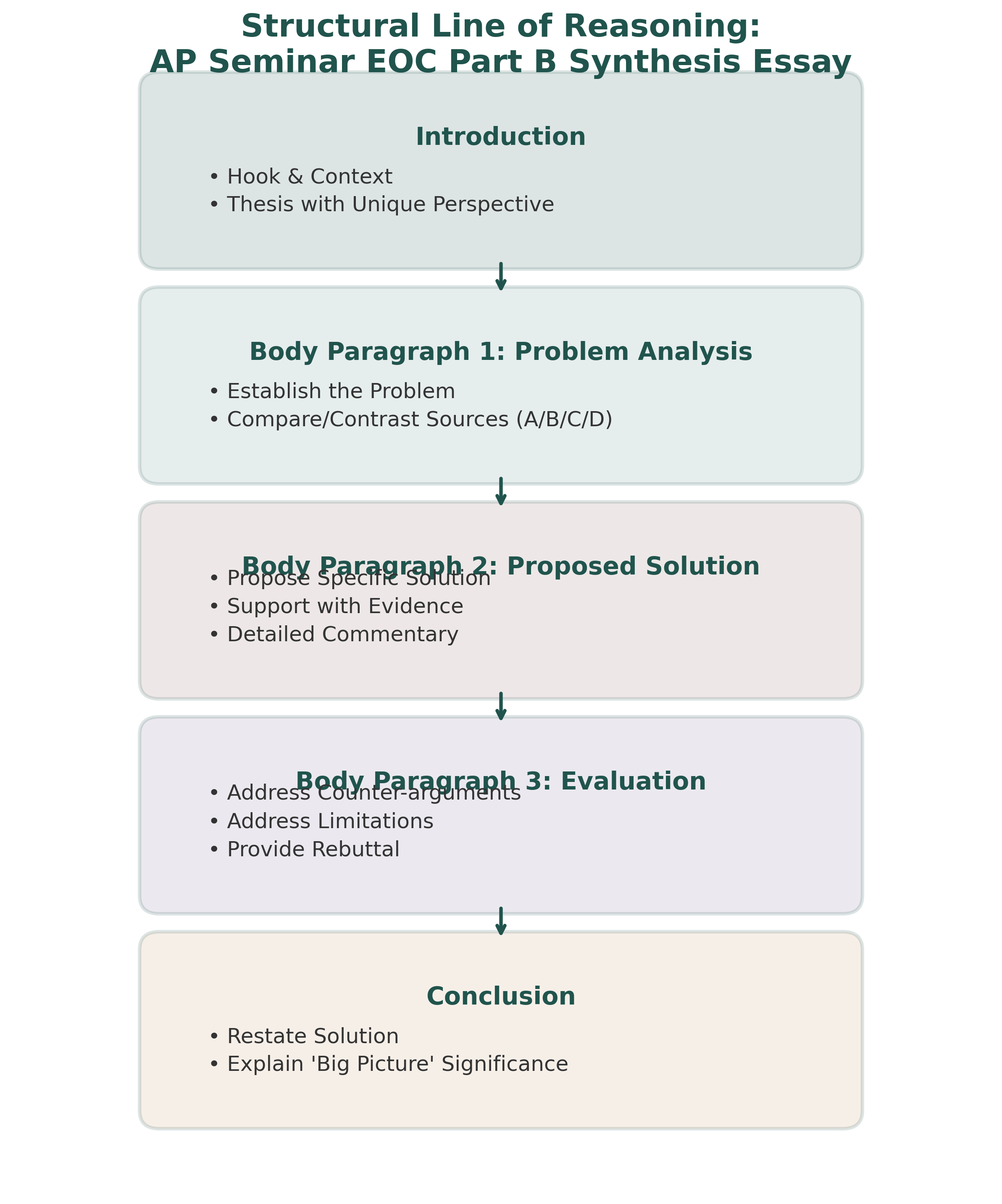
- Visual Support: The "Line of Reasoning" structural flow diagram (see Figure 1).
4. Assessment and Evaluation Plan
- Pre-Assessment (Formative): Students participate in a "Common Thread" brainstorm. After reading two of the provided sources, they must identify one keyword or concept that connects them. Teacher monitors for accuracy in theme identification.
- Performance Task (Formative): Completion of the EOC B Planning Template. The teacher will conduct a "Gallery Walk" or individual check-ins, specifically reviewing the Thesis Statement to ensure it includes both a common theme and a perspective not represented in the documents.
- Peer Review: Students trade their templates and use Row 1 (0–6 points) and Row 3 (0–6 points) of the official scoring guidelines to evaluate their partner. They must find and highlight where the partner "put two sources in conversation."
- Final Check (Summative): A 10-minute "Exit Ticket" where students write one Body Paragraph including a claim, evidence from two sources, and commentary connecting them back to their thesis.
Mastering the Synthesis Essay: AP Seminar EOC Part B Strategy
Lesson Overview
Grade Level: 10th Grade
Duration: 45 Minutes
Subject: AP Seminar
This lesson focuses on the highest-weighted section of the AP Seminar End-of-Course (EOC) Exam: Part B. Students will move beyond simple summary to master the art of "putting sources in conversation" and developing an original, student-driven argument supported by multiple perspectives.
1. Objectives & Learning Outcomes
By the end of this lesson, students will be able to:
- Identify Themes: Analyze four diverse stimulus sources to identify a common theme or central issue.
- Develop a Unique Perspective: Construct a thesis statement that includes a perspective not represented in the documents or brings a particularly insightful approach to the theme.
- Synthesize Evidence: Orally and in writing, put at least two sources "in conversation" with each other to support a claim.
- Structure a Line of Reasoning: Map out a logically organized argument including a hook, context, evidence, counter-argument, and a "big picture" conclusion.
2. 21st Century Skills/College & Career Readiness Skills
- Critical Thinking: Synthesizing divergent viewpoints into a cohesive and original argument.
- Information Literacy: Evaluating multiple sources of information to find valid, supporting evidence for a complex claim.
- Communication: Effectively conveying a line of reasoning that anticipates and rebuts opposing viewpoints.
- Self-Regulation: Using scoring rubrics to self-assess and refine academic writing before final submission.
3. Material & Resources Needed
- Stimulus Material Packet: (e.g., The 2019 EOC Part B sources: Silko on Pueblo migration, Ponte on Dumpster Divers, Thoreau’s Walden, and Vanderbilt on Biomimicry).
- AP Seminar Scoring Guidelines: Focus on Rows 1–4 (Establish Argument, Line of Reasoning, Evidence, and Conventions).
- EOC B Planning Template: A worksheet for drafting the thesis, claims, evidence, and rebuttals.
- High-Score Sample A: An exemplar student response (24/24) for modeling success.
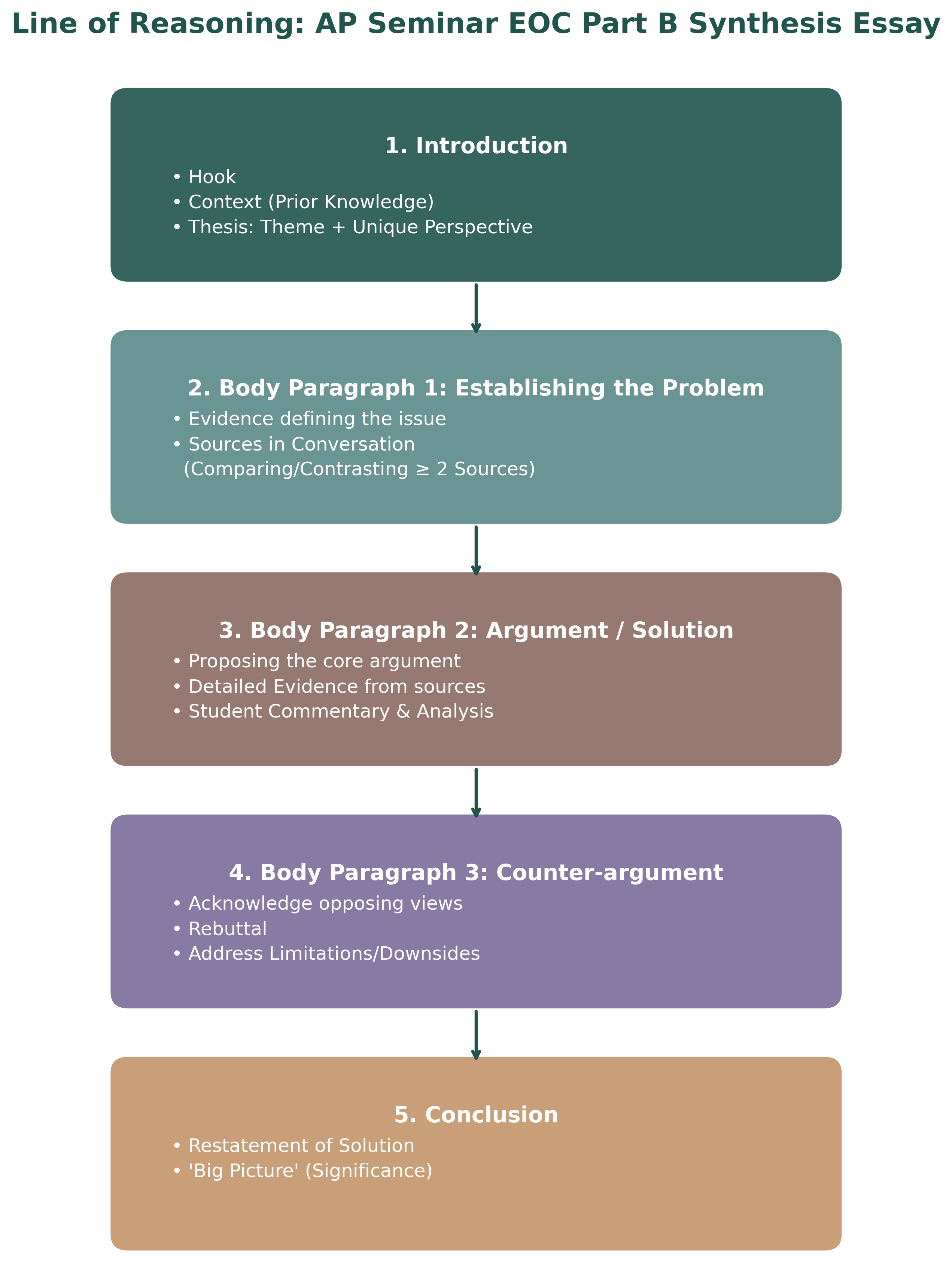
- Visual Guide: The "Line of Reasoning" structural flow diagram (see Figure 1).
4. Assessment and Evaluation Plan
- Formative Assessment (Theme Identification): During the first 10 minutes (Reading Phase), the teacher will circulate and check student annotations. Students must identify the "Common Theme" and one "Missing Perspective" on a sticky note to be placed on the board.
- Guided Practice (Source Conversation): Using the planning template, students will work in pairs to write one sentence that connects two different sources (e.g., "While Source A focuses on the spiritual value of waste, Source B focuses on the practical and political reuse of it"). Teacher will provide immediate feedback on these "conversation" links.
- Peer Evaluation (Thesis Check): Students will swap their drafted thesis statements and use the Row 1 Rubric to score them. They must answer: Does the thesis identify a theme? Does it include a perspective not in the documents?
- Summative Assessment (Exit Ticket): Students will write a 5-sentence "Body Paragraph 3" (Counter-argument and Rebuttal) based on their planning template. These will be graded against the Row 2 (Line of Reasoning) rubric criteria for logical organization.
Vocabulary Summary: AP Seminar EOC Part B Synthesis Essay
Lesson Summary: Cracking the AP Seminar EOC Part B
Lesson Summary: AP Seminar EOC Part B Synthesis Essay
This lesson provided a strategic roadmap for mastering the End-of-Course (EOC) Exam: Part B, which requires students to write an evidence-based argument in 90 minutes using four provided stimulus sources.
I. The First 10 Minutes: Reading and Strategy
Success begins with efficient reading. Students should not simply read the sources but actively annotate them to find:
- The Connecting Theme: The shared issue or "bridge" between all four documents (e.g., power, justice, or environmental sustainability).
- The Perspectives: How each author views the theme. Identify where they agree, disagree, or provide specific examples.
- The "Gap": Identifying what is missing from the sources is the key to earning high scores (6 points) in Row 1. This allows the student to propose a unique perspective.
II. The Essential Structure: Line of Reasoning
A high-scoring essay follows a logical progression, moving from a broad issue to a specific, defended conclusion.
- Introduction: Starts with a compelling hook and context from prior knowledge. Ends with a Thesis that identifies the theme and proposes a specific, student-driven solution.
- Establish the Issue (Body 1): Proves the problem exists by putting sources "in conversation." Instead of summarizing Source A then Source B, students must compare and contrast them within the same paragraph.
- Propose the Argument (Body 2): Details the student's own solution, supported by evidence from the sources and deep commentary explaining the logic.
- The Rebuttal (Body 3): Critically evaluates the solution by acknowledging limitations or downsides, then provides a rebuttal to strengthen the original claim.
- Conclusion: Restates the position and links the argument to the "Big Picture"—explaining why this issue matters in a broader global or social context.
III. Key Success Factors (The "Golden Rules")
- Synthesis, Not Summary: Avoid simply retelling what the sources said. The student's own voice should drive the argument, using the sources only as tools for support.
- Attribution: Always credit the authors or sources (e.g., "Source A") to maintain academic integrity and score well in Row 4 (Conventions).
- Intentional Order: Claims must be ordered logically so that each paragraph builds upon the previous one.