Generated with Monsha
Save this resource to edit, expand, or export it, or create more resources for free.
Mastering the Expository Essay
Worksheet
Grade 7
English
Mastering the Expository Essay
Introduction to Expository Writing
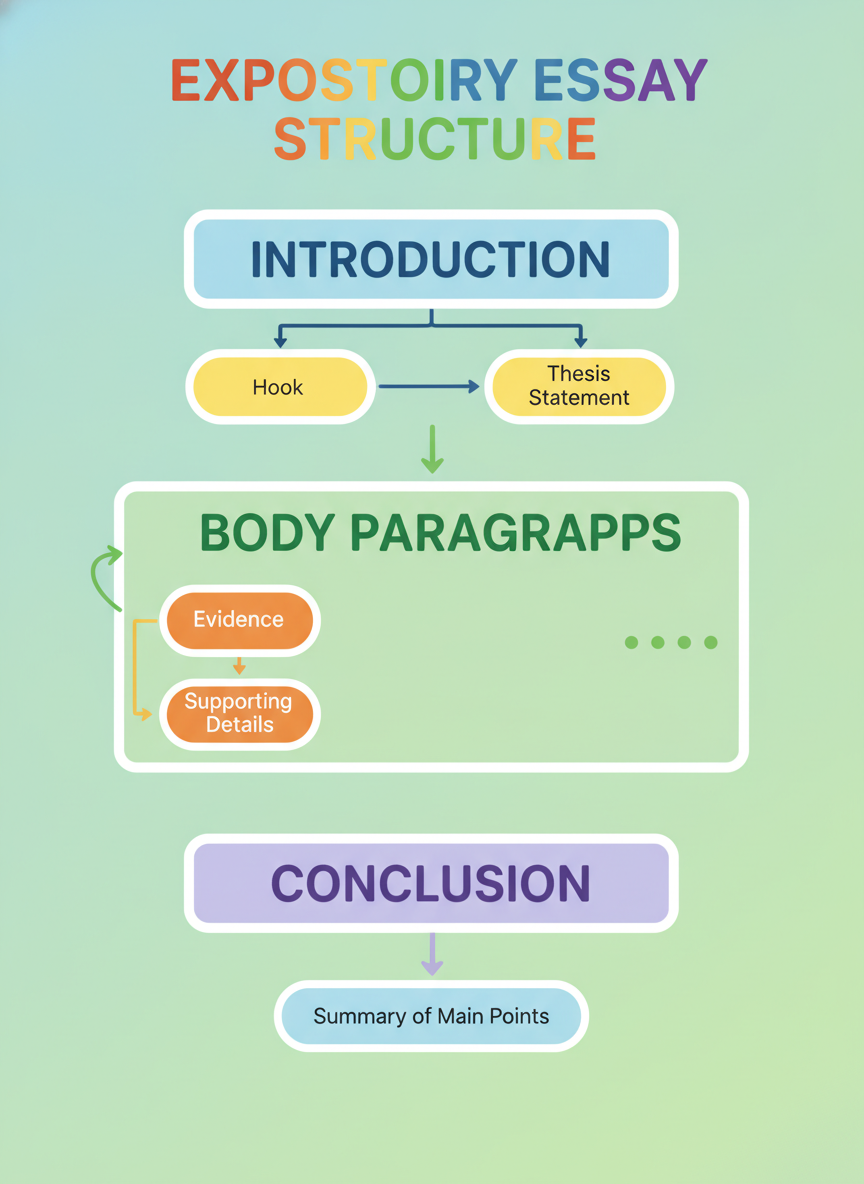
An expository essay is a genre of writing that requires the student to investigate an idea, evaluate evidence, expound on the idea, and set forth an argument concerning that idea in a clear and concise manner. This can be accomplished through comparison and contrast, definition, example, the analysis of cause and effect, etc. Unlike narrative writing, expository writing is factual and objective.
Activity 1: Multiple Choice Questions
Instructions: Read each question carefully and select the best answer from the options provided.
- What is the primary purpose of an expository essay? A) To tell a fictional story with a moral. B) To persuade the reader to change their political views. C) To explain, inform, or describe a specific topic using facts. D) To express the author's deepest personal emotions.
- Where is the thesis statement typically located in an expository essay? A) In the middle of the second body paragraph. B) At the end of the introductory paragraph. C) In the very last sentence of the conclusion. D) It is usually hidden and the reader must guess it.
- Which of the following is NOT a common organizational structure for an expository essay? A) Cause and Effect B) Compare and Contrast C) Problem and Solution D) Hero's Journey (Narrative Arc)
- What should each body paragraph in an expository essay begin with? A) A direct quote from a famous celebrity. B) A topic sentence that supports the thesis. C) A question directed at the reader. D) A new piece of evidence not mentioned in the thesis.
- Which tone is most appropriate for an expository essay? A) Sarcastic and informal B) Highly emotional and biased C) Exciting and suspenseful D) Objective and professional
Activity 2: True or False
Instructions: Write True if the statement is correct and False if it is incorrect.
- An expository essay should primarily be based on the writer's personal opinions.
- Transition words like "furthermore," "however," and "consequently" help the flow of an expository essay.
- The conclusion should introduce new evidence to keep the reader interested at the end.
- A thesis statement acts as a roadmap for the entire essay.
- Expository writing is often used in textbooks, news articles, and instruction manuals.
Activity 3: Writing a Thesis Statement
Instructions: A thesis statement must be clear, specific, and state the main point of your essay. For each of the following topics, write a strong thesis statement for an expository essay.
Example Topic: The importance of recycling.
Example Thesis: Recycling is essential because it reduces the amount of waste in landfills, conserves natural resources, and protects wildlife habitats.
1. Topic: The benefits of physical education in middle school.
2. Topic: How social media affects communication among teenagers.
3. Topic: The impact of climate change on ocean life.